


Software Solutions for Logistics Companies: Logistic...
Logistics software development is becoming a strategic priority for...
 Deepak Saini
April 14, 2026
Deepak Saini
April 14, 2026

Every second your web application is slow, a user leaves. Every minute it’s down, revenue walks out the door.
In 2026, scalability isn’t something you add later. It’s the foundation you build from day one when designing scalable web application features with a web application development company. Enterprises are accelerating digital transformation, serving global users, and integrating AI into core products. As a result, demands on web applications have reached a new level.
The question is no longer “can our app handle today’s load?” — it’s “can it handle 10x tomorrow’s load without breaking, slowing down, or increasing infrastructure costs?”
This is where scalable web application features become critical. They allow systems to grow without sacrificing performance, reliability, or cost efficiency.
In this guide, we break down the essential features of scalable web applications and explore modern architecture patterns, performance strategies, and cost considerations for building high-performance web applications in 2026.
Here’s what you’ll learn:
Whether you’re a CTO, engineering leader, or product manager, these insights will help you design high-performance, scalable web applications that grow with your business.
In 2026, scalability is not just a technical requirement. It is a competitive advantage.
The cost of poor scalability is immediate, measurable, and often underestimated.
These are not just enterprise challenges. SaaS platforms, e-commerce businesses, and growing startups face the same risks because user expectations remain constant regardless of company size.
When an application is slow or unreliable, the impact is immediate. Conversions drop, users churn, and brand trust erodes.
This is why investing in scalable web application architecture directly supports revenue growth, customer retention, and long-term business resilience.
Key Insight
Scalability is no longer just a technical concern. In 2026, it directly drives business performance, impacting revenue, user retention, and competitive advantage.
A scalable web application is designed to handle increasing users, data, and workloads without degrading performance, reliability, or cost efficiency.
Scalability is often misunderstood. It is not just about supporting more users. It is about maintaining consistent performance, resilience, and cost control as the system grows.
In 2026, true web application scalability depends on achieving five key outcomes:
Achieving this requires deliberate scalable web application architecture decisions from the start, not as an afterthought.
Several forces are accelerating the need for scalability. AI-powered features introduce unpredictable traffic spikes. Global-first launches are now common. At the same time, regulations such as GDPR, HIPAA, and SOC 2 add a compliance layer to scalable systems.
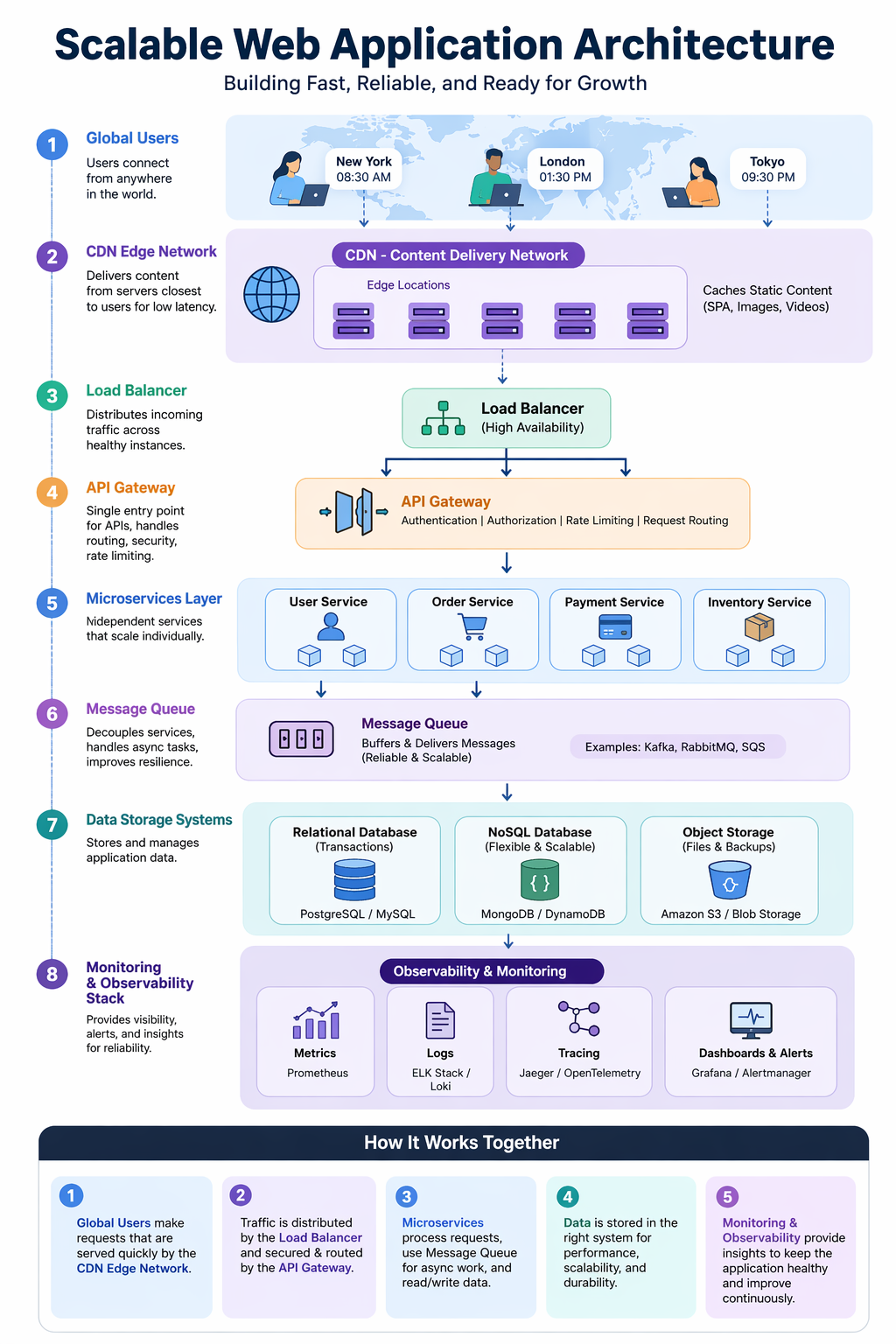
Modern systems face new pressures that make scalable web application features essential:
Most scalability failures do not occur at 10x growth. They happen much earlier, when systems are pushed beyond what they were designed to handle.
Building scalable web application features into your system from the start is not just a technical decision. It is a strategic investment that impacts engineering efficiency, user experience, and long-term costs.
Here are the core benefits scalable web applications deliver:
Scalable systems enable both technical and organizational agility. A modular, decoupled architecture allows teams to deploy independently without being tied to monolithic release cycles.
In scalable web application architecture, agility goes beyond faster releases. It removes dependencies that slow down innovation and growth.
For example, Spotify’s shift from a monolithic system to microservices allowed hundreds of teams to operate independently and ship faster. Learn more from Spotify’s engineering blog.
This leads to faster time-to-market, continuous experimentation, and the ability to respond quickly to changing business needs.
Performance has a direct impact on user experience, conversion rates, and customer trust.
These benchmarks define expectations for high-performance web applications at scale:
| Metric | Industry Benchmark | Business Impact |
|---|---|---|
| Page load time | Under 2 seconds | Higher conversions and lower bounce rates |
| Uptime | 99.9% (three nines) | Consistent availability protects revenue |
| API response time | Under 200ms | Faster interactions improve retention |
| Error rate | Below 0.1% | Supports enterprise SLA requirements |
At scale, maintaining these benchmarks requires more than infrastructure. It depends on practices such as caching, load balancing, and fault isolation.
Companies like Netflix achieve this through auto-scaling, edge caching, and resilience engineering, enabling them to support millions of users without service disruption.
Scalable architecture is often seen as expensive upfront. In reality, the higher cost comes from systems that cannot scale efficiently.
The difference becomes clear as systems grow:
| Cost Category | Without Scalability | With Scalability |
|---|---|---|
| Infrastructure at 2x growth | 2x–4x increase | 1.2x–1.5x increase |
| Incident response hours/month | 15–40 hours | 2–5 hours |
| Feature delivery cycle | 3–6 weeks | 1–2 weeks |
| Engineer onboarding time | 4–8 weeks | 2–3 weeks |
This is why scalability needs to be built early. Fixing it later is significantly more expensive and disruptive.
Now that we have covered the impact and benefits, let’s look at the core features that make scalable systems possible.
If you want a quick way to assess your system, refer to the scalability checklist later in this guide.
To build systems that scale reliably, you need more than infrastructure. You need the right scalable web application features and architectural foundations. The following scalable web application features define how modern applications handle growth, maintain performance, and remain resilient under increasing demand.
Let’s break them down.
If there is one architectural decision that separates scalable applications from fragile ones, it is modularity. A modular architecture structures your application as a collection of independent, loosely coupled components. Each component is responsible for a specific business function.
Instead of scaling the entire system as one unit, modular systems allow you to scale, deploy, and maintain individual services independently. This is fundamental to scalable web application architecture.
| Dimension | Monolithic Architecture | Modular / Microservices |
|---|---|---|
| Deployment | Entire app deployed together | Services deployed independently |
| Scaling | Scale everything or nothing | Scale individual services only |
| Fault isolation | One bug can crash everything | Failures contained to one service |
| Team autonomy | Teams blocked by shared codebase | Teams own and ship independently |
Amazon’s early shift to microservices enabled thousands of engineers to work independently. This structural advantage compounds over time into faster innovation and more resilient systems.
Traffic is inherently unpredictable. A product launch, marketing campaign, or viral event can increase load dramatically within minutes. Scalable systems are designed to respond automatically without manual intervention.
This is achieved through a combination of architectural patterns:
These capabilities ensure that high-performance web applications maintain speed and availability even during sudden traffic spikes.
Systems that rely on manual scaling often fail during peak demand, not because of limited infrastructure, but due to delayed response to traffic changes.
Platforms like Shopify and Netflix rely heavily on automated scaling and caching strategies to maintain uptime and performance under massive, unpredictable workloads.
An API-first approach treats APIs as the foundation of the application, not an afterthought. Because of this, many businesses invest in API development services when building scalable systems. All functionality is exposed through well-defined interfaces before being consumed by frontends, mobile apps, or other services.
This approach is essential for building scalable web applications because it enables:
| Paradigm | Best For | Trade-offs |
|---|---|---|
| REST | Standard operations and broad compatibility | Over/under-fetching data |
| GraphQL | Flexible data querying | Higher complexity |
| gRPC | High-performance service communication | Limited browser support |
| WebSockets | Real-time communication | More complex infrastructure |
For example, poorly versioned APIs often become the biggest blocker in scaling frontend and partner integrations. Following best practices from a detailed API development guide can help teams design more scalable and maintainable systems.
Companies like Stripe have built entire ecosystems on stable, versioned APIs — making integration easier while maintaining long-term scalability.
Once these features are in place, the next step is choosing the right tools to implement them effectively.
Scalable architecture is primarily driven by design decisions. However, the right tools and cloud application development services can help teams implement scalable web application features more efficiently. They also improve reliability and simplify operations.
Here are commonly used technologies that support scalable web application development across different layers of the stack:
When selecting tools, focus on how well they align with your architecture, team expertise, and long-term scalability goals, not just their popularity.
While these tools help implement scalability, real-world systems also need to address security, compliance, and advanced operational requirements.
Security is a foundational requirement for enterprise web application features — not an add-on — which is why many organizations work with a software consulting company to design secure and scalable systems. Modern systems must protect data, users, and infrastructure across multiple layers simultaneously.
At a minimum, enterprise-grade applications implement:
Beyond technical controls, compliance frameworks define how data must be handled, stored, and audited:
| Regulation | Key Requirements | Business Impact |
|---|---|---|
| GDPR | Consent, data protection, right to erasure | Fines up to 4% of global revenue |
| HIPAA | Protection of health data (PHI) | Strict penalties and legal risk |
| PCI DSS | Secure handling of payment data | Financial penalties and trust loss |
| SOC 2 | Security and availability controls | Required for enterprise contracts |
Security failures are rarely caused by missing tools. They are typically the result of misconfigurations and weak access controls.
You cannot scale what you cannot measure. Modern scalable web applications rely on deep observability to understand system behavior in real time.
Enterprise observability is built on three pillars:
Together, these provide complete visibility into system performance, bottlenecks, and failure points.
Leading organizations correlate technical metrics with business outcomes — such as conversion rates and latency — to make faster, data-driven decisions.
Enterprise applications must support diverse user groups — including internal teams, customers, partners, and administrators — each with different roles and access requirements.
Robust user management includes:
Personalization further enhances user experience by adapting interfaces, content, and workflows based on user roles and behavior.
As applications scale, user management becomes both a security requirement and a key driver of user experience.
Frontend performance is one of the most important scalable web application features, measured through user-centric metrics such as Core Web Vitals — including load speed, responsiveness, and visual stability — which is why many companies invest in React.js development services to build fast and scalable user interfaces.
Achieving high performance requires:
Backend performance focuses on reducing response times and handling load efficiently:
Together, these ensure high-performance web applications deliver fast and consistent experiences under scale.
Modern systems use polyglot persistence — selecting different data storage technologies based on workload requirements.
| Database Type | Best For |
|---|---|
| Relational (SQL) | Structured data and transactions |
| Key-Value | Caching and fast lookups |
| Wide-Column | High-scale writes and analytics |
| Search Engines | Full-text search and filtering |
| Object Storage | Files and media at scale |
A well-designed caching strategy can significantly reduce database load and improve overall system performance.
Performance cannot be validated once — it must be continuously tested. High-performing teams integrate performance checks directly into their development pipelines.
This includes:
By treating performance as a continuous discipline, teams ensure their applications remain fast, stable, and scalable as they grow.
Choosing the right technology stack is one of the most important decisions when building scalable web applications and implementing the right scalable web application features.
This is why many businesses partner with a custom web development company to architect scalable systems. The goal is not just to support current requirements, but to ensure the system can evolve as complexity, traffic, and data grow.
Evaluate your stack across five key dimensions:
| Language / Runtime | Strengths | Best For |
|---|---|---|
| Go | High concurrency, efficient resource usage | Microservices and APIs |
| Rust | High performance, memory safety | Performance-critical systems |
| Node.js | Non-blocking I/O, fast development | Real-time applications |
| Python | Rapid development, strong AI ecosystem | Data and AI-driven services |
| Java / Kotlin | Mature ecosystem, strong scalability | Enterprise backends |
For example, many high-traffic applications rely on event-driven architectures powered by Node.js. Learn more about why Node.js is ideal for scalable web applications.
As systems scale, manual deployments become a major risk. High-performing teams rely on automated pipelines to ensure consistent, reliable releases.
Effective deployment strategies include:
| Strategy | How It Works | Best For |
|---|---|---|
| Blue-Green | Switch traffic between two environments | Zero-downtime releases |
| Canary | Gradual rollout to a small user segment | Risk mitigation |
| Feature Flags | Control feature release independently of deployment | Safer experimentation |
| Rolling Updates | Incrementally update system instances | Scalable stateless systems |
Organizations that automate deployments can release updates faster, reduce downtime, and respond quickly to issues in production.
Scalable systems require continuous visibility into both performance and cost. The most effective teams track metrics that connect infrastructure usage directly to business outcomes.
Key metrics include:
This approach shifts focus from raw infrastructure spend to cost efficiency at scale.
Regular optimization — such as right-sizing infrastructure and improving resource utilization — can significantly reduce costs without impacting performance.
If you’re planning a system designed for long-term growth, the right architecture matters.
Building scalable web applications requires strong architecture. Our engineers design platforms that grow with user demand.

| Value Driver | Annual Impact (Mid-size SaaS, $5–10M ARR) |
|---|---|
| Uptime improvement (99.5% → 99.9%) | +$180,000 protected revenue |
| Performance improvement (20% faster) | +$140,000 incremental revenue |
| Faster feature delivery (2x velocity) | +$250,000 competitive value |
| Reduced incident costs | +$120,000 cost savings |
| Infrastructure efficiency | +$80,000 cost savings |
| Total annual benefit | $770,000 |
| Annual architecture investment | $200,000 |
| Net annual ROI | $570,000 (285%) |
As applications scale, architectural complexity increases significantly. Distributed systems introduce challenges such as network latency, partial failures, data consistency trade-offs, and cascading service dependencies. These issues typically do not exist in simpler monolithic systems.
The most effective approach is to evolve architecture deliberately. Many high-performing teams begin with a modular monolith and transition to distributed services only when there is a clear need for independent scaling or team autonomy.
Equally important is investing in internal platform capabilities that reduce complexity for development teams — allowing engineers to focus on business logic rather than infrastructure management.
As systems grow, so does the attack surface. Each new service, API, and integration point introduces potential vulnerabilities.
To mitigate this, security must be embedded throughout the development lifecycle — not treated as a final checkpoint. This includes:
Frameworks such as industry-standard security guidelines provide a baseline, but true enterprise security comes from consistent implementation and operational discipline.
Performance issues often appear only at scale. Components that perform well under moderate load can become critical bottlenecks as data volume and traffic increase.
Common sources of bottlenecks include inefficient database queries, unoptimized APIs, and lack of caching strategies.
Preventing performance degradation requires continuous monitoring and testing under realistic conditions — especially using production-scale data volumes.
Proactive performance optimization — including query tuning, caching strategies, and load testing — ensures systems remain stable and responsive as they grow.
One of the most critical decisions in building scalable web applications is determining what to build in-house versus what to outsource.
The most effective approach for most enterprises follows a simple principle:
Build what differentiates your business. Buy what doesn’t.
| Capability | Recommendation | Rationale |
|---|---|---|
| User authentication | Buy | Complex, security-critical, not a differentiator |
| Payment processing | Buy | High regulatory overhead and specialization |
| Core recommendation engine | Build | Direct impact on product differentiation |
| Observability systems | Buy | Requires deep expertise and ongoing maintenance |
| Custom pricing logic | Build | Core to business model and competitive positioning |
| Search functionality | Buy | Well-optimized solutions already exist |
If you’re planning to build or scale a high-performance system, having a structured evaluation framework is essential.
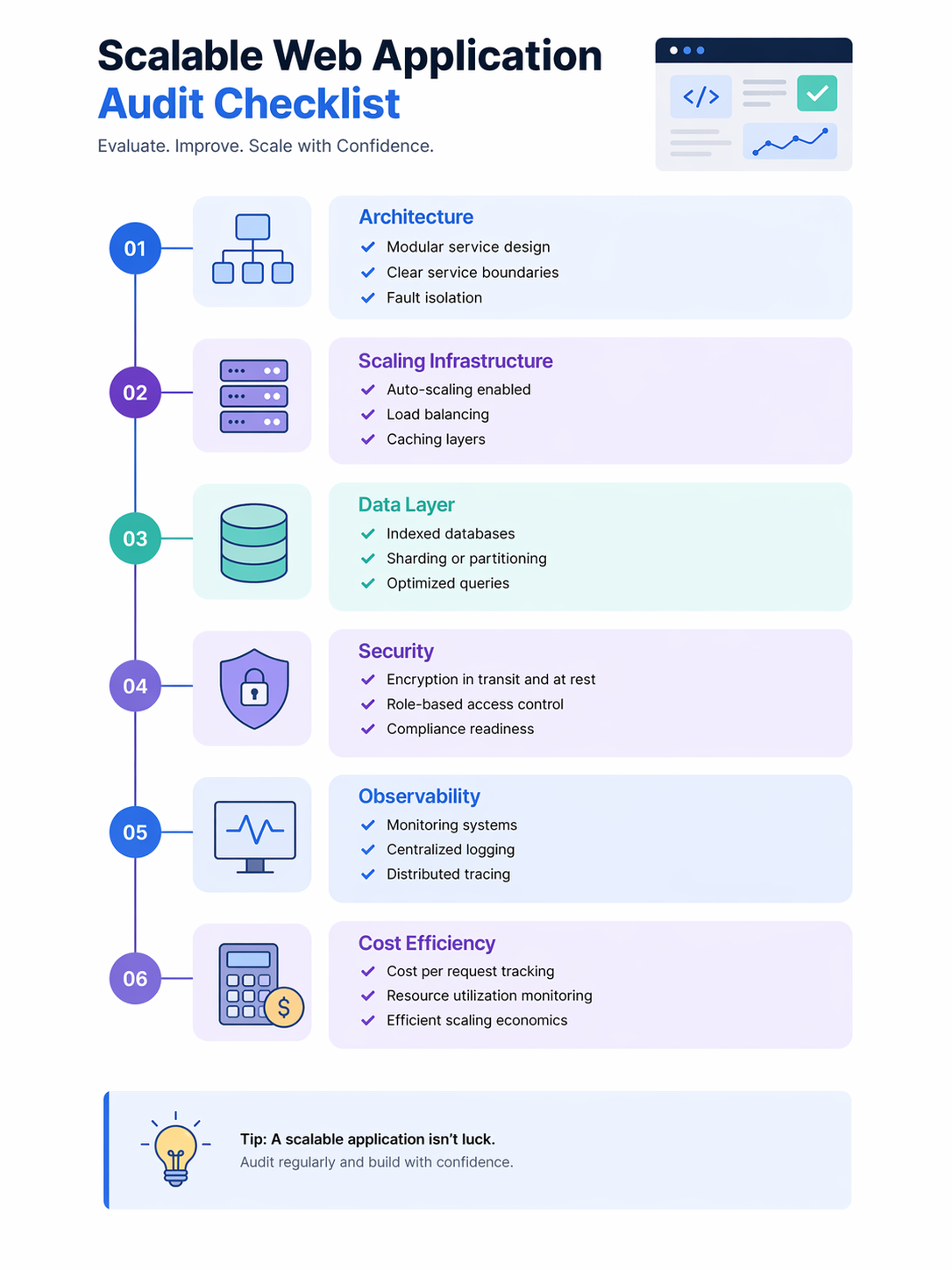
This checklist is designed to help you assess your current architecture and identify gaps across all critical dimensions of web application scalability:
Each section includes practical guidance to help you evaluate and improve your system.
📋 Free Download: A comprehensive checklist with 50+ evaluation points to plan, audit, and scale your application with confidence.
→ Download the Scalable Web Application Checklist
The must-have features of scalable web applications fall into three categories: architecture, infrastructure, and operations.
Architectural foundations: modular architecture (microservices or modular monolith), API-first design with versioning, and stateless services.
Infrastructure capabilities: horizontal auto-scaling, intelligent load balancing, multi-layer caching, and CDN delivery.
Operational excellence: observability (logs, metrics, traces), CI/CD pipelines, and defined SLOs with error budgets.
Applications that implement all three layers are best positioned to scale efficiently without performance or reliability issues.
Enterprise web applications handle high user loads through a combination of scaling, caching, and distributed system design.
No single technique is sufficient — it’s the combination that enables systems to handle massive and unpredictable traffic.
Most scalable web application investments deliver positive ROI within 12–24 months and continue compounding over time.
Key ROI drivers include:
For mid-sized SaaS businesses, long-term ROI often significantly outweighs initial investment.
The right technology stack is chosen by evaluating scalability, team capability, ecosystem maturity, cost, and long-term alignment.
Key evaluation criteria include:
The best choice is rarely the most popular or the most familiar — it’s the one that performs well across all dimensions.
The most common challenges are complexity, security risks, and performance bottlenecks.
These challenges require proactive planning, continuous monitoring, and strong architectural decisions.
The best approach is a hybrid: build what differentiates your business, and buy what doesn’t.
The key question is: “Will this capability provide long-term differentiation?” If yes, build it. If not, use proven solutions and focus internal resources strategically.
Scalability is no longer a concern reserved for tech giants. In 2026, it is the baseline expectation for any web application that aims to compete, grow, and deliver consistent value to users.
The companies that lead their industries are not those with the largest teams or the biggest budgets. They are the ones that make deliberate architectural decisions early, treat scalability as a continuous discipline, and build systems designed to expand with their ambitions instead of restricting them.
In this guide, you have explored the essential features, architectural patterns, and decision frameworks required to build applications that remain fast, resilient, and reliable as they grow.
Now the real question is:
Is your application built for the scale you are heading toward, or is it still designed for where you are today?
In a landscape where performance, reliability, and speed directly impact user experience and revenue, falling behind is not gradual. It is immediate.
Launching a new platform or improving an existing system? Our engineers help design architecture built for performance and scale.
Understanding scalability principles is only the first step. The real challenge lies in translating those principles into systems that perform reliably under real-world growth.
At Nascenture, we work with businesses to design and build web applications where scalability is not an afterthought but a core architectural priority. From modular system design to API-first development and cloud-native infrastructure, every layer is built to support long-term performance and expansion.
Unlike traditional development approaches that focus only on feature delivery, we focus on how your system behaves as it grows. This includes handling traffic spikes, managing increasing data loads, and maintaining consistent performance without costly rewrites.
If you are exploring how to implement these principles in your own product, you can also learn more about our approach to scalable web application development, where we break down how we design systems for high growth environments.
Whether you are launching a new platform or scaling an existing one, the goal is the same. Build a system that supports your growth, not one that limits it.
If you are planning your next phase, you can also discuss your scalability requirements with our team.

Deepak Saini
Deepak Saini is the CEO of Nascenture, a technology company focused on building scalable digital solutions. With a strong interest in AI, blockchain, and emerging technologies, he helps businesses leverage innovation to drive growth, efficiency, and competitive advantage. He regularly shares insights on software development, automation, and future-ready tech strategies.
Software Solutions for Logistics Companies: Logistic...
Logistics software development is becoming a strategic priority for...

Top Software Development Trends in the UK for 2026
Software development trends UK businesses are prioritizing in 2026 ...

How to Choose the Best SEO Company in Mississauga in...
Finding the right SEO company in Mississauga is not as simple as picki...