


Software Solutions for Logistics Companies: Logistic...
Logistics software development is becoming a strategic priority for...
 Deepak Saini
May 30, 2026
Deepak Saini
May 30, 2026

Logistics software development is becoming a strategic priority for companies looking to improve operational visibility, reduce delivery delays, and scale supply chain operations efficiently. Manual coordination and disconnected software environments are becoming major operational risks, particularly for companies scaling across regions, warehouses, carriers, and fulfillment channels.
Modern logistics software development is no longer limited to basic shipment tracking or inventory management. Companies are investing in integrated digital ecosystems to improve operational coordination and visibility. These ecosystems combine transportation management systems, warehouse management systems, fleet tracking software, ERP integrations, route optimisation tools, mobile applications, and AI-driven analytics.
The challenge is not simply choosing software. The real challenge is identifying which technology investments align with operational complexity, growth stage, customer expectations, and long-term scalability requirements.
For some organizations, off-the-shelf logistics platforms provide sufficient standardization and faster implementation timelines. For others, custom logistics software solutions become necessary. This is particularly true when operational workflows, carrier relationships, warehouse coordination processes, or reporting requirements exceed the flexibility of packaged software.
This guide examines the most important software solutions for logistics companies. It explains where different approaches succeed, where they become limiting, and how businesses should evaluate logistics technology investments in 2026.
Logistics operations have become significantly more complex over the last several years. Customer expectations for real-time shipment visibility, faster fulfillment, accurate delivery estimates, and responsive issue resolution continue to increase across both B2B and consumer supply chains.
At the same time, logistics providers are dealing with rising fuel costs, labor shortages, and growing compliance requirements. Many are also struggling with carrier coordination issues and operational inefficiencies caused by disconnected legacy systems.
Many organizations still rely on spreadsheets, manual dispatch coordination, outdated ERP workflows, or isolated software systems that do not communicate effectively with each other. These limitations create operational bottlenecks that become more expensive as logistics networks scale.
Modern transportation software development initiatives are increasingly focused on solving operational fragmentation rather than simply digitizing individual workflows.
Leading logistics organizations are prioritizing software investments to improve:
The most successful logistics modernization projects typically focus on operational coordination and decision-making visibility rather than isolated feature adoption.
Before evaluating logistics software solutions, decision-makers need to understand which operational problems are creating the greatest business impact.
Many software implementations fail because organizations purchase platforms before clearly identifying operational bottlenecks, integration limitations, or process inefficiencies.
One of the most common challenges in logistics environments is fragmented software infrastructure. Dispatch teams, warehouse operators, finance departments, customer service teams, and fleet managers often operate across disconnected platforms.
This creates duplicated data, delayed reporting, inconsistent inventory visibility, and communication gaps between departments.
Without centralized operational visibility, companies struggle to make real-time decisions during delays, inventory shortages, or delivery disruptions.
Customers increasingly expect accurate shipment tracking and proactive communication throughout the delivery lifecycle.
Legacy logistics systems often provide delayed or incomplete tracking information, particularly when multiple carriers, warehouses, or third-party fulfillment providers are involved.
Real-time shipment tracking and centralized visibility platforms are becoming operational necessities rather than competitive differentiators.
Many growing logistics companies still rely heavily on manual route planning, dispatcher coordination, and spreadsheet-based scheduling.
As delivery volumes increase, these workflows become difficult to scale efficiently.
Route optimisation software helps reduce fuel costs, improve delivery accuracy, and increase fleet utilization. However, implementation complexity increases significantly when businesses operate across multiple delivery regions, transportation partners, or compliance environments.
Warehouse operations become increasingly difficult to manage when inventory systems, transportation workflows, and order management platforms are poorly synchronized.
Common operational problems include:
Warehouse management systems improve operational coordination, but integration quality often determines whether organizations achieve measurable efficiency improvements.
Many logistics companies outgrow their initial software stack faster than expected.
Platforms that work well for smaller regional operations may become operational constraints once organizations expand into multi-location logistics networks, cross-border shipping, or enterprise fulfillment environments.
This is one reason why custom logistics software development is becoming increasingly common among mid-market and enterprise logistics providers.
Modern logistics operations depend on multiple interconnected software systems working together across transportation, warehousing, inventory management, customer communication, and financial operations.
The right technology stack depends heavily on operational complexity, shipment volume, geographic scale, and integration requirements.
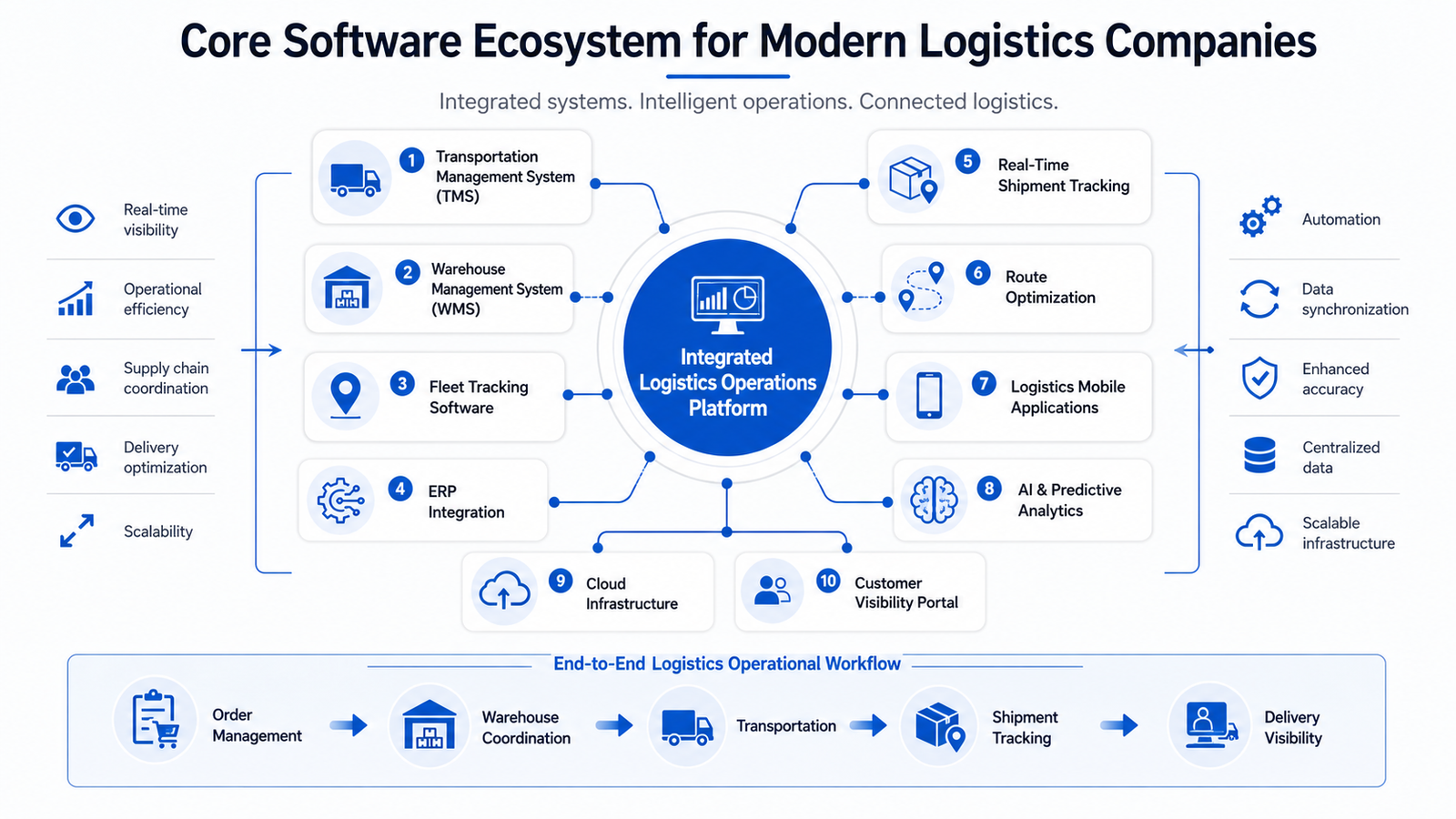
Transportation management systems help logistics companies plan, execute, and optimize freight movement across carriers, routes, and delivery networks.
A modern TMS typically supports:
TMS platforms are particularly valuable for organizations managing high shipment volumes or multi-carrier logistics environments.
However, many off-the-shelf transportation systems become difficult to customize once operational workflows become highly specialized.
Organizations with complex dispatch logic, regional compliance requirements, or unique pricing structures often require custom transportation software development to maintain operational flexibility.
Warehouse management systems coordinate inventory movement, picking workflows, storage allocation, inbound receiving, and outbound fulfillment processes.
Effective warehouse management systems improve:
For SMEs, cloud-based warehouse management systems may provide sufficient operational capabilities without major infrastructure investment.
Enterprise logistics providers often require deeper ERP synchronization, advanced automation support, robotics integration, and real-time analytics capabilities.
Fleet tracking software helps logistics operators monitor vehicle movement, driver activity, fuel consumption, maintenance schedules, and delivery performance.
GPS and IoT-enabled fleet management systems improve operational visibility while supporting more accurate delivery forecasting.
Key operational advantages include:
Fleet tracking becomes significantly more valuable when integrated directly with transportation management systems and customer-facing tracking platforms.
ERP systems provide centralized operational coordination across finance, procurement, inventory management, customer accounts, and reporting workflows.
Many logistics organizations struggle with ERP fragmentation caused by disconnected operational software environments.
ERP modernization projects often become necessary when companies experience:
ERP implementations are rarely simple technology deployments. They are operational transformation initiatives that require process redesign, governance alignment, and phased migration planning.
Shipment visibility platforms help logistics companies centralize tracking data across carriers, warehouses, transportation providers, and fulfillment systems.
Real-time shipment tracking has become a customer expectation across both B2B and consumer logistics environments.
Many logistics organizations also rely on global supply chain standards to improve shipment visibility, inventory accuracy, and operational interoperability across partners and carriers.
Organizations investing in shipment visibility platforms typically aim to reduce:
Advanced logistics automation platforms increasingly combine shipment tracking with predictive analytics and delivery exception management.
Mobile logistics applications are increasingly important for drivers, warehouse operators, dispatch coordinators, and field logistics teams.
Operational use cases include:
Mobile-first operational workflows improve coordination speed and reduce communication delays between operational teams.
However, mobile application performance becomes heavily dependent on backend system integration quality and real-time data synchronization capabilities.
One of the most important decisions logistics companies face is whether to implement packaged software platforms or invest in custom logistics software development.
There is no universally correct answer. The best approach depends on operational complexity, scalability requirements, internal technical capabilities, and long-term business strategy.
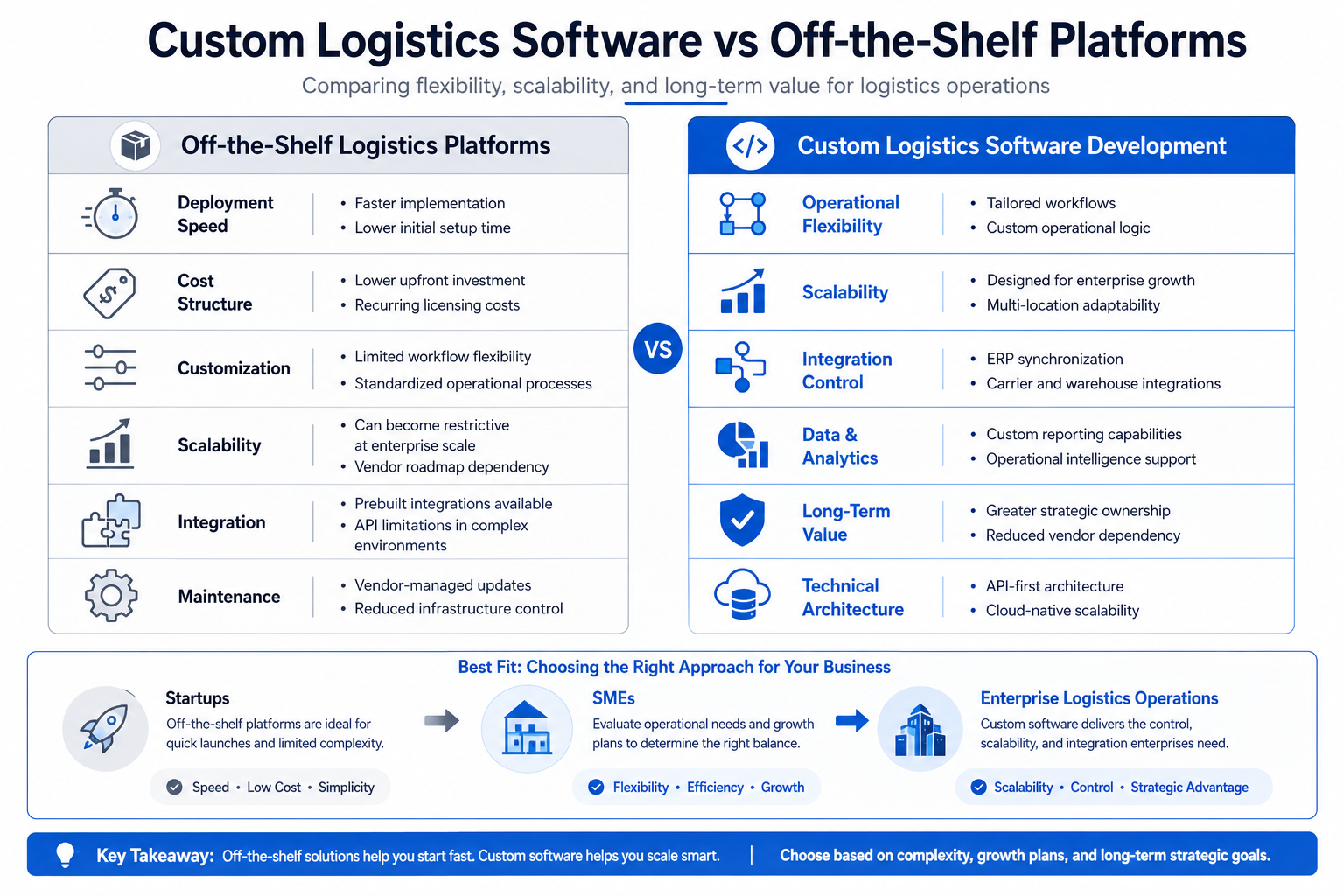
Prebuilt logistics platforms are often suitable for organizations with standardized workflows and relatively predictable operational requirements.
Advantages include:
For startups and smaller logistics operators, packaged platforms can accelerate operational digitization without requiring major engineering investment.
However, operational limitations often emerge as businesses scale.
Many logistics organizations eventually encounter problems with rigid workflow structures, limited integrations, or escalating licensing costs.
Common limitations include:
These issues become more pronounced in enterprise logistics environments involving multiple warehouses, carriers, fulfillment partners, or regional operational requirements.
Custom logistics software solutions become strategically valuable when operational workflows directly influence competitive advantage.
This is particularly true for organizations with:
Custom software development provides greater flexibility and long-term operational control, but implementation complexity increases significantly.
Successful custom logistics platforms require:
Organizations that underestimate ongoing platform governance often experience rising maintenance overhead and operational complexity over time.
Software implementation failures in logistics environments are rarely caused by technology alone. Most operational problems emerge from poor integration planning, incomplete workflow analysis, or unrealistic deployment expectations.
Many logistics organizations operate legacy ERP systems, warehouse software, accounting platforms, and carrier management tools that cannot be replaced immediately.
Modern logistics software development projects often require phased modernization strategies that preserve operational continuity while gradually improving system interoperability.
API architecture and integration planning become critical in these environments.
Even technically successful implementations can fail operationally if internal teams are not prepared for workflow changes.
Dispatch teams, warehouse operators, drivers, customer support teams, and finance departments all interact differently with logistics software systems.
Organizations should allocate significant attention to:
Operational readiness is often as important as technical readiness during logistics software deployments.
Cloud logistics platforms provide greater scalability and operational flexibility than many legacy on-premise systems.
Many enterprise logistics organizations are also investing in cloud-based supply chain platforms to improve operational visibility and infrastructure scalability.
However, cloud migration strategies require careful planning around:
Enterprise logistics environments often require hybrid infrastructure approaches during transition periods.
Logistics companies increasingly manage sensitive shipment data, financial records, customer information, and operational analytics across distributed software environments.
Security requirements now extend beyond basic infrastructure protection.
Modern logistics software ecosystems require:
Security planning should be integrated into architecture decisions from the beginning rather than treated as a post-implementation layer.
| Software Type | Best For | Primary Benefit | Common Limitation |
|---|---|---|---|
| Transportation Management System | Multi-carrier logistics operations | Freight optimization and dispatch coordination | Customization limitations at enterprise scale |
| Warehouse Management System | Inventory-heavy logistics operations | Warehouse visibility and fulfillment efficiency | Integration complexity with legacy systems |
| Fleet Tracking Software | Delivery and transportation fleets | Real-time vehicle visibility | Limited value without operational integration |
| ERP for Logistics | Enterprise operational coordination | Centralized operational governance | Complex implementation timelines |
| Custom Logistics Software | Complex or rapidly scaling operations | Operational flexibility and scalability | Higher long-term ownership responsibility |
| Shipment Tracking Platforms | Customer-facing logistics operations | Real-time shipment transparency | Carrier integration dependencies |
Logistics technology investments are increasingly shifting from isolated software deployments toward integrated operational intelligence platforms.
Recent MHI logistics industry research also highlights growing enterprise investment in automation, predictive analytics, and supply chain visibility technologies.
Over the next several years, logistics organizations will prioritize systems capable of improving real-time decision-making, automation, predictive planning, and operational resilience. Many of these priorities are also being shaped by broader software development trends in the UK, including AI adoption, cloud-native architecture, and platform engineering.
Artificial intelligence is becoming increasingly practical within logistics environments, particularly for forecasting, route optimization, shipment risk analysis, and delivery exception management.
AI-enabled logistics automation platforms are helping companies:
However, AI readiness depends heavily on data quality and operational system integration maturity.
Organizations with fragmented data environments often struggle to generate meaningful results from AI initiatives.
Many enterprise logistics organizations are moving away from monolithic operational systems toward modular software ecosystems connected through APIs and cloud infrastructure.
This shift toward composable enterprise architecture allows organizations to scale operational capabilities with greater flexibility and lower long-term vendor dependency.
This approach allows businesses to scale capabilities gradually while avoiding excessive dependency on a single vendor platform.
Composable logistics architectures are particularly valuable for organizations operating across:
However, composable ecosystems require stronger governance, integration monitoring, and technical architecture oversight.
IoT-enabled logistics systems are improving visibility across fleets, warehouses, cold chain operations, and shipment conditions.
Connected sensors and telematics platforms help organizations monitor:
Real-time operational visibility is becoming a baseline expectation in enterprise logistics environments rather than an advanced capability.
Logistics companies increasingly require analytics platforms capable of supporting operational forecasting rather than simple historical reporting.
Predictive logistics systems help organizations prepare for:
The long-term competitive advantage will increasingly depend on how effectively organizations transform operational data into actionable decision-making intelligence.
Many logistics software projects fail because organizations evaluate platforms primarily through feature comparisons instead of operational fit analysis.
Technology decisions should be evaluated against operational realities, scalability goals, and integration complexity.
Many enterprise organizations are increasingly aligning software evaluations with broader enterprise supply chain technology strategies focused on resilience, operational visibility, and long-term scalability.
Organizations should first identify which operational workflows create the greatest inefficiencies or scalability risks.
This may include:
Software selection becomes significantly easier once operational priorities are clearly defined.
Integration complexity is often underestimated during software evaluations.
Decision-makers should assess:
Systems that appear cost-effective initially may create substantial operational overhead if integration requirements are poorly understood.
Many logistics companies select software that supports current operational needs but fails to accommodate future expansion.
Decision-makers should evaluate:
Scalability limitations often become visible only after operational growth accelerates.
Off-the-shelf platforms usually provide faster implementation timelines.
Custom logistics software development provides greater flexibility and operational differentiation.
The right decision depends on whether logistics workflows are viewed primarily as operational support functions or strategic competitive capabilities.
Organizations with highly differentiated logistics models often benefit more from custom platform investment despite higher implementation complexity.
Early-stage organizations should prioritize implementation speed, operational visibility, and cost efficiency.
Cloud-based transportation management systems and modular SaaS platforms are often the most practical starting point.
Custom development should typically focus on customer-facing workflows or operational differentiators rather than rebuilding core logistics infrastructure too early.
SMEs often reach a stage where disconnected systems begin limiting operational efficiency.
At this stage, businesses should focus on:
Hybrid approaches combining packaged platforms with custom operational modules often provide the best balance between flexibility and implementation cost.
Enterprise logistics companies usually require highly scalable, integration-heavy software ecosystems capable of supporting complex operational coordination.
Priorities typically include:
These organizations often benefit from strategic custom logistics software development initiatives supported by long-term digital transformation planning.
Whether you’re selecting logistics software or planning a custom platform, we help you make informed technology decisions.

Logistics software development involves designing and implementing digital platforms for transportation and supply chain operations. These platforms help companies manage operational workflows such as shipment tracking, warehouse coordination, fleet management, dispatch planning, and inventory control.
Most logistics companies use transportation management systems, warehouse management systems, ERP platforms, fleet tracking software, shipment visibility tools, and logistics mobile applications.
Custom logistics software becomes valuable when standard platforms can no longer support operational complexity or integration requirements effectively. It is also a strong investment when software flexibility directly impacts scalability, efficiency, or competitive advantage.
Implementation costs vary significantly depending on operational complexity, integration requirements, customization scope, infrastructure needs, and migration complexity. Enterprise logistics modernization projects often require phased implementation strategies.
Common risks include poor integration planning, inadequate operational process mapping, low user adoption, fragmented data governance, unrealistic deployment timelines, and insufficient scalability planning.
Logistics software development is increasingly becoming a strategic business decision rather than a technology upgrade. As supply chains grow more complex, organizations need software ecosystems that support operational visibility, scalability, and long-term adaptability.
Whether investing in logistics software solutions, transportation software development, or custom logistics solutions, the most successful organizations align technology decisions with operational requirements and future growth objectives. Businesses that take a strategic approach to software investment will be better positioned to improve efficiency, strengthen resilience, and respond to evolving customer and supply chain demands.

Deepak Saini
Deepak Saini is the CEO of Nascenture, a technology company focused on building scalable digital solutions. With a strong interest in AI, blockchain, and emerging technologies, he helps businesses leverage innovation to drive growth, efficiency, and competitive advantage. He regularly shares insights on software development, automation, and future-ready tech strategies.
Software Solutions for Logistics Companies: Logistic...
Logistics software development is becoming a strategic priority for...

Top Software Development Trends in the UK for 2026
Software development trends UK businesses are prioritizing in 2026 ...

How to Choose the Best SEO Company in Mississauga in...
Finding the right SEO company in Mississauga is not as simple as picki...