


Software Solutions for Logistics Companies: Logistic...
Logistics software development is becoming a strategic priority for...
 Deepak Saini
May 30, 2026
Deepak Saini
May 30, 2026

Software development trends UK businesses are prioritizing in 2026 are becoming increasingly shaped by AI adoption, cloud modernization, cybersecurity pressure, and enterprise-wide digital transformation initiatives. Organizations are investing more selectively in technology, with greater focus on operational scalability, governance, software quality, and long-term cost efficiency.
At the same time, many UK companies are facing growing pressure to modernize legacy systems while continuing to support existing operational infrastructure. This is driving stronger demand for cloud-native applications, API-first architecture, DevOps maturity, software automation, and AI-assisted development workflows.
However, not every trend delivers equal business value. Some technologies improve delivery speed and operational flexibility significantly. Others introduce governance complexity, integration overhead, technical debt, or rising infrastructure costs when implemented without clear architectural planning.
The most important enterprise software trends in 2026 are no longer defined by hype cycles alone. They are increasingly shaped by practical business priorities such as resilience, scalability, cybersecurity readiness, developer productivity, and operational efficiency.
This guide examines the top software development trends in the UK for 2026 and highlights where different technologies are creating measurable business impact. It also outlines how organizations should evaluate software investment decisions in a rapidly changing technology environment.
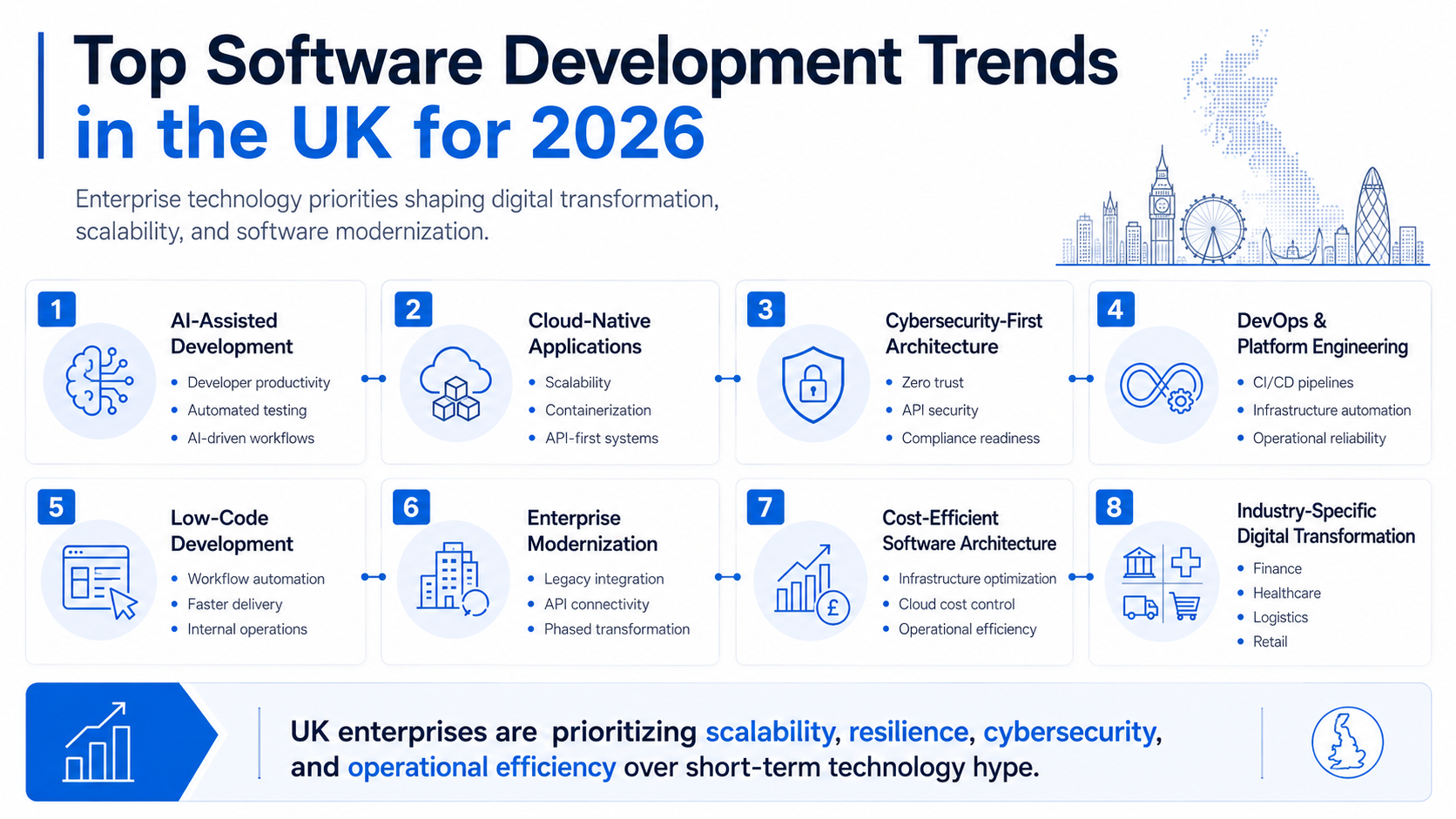
UK software trends in 2026 are being shaped less by experimental innovation and more by operational pressure. Many organizations are balancing digital transformation goals against rising infrastructure costs, cybersecurity risks, compliance requirements, and growing expectations for faster software delivery.
Over the last several years, businesses across finance, healthcare, retail, logistics, and enterprise services have accelerated investments in cloud platforms, software automation, and AI-driven operational workflows. However, many companies are now discovering that rapid adoption without architectural discipline creates scalability challenges and technical debt.
As a result, software technology trends UK enterprises are prioritizing increasingly focus on long-term maintainability rather than short-term feature velocity alone. Organizations are placing greater emphasis on platform engineering, DevOps maturity, API standardization, cloud-native infrastructure, and software governance frameworks.
AI in software development is also shifting from experimentation toward practical implementation. Businesses are using AI-assisted development tools to improve developer productivity, accelerate testing workflows, automate documentation, and support operational analytics. At the same time, concerns around software quality, governance, security, and reliability are becoming more important.
Another major shift is taking place in modernization strategy. Many UK enterprises are no longer aggressively pursuing full system replacements. Instead, they are adopting phased modernization approaches that gradually improve interoperability between legacy systems, cloud-native applications, and newer digital platforms.
This changing environment is forcing technology leaders to evaluate software investments more strategically. Delivery speed still matters, but resilience, scalability, integration flexibility, and long-term operational efficiency are increasingly becoming the primary drivers behind enterprise technology decisions.
AI in software development is one of the most significant software development trends UK organizations are evaluating in 2026. However, the conversation is moving beyond experimental AI adoption and toward practical questions around governance, software quality, operational risk, and long-term maintainability.
Many engineering teams are now using AI-assisted development tools to accelerate repetitive development tasks such as code generation, testing, debugging, documentation, and workflow automation. This is helping organizations improve delivery speed while reducing some operational bottlenecks inside development pipelines.
At the same time, AI-generated code is introducing new architectural and governance challenges. Faster code production does not automatically result in better software systems. In many cases, organizations are discovering that poorly governed AI-assisted development workflows can increase technical debt, security vulnerabilities, and software maintenance complexity.
As a result, enterprises are investing more heavily in software review processes, automated testing frameworks, DevOps maturity, and engineering governance standards. AI tools are becoming part of the development workflow, but human oversight and architectural discipline remain critical.
Another important shift involves internal enterprise operations. Businesses are increasingly using machine learning applications and AI-driven analytics to improve forecasting, operational reporting, customer support workflows, fraud detection, and process automation.
For many UK enterprises, the long-term value of AI will depend less on standalone tools and more on how effectively AI capabilities integrate into broader software ecosystems, cloud infrastructure, and operational decision-making frameworks.
Cloud-native applications remain one of the latest software development trends influencing enterprise technology strategy across the UK. Organizations are increasingly moving away from tightly coupled monolithic systems and toward modular architectures designed for scalability, resilience, and faster deployment cycles.
Many businesses are adopting microservices architecture, containerized infrastructure, and API-first development models to improve operational flexibility. Many of these modernization strategies are also being influenced by broader cloud-native computing standards and container ecosystem practices across enterprise infrastructure environments.
These approaches allow teams to scale services independently, accelerate feature releases, and reduce dependencies between systems.
At the same time, composable architecture is becoming more important in enterprise environments. In these environments, organizations need to integrate multiple platforms, third-party services, and legacy systems without rebuilding entire software ecosystems.
This shift toward composable enterprise architecture is helping organizations improve flexibility while reducing dependency on tightly coupled software ecosystems.
However, cloud-native modernization is not always straightforward. While microservices and distributed systems improve scalability, they also introduce additional operational complexity. Organizations often face challenges involving observability, service orchestration, infrastructure monitoring, API governance, and distributed security management.
As a result, many enterprises are investing more heavily in platform engineering and infrastructure automation to support increasingly complex cloud environments. DevOps teams are becoming responsible not only for deployment pipelines, but also for operational reliability, cloud cost optimization, and system resilience.
For UK organizations managing large-scale digital transformation programs, cloud-native infrastructure is no longer viewed simply as a modernization trend. It is increasingly becoming the operational foundation for long-term software scalability and enterprise agility.
Cybersecurity trends are increasingly influencing how modern software systems are designed, deployed, and maintained. For many UK organizations, security is no longer treated as a separate operational layer added after development. It is becoming a central part of software architecture and delivery strategy.
Growing ransomware threats, supply chain attacks, regulatory pressure, and cloud infrastructure exposure are forcing businesses to rethink how applications handle authentication, data protection, API security, and operational monitoring.
As a result, security-first development practices are becoming more common across enterprise engineering environments. Many organizations are also aligning software security practices with widely adopted application security standards to reduce vulnerabilities across modern software ecosystems. Development teams are integrating automated security testing, dependency scanning, infrastructure validation, and continuous monitoring directly into DevOps pipelines.
Cloud-native applications and distributed systems are also increasing the complexity of security management. Microservices architecture improves scalability and deployment flexibility, but it expands the number of services, APIs, and infrastructure components that require active security governance.
Many enterprises are now adopting zero-trust security models alongside stronger identity management frameworks, role-based access controls, and API governance policies. These approaches are helping organizations reduce exposure across increasingly fragmented software ecosystems.
For businesses investing in digital transformation, cybersecurity is no longer viewed only as a compliance requirement. It is increasingly becoming a core operational requirement that directly affects software reliability, customer trust, and long-term business resilience.
Low-code development platforms are becoming increasingly common across UK enterprises looking to improve operational efficiency without overloading engineering teams. Businesses are using low-code tools to accelerate internal workflow automation, reporting systems, approval processes, and departmental applications.
For many organizations, low-code platforms offer a practical way to reduce development backlogs and deliver operational tools more quickly. This is especially useful for internal business functions where speed and process automation matter more than highly customized software architecture.
At the same time, low-code adoption is creating new governance and scalability challenges. Applications built outside centralized engineering standards can introduce security risks, fragmented data environments, inconsistent integrations, and long-term maintenance issues.
As a result, many enterprises are establishing stronger governance frameworks around low-code development. IT and engineering teams are increasingly responsible for defining integration standards, access controls, API policies, and infrastructure oversight.
Another important shift involves the relationship between low-code platforms and professional software engineering teams. Rather than replacing developers, many organizations are using low-code tools to support operational agility. More complex systems, customer-facing platforms, and large-scale integrations continue to rely on the custom software solutions that UK enterprises depend on.
In practice, low-code development is becoming most effective when used selectively within clearly defined operational boundaries. Organizations that approach low-code adoption strategically are often able to improve delivery speed without compromising long-term scalability or governance standards.
DevOps is evolving beyond deployment automation and becoming a central operational capability for enterprise software teams. Many UK organizations are investing in platform engineering to improve development consistency, infrastructure reliability, deployment speed, and operational scalability.
As software ecosystems become more distributed, engineering teams are struggling with increasing infrastructure complexity. Cloud-native applications, microservices architecture, API integrations, and hybrid cloud environments require stronger operational coordination across development and infrastructure teams.
Platform engineering is emerging as a response to this complexity. Rather than requiring developers to manage infrastructure manually, organizations are building centralized internal platforms. These platforms standardize deployment workflows, infrastructure provisioning, observability, security policies, and developer tooling.
This approach helps reduce operational friction while improving software delivery consistency across large engineering environments. It also allows development teams to focus more heavily on product delivery rather than infrastructure management.
At the same time, DevOps maturity is becoming increasingly tied to business performance. Organizations with inefficient deployment pipelines, inconsistent testing practices, or weak operational monitoring often struggle to scale digital transformation initiatives effectively.
As a result, many enterprises are prioritizing infrastructure automation, continuous integration pipelines, observability tooling, and software reliability engineering. These initiatives are becoming an important part of the broader enterprise software trends shaping technology investment decisions in 2026.
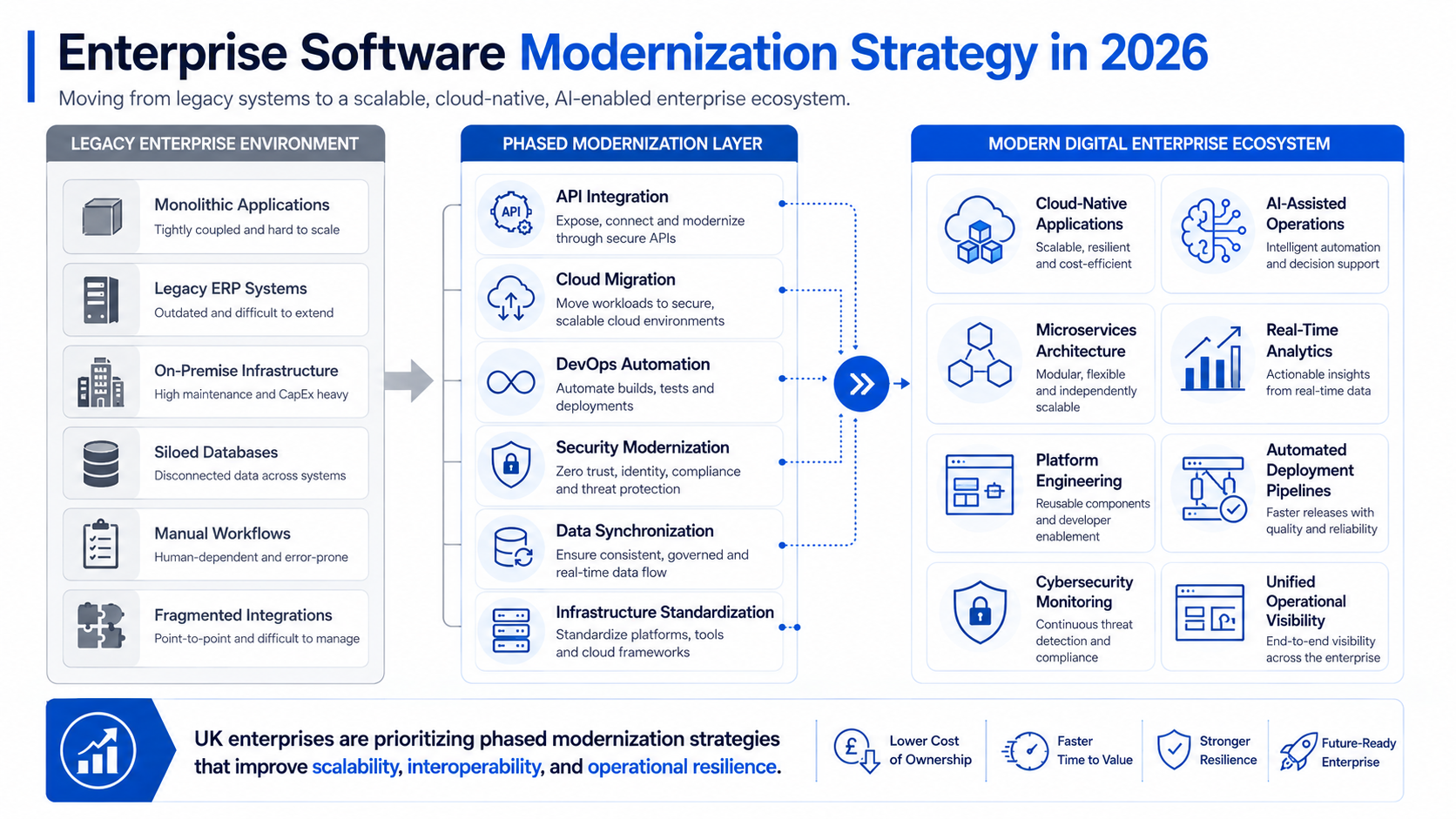
One of the most important software technology trends UK enterprises are adopting in 2026 is phased modernization rather than large-scale system replacement. Many organizations are discovering that rebuilding entire software ecosystems at once creates significant operational risk, implementation delays, and budget overruns.
Instead, businesses are modernizing incrementally by improving interoperability between legacy systems, cloud-native applications, APIs, and newer digital platforms. This approach allows organizations to reduce operational disruption while continuing to modernize critical infrastructure gradually.
API-first architecture is playing a major role in this transition. Enterprises are increasingly using APIs to connect older operational systems with modern applications, customer portals, analytics platforms, and cloud services without requiring immediate full replacement.
At the same time, legacy modernization is becoming more closely tied to operational resilience and long-term maintainability. Many organizations are prioritizing modernization projects that improve scalability, reduce infrastructure overhead, strengthen cybersecurity posture, and simplify software maintenance.
However, phased modernization also creates architectural complexity when governance standards are weak. Without clear integration planning, organizations can end up with fragmented software ecosystems that become increasingly difficult to manage over time.
As a result, enterprises are placing greater emphasis on software architecture strategy, integration governance, infrastructure standardization, and long-term technical planning. Modernization is increasingly viewed as an ongoing operational strategy rather than a one-time transformation project.
Rising infrastructure expenses and economic pressure are forcing organizations to evaluate software investments more carefully. Many UK enterprises are shifting focus from rapid expansion toward cost-efficient architecture, operational sustainability, and measurable business outcomes.
Over the last several years, many businesses adopted cloud infrastructure aggressively without fully optimizing resource management, scalability planning, or operational governance. As a result, cloud spending and infrastructure complexity have increased significantly across enterprise environments.
In response, organizations are placing greater emphasis on software efficiency, infrastructure optimization, and workload management. Engineering teams are being asked to improve application performance while controlling operational costs across cloud-native environments.
This shift is influencing software architecture decisions directly. Businesses are evaluating whether distributed systems, microservices architecture, and large-scale cloud deployments genuinely improve operational value or simply introduce additional complexity and maintenance overhead.
Many enterprises are also investing in software automation trends that reduce repetitive operational work, improve infrastructure utilization, and simplify deployment management. Automation is increasingly viewed as both a productivity strategy and a cost-control mechanism.
For technology leaders, the conversation around digital transformation is becoming more financially disciplined. Scalability still matters, but organizations are increasingly prioritizing software strategies that balance performance, resilience, maintainability, and long-term operational efficiency.
Digital transformation trends in the UK are increasingly being shaped by industry-specific operational requirements rather than broad technology adoption alone. Organizations across finance, healthcare, retail, logistics, manufacturing, and professional services are prioritizing software investments that address sector-specific scalability, compliance, and operational challenges.
In financial services, businesses are investing heavily in AI-driven analytics, cybersecurity modernization, fraud detection systems, and API-enabled customer platforms. Regulatory pressure and operational resilience requirements are also influencing software architecture decisions significantly.
Healthcare organizations are focusing on interoperability, secure patient data management, workflow automation, and cloud-enabled operational coordination. Many providers are modernizing legacy systems gradually to improve scalability while maintaining strict compliance standards.
Retail and ecommerce businesses are prioritizing cloud-native applications, real-time analytics, customer experience platforms, and software automation strategies. These investments help improve operational responsiveness across increasingly complex digital commerce environments.
At the same time, logistics and manufacturing companies are accelerating investments in operational visibility platforms, IoT-enabled infrastructure, predictive analytics, and intelligent workflow automation. These investments are helping improve efficiency across distributed operational ecosystems.
These industry-specific priorities are influencing how enterprises evaluate logistics software development and broader software investment strategies overall.
Not every emerging technology trend deserves immediate adoption. One of the biggest mistakes organizations make is investing in software initiatives based on market hype rather than operational requirements, architectural readiness, or long-term business value.
For many enterprises, the most effective technology strategies are built around solving operational bottlenecks first. This may involve improving software scalability, modernizing legacy infrastructure, strengthening cybersecurity posture, accelerating deployment workflows, or reducing infrastructure complexity.
Technology leaders should also evaluate how different trends affect governance, maintainability, and integration complexity over time. Many enterprises are increasingly aligning software investment decisions with broader enterprise technology strategy frameworks focused on resilience, scalability, and operational efficiency.
Faster development cycles and rapid platform adoption can improve short-term delivery speed, but they can also introduce technical debt and operational inefficiencies when architectural planning is weak.
Another important consideration involves organizational maturity. Some businesses benefit significantly from AI-assisted development, cloud-native infrastructure, or platform engineering investments. Others may achieve better results by focusing first on software governance, DevOps stability, API standardization, or operational modernization.
Custom software solutions UK enterprises invest in should also align with long-term operational goals rather than temporary technology cycles. Scalability, interoperability, security, and maintainability are increasingly becoming more important than adopting every emerging platform or framework.
As software development trends UK organizations continue to evolve in 2026, businesses face increasingly complex technology decisions. Those that prioritize strategic technology planning over reactive adoption will likely be better positioned to improve operational resilience, delivery efficiency, and long-term digital competitiveness.
| Trend | Primary Business Benefit | Common Challenge | Best Fit |
|---|---|---|---|
| AI-Assisted Development | Improves developer productivity and automation | Governance and software quality risks | Mid-market and enterprise engineering teams |
| Cloud-Native Applications | Improves scalability and deployment flexibility | Infrastructure and observability complexity | Scalable digital platforms |
| Low-Code Development | Accelerates internal operational workflows | Governance and integration limitations | Internal business applications |
| Platform Engineering | Standardizes infrastructure and DevOps operations | Requires operational maturity | Large engineering organizations |
| Microservices Architecture | Supports modular scalability | Distributed system management overhead | Enterprise cloud ecosystems |
| Cybersecurity-First Development | Strengthens resilience and compliance readiness | Increased implementation complexity | Regulated industries and enterprise systems |
From modernization planning to cloud, AI, and software architecture decisions, we help businesses invest in technology with confidence.

The most important software development trends UK businesses are prioritizing include:
Cloud-native applications improve scalability, deployment flexibility, operational resilience, and integration capabilities. Many organizations are adopting cloud-native infrastructure to support long-term digital transformation and software modernization initiatives.
AI is improving developer productivity by automating repetitive tasks such as testing, documentation, debugging, and code generation. However, human oversight, software architecture expertise, governance, and engineering strategy remain essential.
Platform engineering helps organizations standardize infrastructure management, deployment workflows, observability, and developer tooling. This improves operational consistency and reduces infrastructure complexity across large software environments.
Organizations should evaluate technology trends based on operational goals, scalability requirements, integration complexity, governance readiness, cybersecurity impact, and long-term maintainability rather than short-term hype alone.
Software development trends UK businesses are prioritizing in 2026 are increasingly shaped by scalability, cybersecurity, operational resilience, and long-term maintainability. While AI-assisted development, cloud-native applications, platform engineering, and software automation continue to influence technology strategy, successful adoption depends on strong governance, architectural discipline, and clear business objectives.
Organizations that evaluate emerging technologies through the lens of operational value rather than market hype will be better positioned to modernize effectively, control complexity, and build software ecosystems capable of supporting long-term growth and digital competitiveness.

Deepak Saini
Deepak Saini is the CEO of Nascenture, a technology company focused on building scalable digital solutions. With a strong interest in AI, blockchain, and emerging technologies, he helps businesses leverage innovation to drive growth, efficiency, and competitive advantage. He regularly shares insights on software development, automation, and future-ready tech strategies.
Software Solutions for Logistics Companies: Logistic...
Logistics software development is becoming a strategic priority for...

Top Software Development Trends in the UK for 2026
Software development trends UK businesses are prioritizing in 2026 ...

How to Choose the Best SEO Company in Mississauga in...
Finding the right SEO company in Mississauga is not as simple as picki...