

Software Solutions for Logistics Companies: Logistic...
Logistics software development is becoming a strategic priority for...
 Deepak Saini
May 19, 2026
Deepak Saini
May 19, 2026
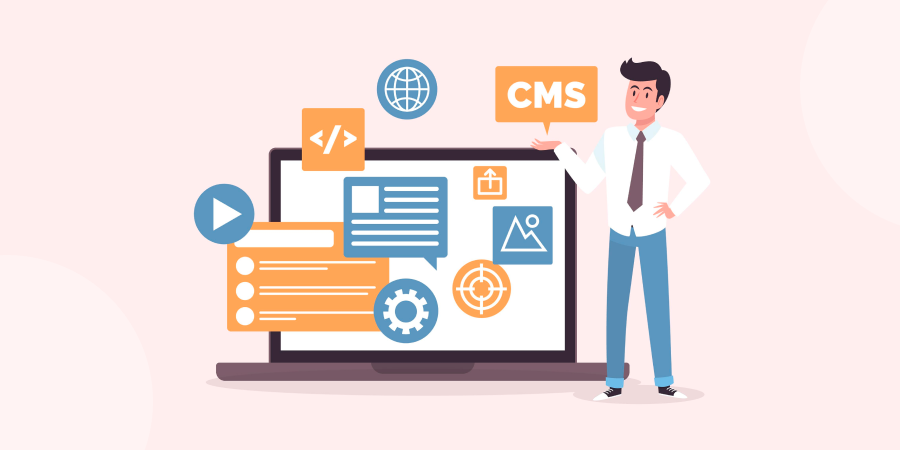
The best headless CMS platforms in 2026 are no longer competing only on content management features. Businesses now evaluate headless CMS solutions based on scalability, developer workflows, AI readiness, governance, and long-term digital flexibility.
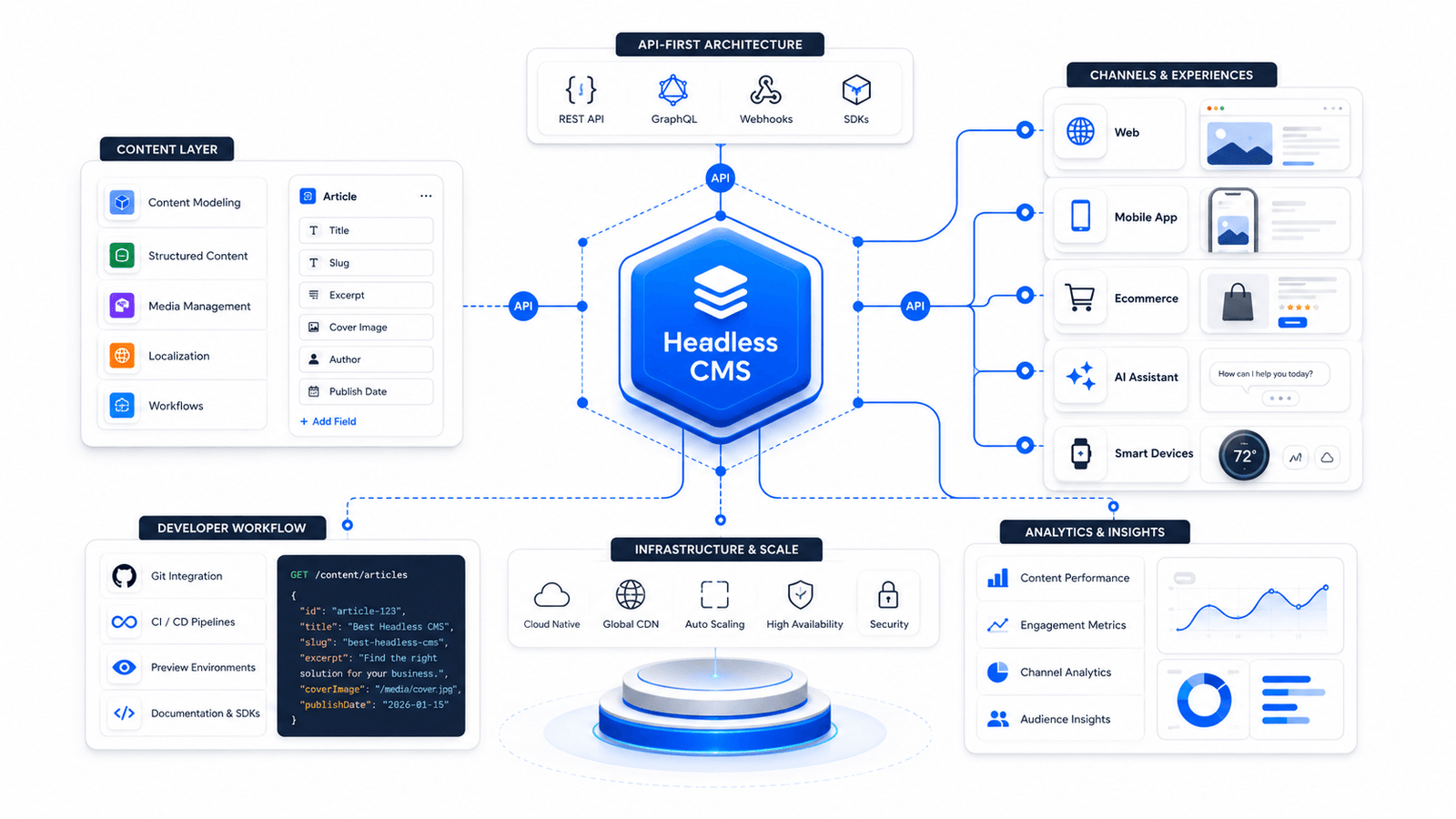
That is why the market for headless CMS platforms has evolved rapidly over the last few years. Organizations are moving away from traditional monolithic systems and investing in API-first content infrastructure that can support websites, mobile apps, ecommerce platforms, customer portals, digital signage, AI workflows, and future delivery channels simultaneously.
However, most comparisons of the top headless CMS platforms still focus too heavily on feature lists. Real-world platform selection is rarely about features alone.
A startup building quickly with a small engineering team has very different priorities than an enterprise managing governance, localization, multiple brands, and strict publishing workflows.
The better question is this:
Which headless CMS platform fits your organization’s technical maturity, operational model, and long-term architecture goals?
This guide compares the leading headless CMS solutions in 2026 using practical decision-making criteria, including:
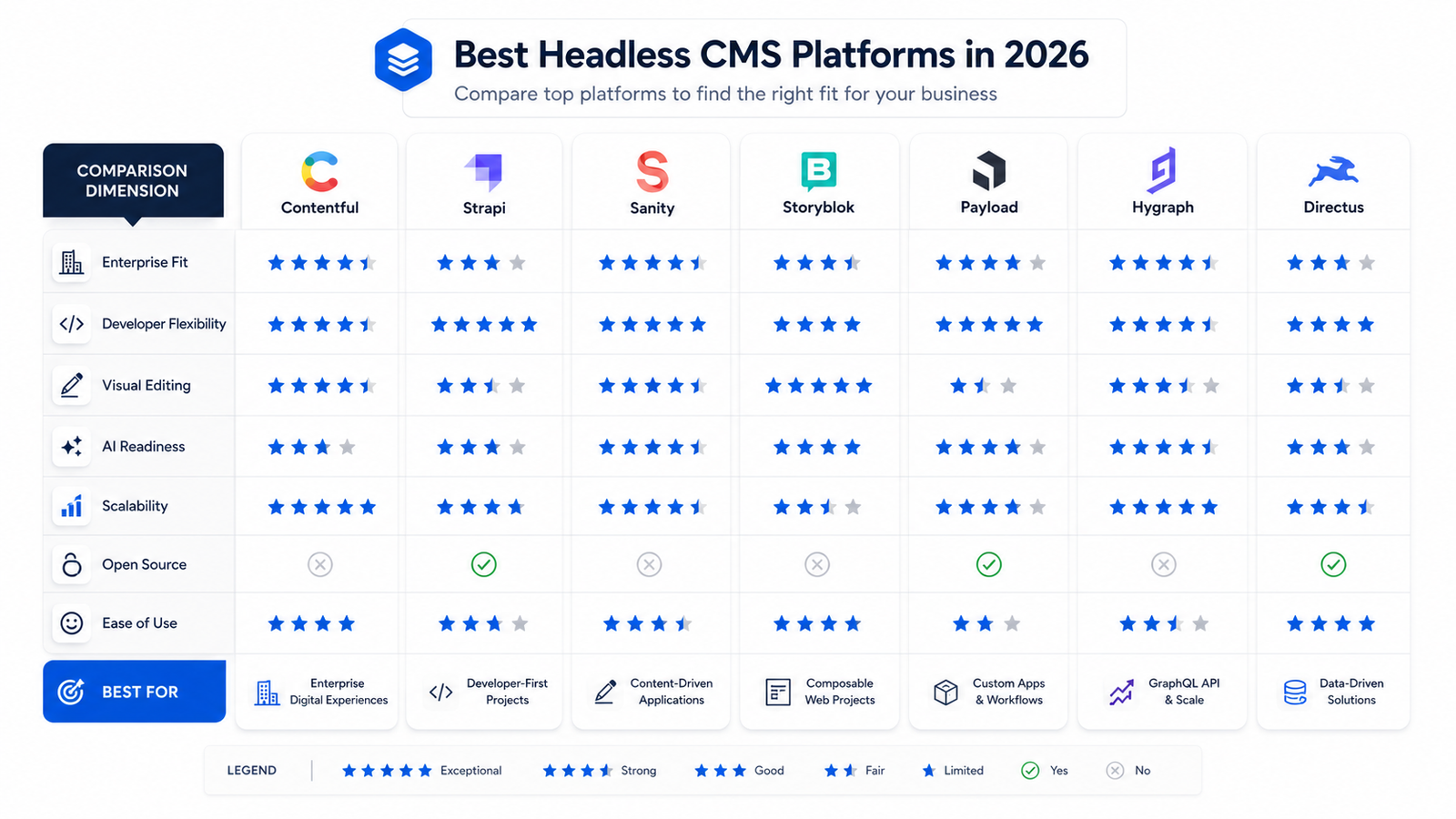
| Platform | Best For | Primary Strength | Potential Limitation |
|---|---|---|---|
| Contentful | Large enterprises | Governance and scalability | High pricing at scale |
| Strapi | Developer-first organizations | Customization and flexibility | Infrastructure management |
| Sanity | Structured content operations | Content flexibility | Requires planning discipline |
| Storyblok | Marketing-led teams | Visual editing workflows | Less backend flexibility |
| Payload | Modern TypeScript teams | Developer experience | Enterprise maturity still growing |
| Hygraph | GraphQL-centric stacks | API architecture | Smaller ecosystem |
| Directus | Database-first systems | SQL flexibility | Editorial UX limitations |
Traditional CMS platforms were designed primarily for website publishing. Content management and frontend presentation were tightly coupled together.
That model increasingly becomes restrictive when organizations need:
Headless CMS platforms separate the content layer from the presentation layer. Developers can build frontend experiences independently while content teams continue managing structured content through centralized systems.
Separating the content layer from the presentation layer provides several advantages and aligns closely with modern SaaS development practices built around modular, API-first infrastructure:
In 2026, another major driver is AI-readiness.
Modern enterprises increasingly need structured, reusable content that can support:
As a result, CMS decisions now influence broader digital infrastructure strategy.
Many organizations also align CMS modernization initiatives with broader custom software development strategies to improve long-term scalability and integration flexibility.
Different headless CMS platforms solve different operational problems. The right choice depends less on popularity and more on organizational fit.
Before selecting a platform, businesses should evaluate operational requirements beyond simple feature comparisons.
Some CMS platforms are highly developer-centric. Others prioritize editorial usability and visual workflows.
A company with a strong internal engineering team may prefer infrastructure flexibility and customization. A marketing-heavy organization may prioritize publishing efficiency and ease of use.
Early-stage startups and enterprise organizations have fundamentally different scaling concerns.
Key considerations include:
Open-source headless CMS platforms often provide greater flexibility, but they also introduce operational responsibilities.
Teams should realistically evaluate:
Modern content systems should support structured content modeling rather than page-centric publishing alone.
Structured content modeling becomes increasingly important for:
Subscription pricing rarely reflects actual long-term cost.
Businesses should also evaluate:
Many CMS migration projects become expensive not because the platform is technically weak, but because the original evaluation process failed to account for long-term operational realities.
Contentful remains one of the most widely adopted enterprise CMS platforms in 2026.
Its strongest advantage is operational maturity. Enterprise teams often use Contentful to manage large-scale content ecosystems across multiple channels, teams, and regions.
The platform performs particularly well for:
Its API infrastructure and governance capabilities remain among the strongest in the market.
Key capabilities include:
Many organizations adopting MACH architecture principles continue to use Contentful as a central content infrastructure layer.
It also integrates well with modern frontend frameworks and composable commerce ecosystems.
Typical Pricing Reality: Contentful’s pricing often scales faster than expected once API usage, localization, user seats, and multi-environment workflows increase.
Contentful is rarely the cheapest option.
This is one of the biggest surprises for growing companies evaluating SaaS headless CMS platforms. Initial pricing may appear manageable, but costs often increase significantly as API usage, environments, content models, and user seats expand.
For enterprises, the operational maturity usually justifies the investment.
For startups and SMEs, pricing can become difficult to justify if governance complexity remains relatively low.
Contentful works best when organizations prioritize governance, scalability, and operational consistency over maximum customization flexibility.
Strapi remains one of the most popular open source headless CMS platforms in 2026. Businesses evaluating implementation support often work with a Strapi CMS development company to accelerate architecture planning and deployment.
Engineering-focused organizations are often drawn to Strapi because it provides greater ownership over architecture, APIs, and infrastructure decisions.
Unlike fully managed SaaS platforms, Strapi provides much more implementation flexibility.
Strapi aligns strongly with modern JavaScript and Node.js ecosystems.
Developer-focused advantages include:
For organizations building highly customized applications or internal platforms, Strapi can provide far more control than traditional enterprise SaaS CMS platforms.
One of the biggest misconceptions around open-source CMS platforms is assuming they are automatically cheaper.
In reality, operational ownership introduces additional responsibilities:
These responsibilities are manageable for technically mature teams. However, smaller organizations often underestimate the long-term operational effort involved.
The Contentful vs Strapi debate ultimately comes down to governance versus control.
Contentful prioritizes operational maturity, reliability, and enterprise workflows.
Strapi prioritizes flexibility, customization, and infrastructure ownership.
Neither platform is universally better. Team structure and operational priorities ultimately determine the right choice.
Sanity has evolved into one of the most flexible and forward-looking headless CMS platforms available in 2026.
Its core strength is structured content architecture combined with strong real-time collaboration capabilities. Unlike many traditional CMS platforms that still revolve around page-based publishing models, Sanity is designed around reusable content structures.
As a result, the platform becomes particularly attractive for organizations treating content as a long-term operational asset rather than simple website copy.
Sanity is especially strong for businesses managing content across multiple touchpoints, including:
This structured approach aligns well with modern content operations where reuse, metadata consistency, and semantic organization matter increasingly more.
Sanity’s flexibility can become a double-edged sword.
Without proper governance and architecture planning, organizations may create overly customized content models that become difficult to maintain over time.
The platform often performs best when implementation is guided by experienced content architects rather than purely frontend-focused development teams.
Sanity’s entry pricing is relatively accessible compared to some enterprise-focused competitors. However, advanced collaboration, enterprise governance, and scaling requirements can still increase costs significantly.
Compared to traditional enterprise CMS platforms, Sanity often provides better developer flexibility while maintaining strong editorial capabilities.
Storyblok has become one of the most popular headless CMS platforms for organizations prioritizing editor usability and visual workflows.
One of the biggest barriers to headless CMS adoption historically was poor editorial experience. Many developer-first platforms created operational friction for marketing and content teams.
Storyblok addresses this directly through visual editing capabilities and component-based workflows.
For organizations where marketing agility and publishing speed are strategic priorities, Storyblok often provides a more balanced experience between developers and content teams.
Storyblok is not always the strongest choice for highly customized backend architectures.
Compared to platforms like Strapi or Payload, backend extensibility can feel more constrained for engineering-heavy organizations.
Some enterprises may also require additional governance tooling depending on operational complexity.
Storyblok’s pricing is generally more approachable than large enterprise CMS vendors, but costs still scale with usage, environments, and collaboration requirements.
Businesses should evaluate long-term content growth and operational scaling rather than only entry-level pricing tiers.
Payload has gained major momentum among developers in 2026 and is increasingly viewed as one of the best CMS for developers building modern applications.
Developer experience, TypeScript alignment, and architectural flexibility remain central strengths of Payload CMS.
Unlike older CMS platforms adapted for headless usage, Payload feels intentionally built for modern application development workflows.
Payload is especially attractive for startups and product-focused engineering teams building highly customized digital experiences.
Despite rapid growth, Payload is still newer than major enterprise incumbents.
Organizations evaluating Payload should consider:
That does not necessarily make Payload a risky choice. However, enterprises with strict governance and procurement requirements may still prefer more operationally mature vendors.
Payload often works best for organizations that prioritize developer productivity and architectural control over enterprise procurement familiarity.
For greenfield projects and modern application stacks, it is becoming an increasingly serious contender.
Hygraph continues to differentiate itself through GraphQL-native architecture and composable content delivery capabilities.
While some CMS platforms support GraphQL as an additional feature, Hygraph places GraphQL at the center of its architecture strategy.
This appeals strongly to organizations building API-heavy systems and composable digital experiences.
Hygraph works best when API architecture itself is a strategic requirement rather than simply a technical preference.
Directus approaches content management differently from most modern headless CMS platforms.
Instead of abstracting content heavily behind proprietary layers, Directus works directly on top of SQL databases.
This makes it particularly attractive for organizations with existing relational database infrastructure or operational systems.
Directus is often strongest in technical organizations where data architecture flexibility matters more than traditional publishing workflows.
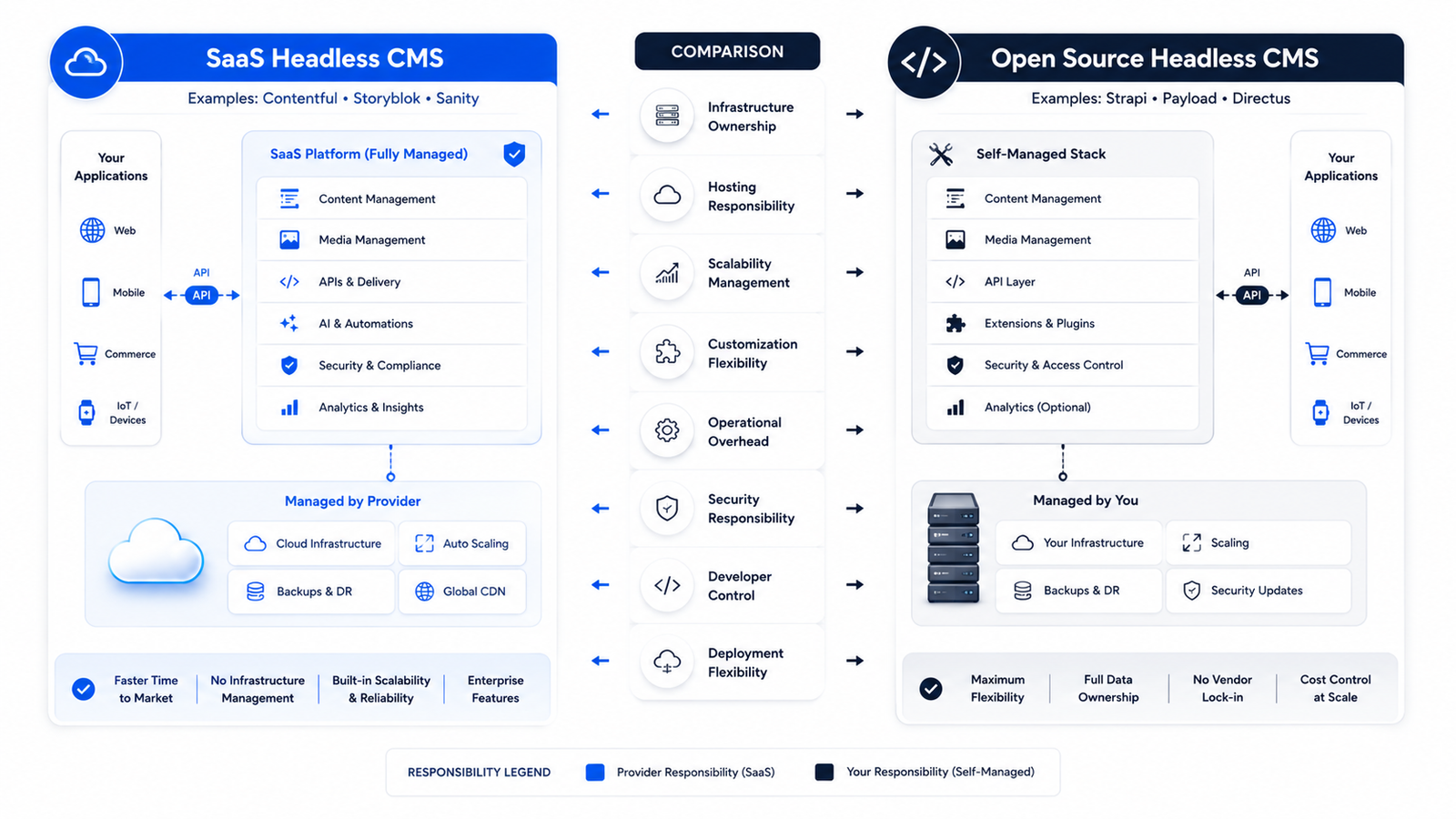
| Factor | SaaS CMS | Open Source CMS |
|---|---|---|
| Infrastructure Management | Vendor-managed | Self-managed |
| Customization Flexibility | Moderate | High |
| Operational Overhead | Lower | Higher |
| Security Responsibility | Vendor-led | Internal ownership |
| Scaling Complexity | Simpler | Internal responsibility |
| Deployment Flexibility | Limited | Extensive |
There is no universally superior model.
SaaS headless CMS platforms typically reduce operational complexity and accelerate implementation.
Open-source CMS platforms provide more architectural flexibility but require stronger internal engineering maturity.
Organizational capabilities matter far more than ideology when evaluating SaaS versus open-source CMS platforms.
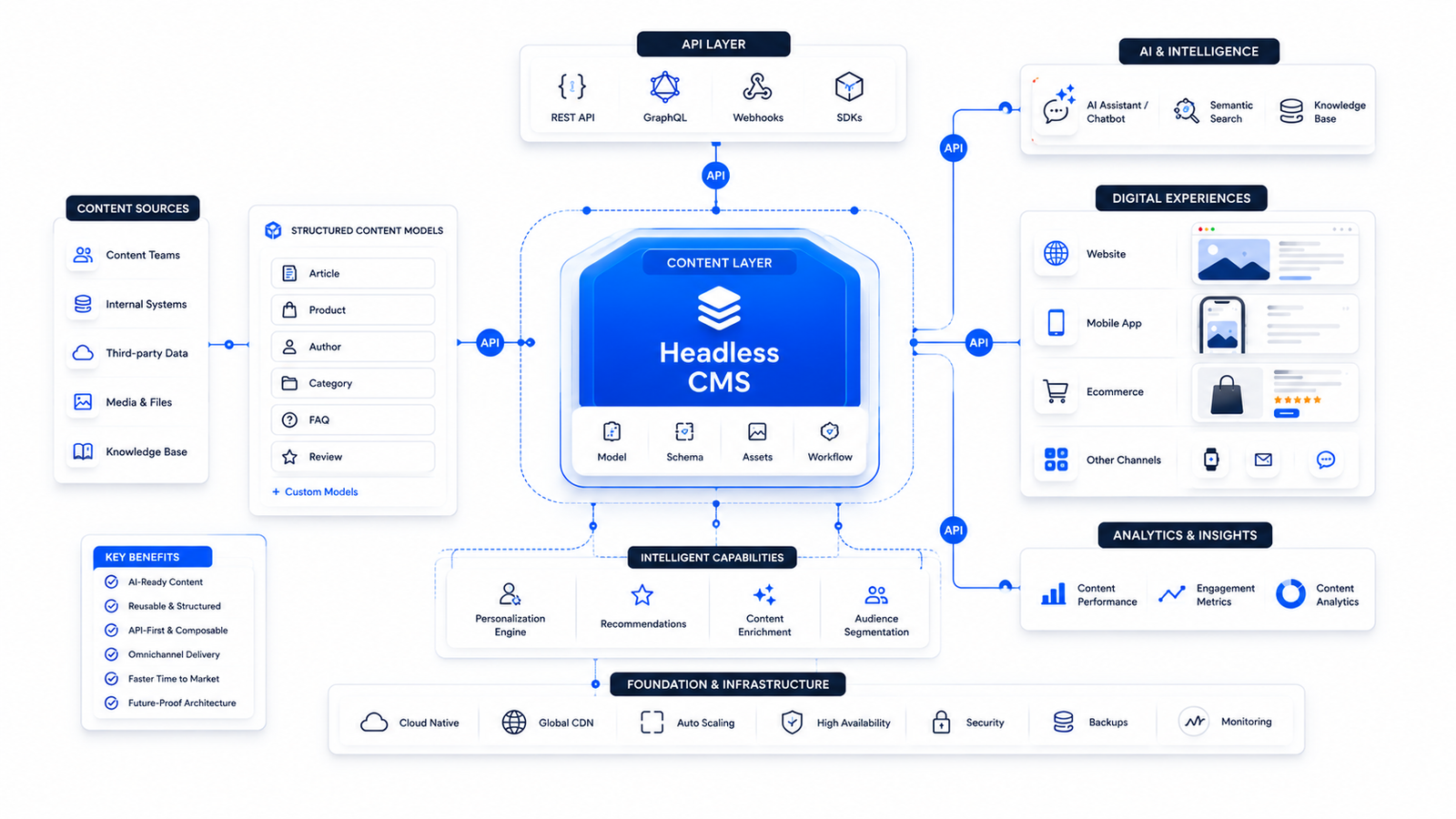
One of the biggest shifts affecting enterprise CMS platforms in 2026 is AI integration.
Structured content is becoming increasingly important for:
Organizations still relying heavily on page-centric content architectures may face increasing limitations as AI-driven experiences evolve.
Modern headless CMS platforms support:
These capabilities increasingly affect long-term digital adaptability.
The CMS is no longer just a publishing tool. It is increasingly part of the organization’s digital infrastructure layer.
Developer-focused teams typically prioritize API flexibility, frontend freedom, extensibility, and infrastructure control. Platforms like Payload, Strapi, and Sanity are often preferred because they align well with modern TypeScript, React, and composable architecture workflows.
However, the best CMS for developers also depends on operational maturity. Open-source flexibility can increase infrastructure responsibility, while SaaS platforms may reduce maintenance overhead at the cost of customization.
Whether you’re defining the right tech stack, estimating development cost, or planning product architecture, our team helps you make informed decisions before you invest.
The best headless CMS platforms in 2026 are not necessarily the platforms with the longest feature lists.
The right decision depends on:
Many organizations make the mistake of selecting a CMS purely based on developer preference, pricing, or popularity.
A better approach is evaluating how the platform fits long-term operational realities.
Modern CMS decisions increasingly influence:
Companies investing in composable digital platforms increasingly evaluate CMS architecture alongside frontend performance, API orchestration, and long-term platform scalability requirements.
Choosing carefully now can prevent expensive migrations, workflow bottlenecks, and operational inefficiencies later.
There is no universal best platform. Contentful is strong for enterprises, Strapi for customization, Sanity for structured content operations, and Storyblok for visual editing workflows.
Payload, Strapi, and Sanity are often considered among the best CMS platforms for developers because of flexibility, APIs, and modern framework compatibility.
Not always. Open-source platforms provide more control and flexibility, while SaaS platforms reduce operational overhead and infrastructure management responsibilities.
Enterprises increasingly require omnichannel delivery, composable architectures, structured content, and API-first systems that traditional monolithic CMS platforms struggle to support efficiently.
AI readiness is becoming increasingly important because structured content systems support personalization, semantic search, AI workflows, and multi-channel content delivery more effectively.
Contentful is typically better for enterprises needing governance, localization, and operational maturity, while Strapi is often preferred by engineering-heavy teams wanting greater customization and infrastructure control.

Deepak Saini
Deepak Saini is the CEO of Nascenture, a technology company focused on building scalable digital solutions. With a strong interest in AI, blockchain, and emerging technologies, he helps businesses leverage innovation to drive growth, efficiency, and competitive advantage. He regularly shares insights on software development, automation, and future-ready tech strategies.
Software Solutions for Logistics Companies: Logistic...
Logistics software development is becoming a strategic priority for...

Top Software Development Trends in the UK for 2026
Software development trends UK businesses are prioritizing in 2026 ...

How to Choose the Best SEO Company in Mississauga in...
Finding the right SEO company in Mississauga is not as simple as picki...