

Traditional CMS vs Headless CMS is no longer just a technology comparison. For enterprise organizations, this decision affects content operations, frontend architecture, governance, scalability, developer workflows, digital experience delivery, and long-term operational cost.
Modern enterprises increasingly adopt composable digital architecture where independent services integrate through APIs.
Many companies adopt headless CMS platforms because they appear modern and flexible. Some benefit significantly from the transition. Others discover that they introduced unnecessary complexity into their technology stack without solving a meaningful business problem.
The right choice depends less on trends and more on organizational readiness, delivery requirements, engineering maturity, governance structure, and content distribution complexity.
This guide examines Traditional CMS vs Headless CMS from a practical enterprise perspective. Instead of focusing only on features, it explores operational realities, implementation tradeoffs, governance considerations, SEO implications, AI-readiness, migration complexity, and total cost of ownership.
Executive Summary
Traditional CMS platforms remain the better choice for many organizations, especially companies prioritizing fast deployment, lower operational overhead, straightforward editorial workflows, and limited engineering complexity. Many mid-market businesses still rely on proven CMS development solutions to support scalable website operations without introducing unnecessary architectural complexity.
Headless CMS platforms become valuable when organizations require:
- Omnichannel content delivery
- Structured reusable content
- Frontend flexibility
- Composable architecture
- Multi-platform digital experiences
- Advanced personalization capabilities
- Scalable API-driven ecosystems
However, headless architecture also introduces significant operational responsibilities, including frontend ownership, DevOps maturity requirements, governance fragmentation risks, workflow redesign, and higher implementation complexity.
The most effective CMS decision is not the most technically advanced option. It is the architecture that aligns with your organizational capabilities, operating model, content strategy, and long-term digital goals.
Traditional CMS vs Headless CMS: Quick Comparison
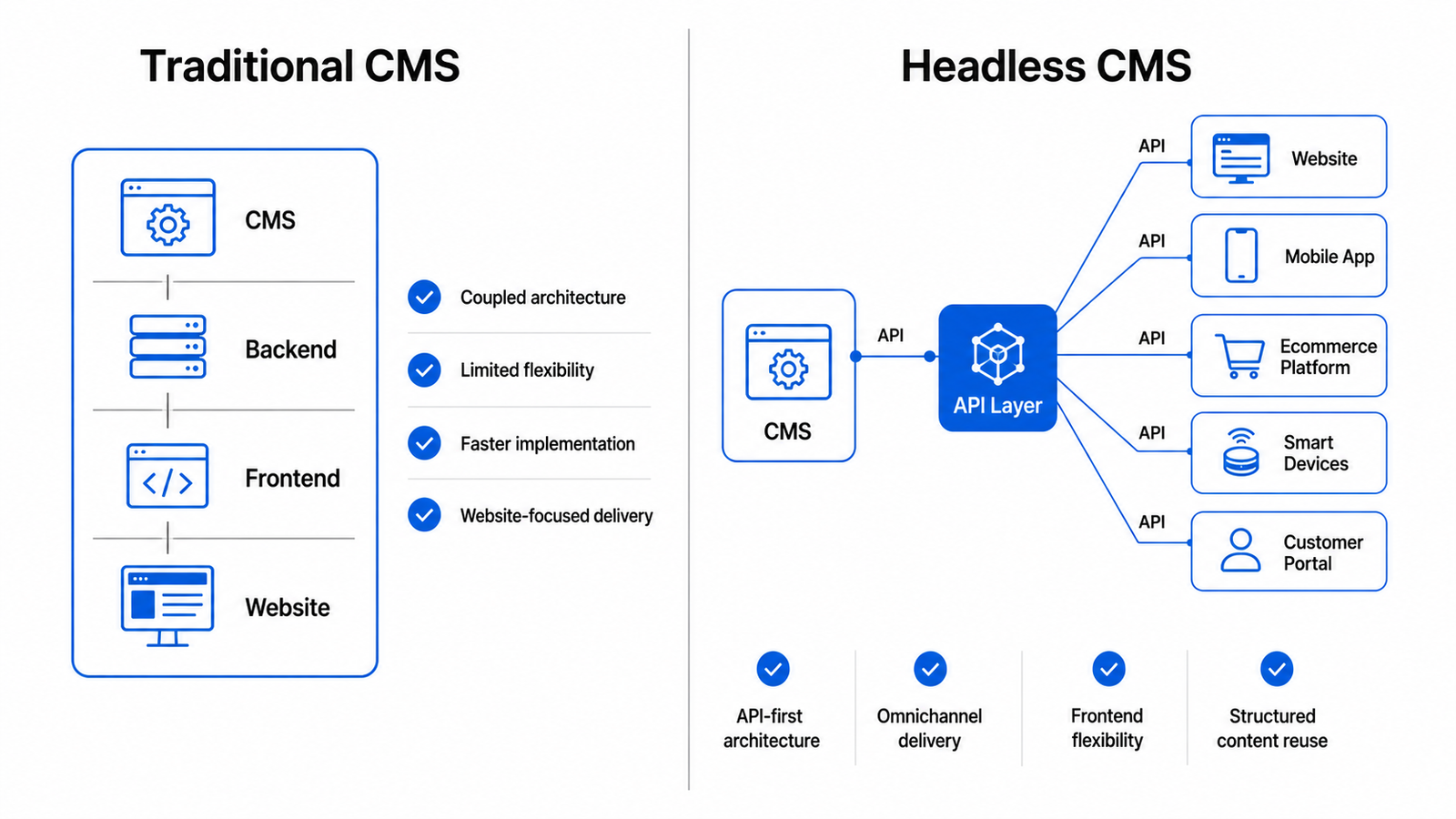
| Factor | Traditional CMS | Headless CMS |
|---|---|---|
| Architecture | Coupled frontend and backend | Decoupled API-first architecture |
| Implementation Speed | Faster initial deployment | Longer implementation cycle |
| Frontend Flexibility | Limited by theme and template systems | Highly flexible frontend architecture |
| Developer Dependency | Lower ongoing dependency | Higher engineering involvement |
| Omnichannel Delivery | Limited | Strong multi-channel support |
| SEO Complexity | Simpler SEO management | Requires frontend SEO ownership |
| Governance Complexity | Centralized workflows | Distributed governance considerations |
| Operational Overhead | Lower | Higher |
| Scalability | Moderate | High |
| AI-Readiness | Limited structured content support | Strong structured content capabilities |
| Best Fit | Marketing websites and SMBs | Enterprise digital ecosystems |
What Is a Traditional CMS?
A traditional CMS uses a coupled architecture where content management, backend logic, templating, and frontend rendering exist within the same platform.
Platforms like WordPress and Drupal popularized this model because they simplify website management. Editorial teams can create content, manage pages, configure layouts, and publish updates without extensive developer involvement.
Traditional CMS platforms are optimized primarily for website publishing. The platform controls both content management and presentation layers.
This architecture works particularly well for organizations that prioritize:
- Rapid deployment
- Lower implementation complexity
- Centralized workflows
- Marketing-driven website management
- Lower engineering dependency
What Is a Headless CMS?
A headless CMS separates content management from frontend presentation. Content is stored centrally and delivered through APIs to multiple digital channels.
Instead of tightly coupling content and website templates, headless architecture treats content as structured reusable data.
This allows organizations to distribute content across:
- Websites
- Mobile applications
- Ecommerce platforms
- Digital kiosks
- Customer portals
- IoT interfaces
- AI-driven systems
- Third-party applications
Headless CMS platforms such as Contentful are particularly valuable for organizations building composable digital ecosystems where multiple frontend experiences consume shared structured content. Many enterprises evaluating this model also explore Headless CMS development services to support API-first content delivery across channels.
Traditional CMS vs Headless CMS: The Real Architectural Difference
The core difference between traditional CMS and headless CMS is not simply frontend separation. It is a fundamentally different approach to content architecture.
Traditional CMS Philosophy
Traditional CMS platforms are page-oriented systems. Content is usually created for a specific presentation layer. Editorial workflows, layouts, themes, and publishing logic operate within a centralized environment.
This creates operational simplicity but limits flexibility when organizations expand beyond websites.
Headless CMS Philosophy
Headless CMS platforms are content infrastructure systems. Content exists independently from presentation layers and can be reused across multiple digital experiences.
This architecture supports:
- Structured content modeling
- Composable architecture
- Cross-platform content reuse
- API-driven delivery
- Frontend independence
- Distributed digital ecosystems
For enterprise organizations, this difference becomes increasingly important as customer experiences expand across channels.
Traditional CMS Advantages for Enterprise Teams
Despite the industry shift toward headless architecture, traditional CMS platforms continue to offer meaningful advantages.
Faster Time to Market
Traditional CMS platforms allow organizations to launch websites quickly using prebuilt themes, plugins, templates, and integrated workflows.
For companies focused primarily on website publishing, this simplicity often creates better business outcomes than introducing complex composable architecture.
Lower Operational Complexity
Traditional CMS environments centralize:
- Content management
- Frontend rendering
- SEO configuration
- Publishing workflows
- User management
- Theme customization
This reduces coordination overhead between content teams, frontend developers, and DevOps operations.
Lower Engineering Dependency
Marketing and editorial teams can often manage day-to-day operations independently without requiring continuous frontend engineering support.
This becomes especially valuable for organizations with limited technical resources.
Mature Ecosystem Support
Platforms like WordPress benefit from extensive plugin ecosystems, hosting support, community documentation, and large talent pools.
For many mid-market businesses, this operational maturity outweighs the architectural limitations.
Benefits of Headless CMS
Headless CMS platforms become valuable when organizations move beyond conventional website publishing and require scalable digital experience infrastructure. Enterprise platforms such as Contentful CMS are commonly used for structured content delivery and composable digital experiences.
Omnichannel Content Delivery
Headless architecture allows organizations to manage content centrally while distributing it across multiple digital channels.
This eliminates duplicated content management across separate systems and improves content consistency.
Frontend Flexibility
Frontend teams can build experiences using modern frameworks such as React, Next.js, Vue, or native mobile technologies without being constrained by traditional templating systems, a common requirement in enterprise web development services engagements.
This flexibility improves capabilities often prioritized in modern web development services engagements:
- Performance optimization
- User experience customization
- Application scalability
- Frontend innovation velocity
Structured Content and Content Reuse
Headless CMS platforms encourage organizations to model content structurally instead of treating pages as isolated publishing units. Open-source platforms like Strapi CMS are frequently adopted by organizations seeking greater flexibility and API-first content management capabilities.
This supports:
- Content reuse
- Personalization engines
- AI content orchestration
- Dynamic content assembly
- Machine-readable content systems
Composable Architecture Alignment
Modern enterprises increasingly adopt composable digital architecture where independent services integrate through APIs.
Headless CMS platforms align naturally with this strategy because they function as modular content infrastructure components.
Scalability for Enterprise Ecosystems
Organizations managing multiple brands, regions, platforms, or customer experiences often benefit from centralized content infrastructure combined with distributed frontend experiences.
This scalability is difficult to achieve efficiently within traditional monolithic CMS systems.
The Hidden Costs of Headless CMS
This is the area many vendor-driven comparisons avoid discussing honestly.
Headless CMS platforms can provide architectural flexibility, but they also shift significant operational responsibility onto engineering and platform teams.
Frontend Ownership Becomes Permanent
Traditional CMS platforms bundle frontend rendering capabilities directly into the platform.
With headless architecture, organizations become responsible for maintaining:
- Frontend applications
- Rendering frameworks
- SEO implementation
- Accessibility compliance
- Deployment pipelines
- Performance optimization
- Preview environments
This increases long-term engineering responsibility significantly.
DevOps and Infrastructure Complexity
Headless CMS environments often require:
- CI/CD pipelines
- Frontend hosting infrastructure
- API orchestration
- Caching strategies
- Environment synchronization
- Observability tooling
Organizations without mature platform engineering capabilities can struggle operationally after implementation.
Editorial Workflow Friction
Content editors frequently lose the visual editing simplicity available in traditional CMS platforms.
Preview workflows, content staging, and frontend synchronization often require additional custom development.
This becomes a major adoption challenge for non-technical teams.
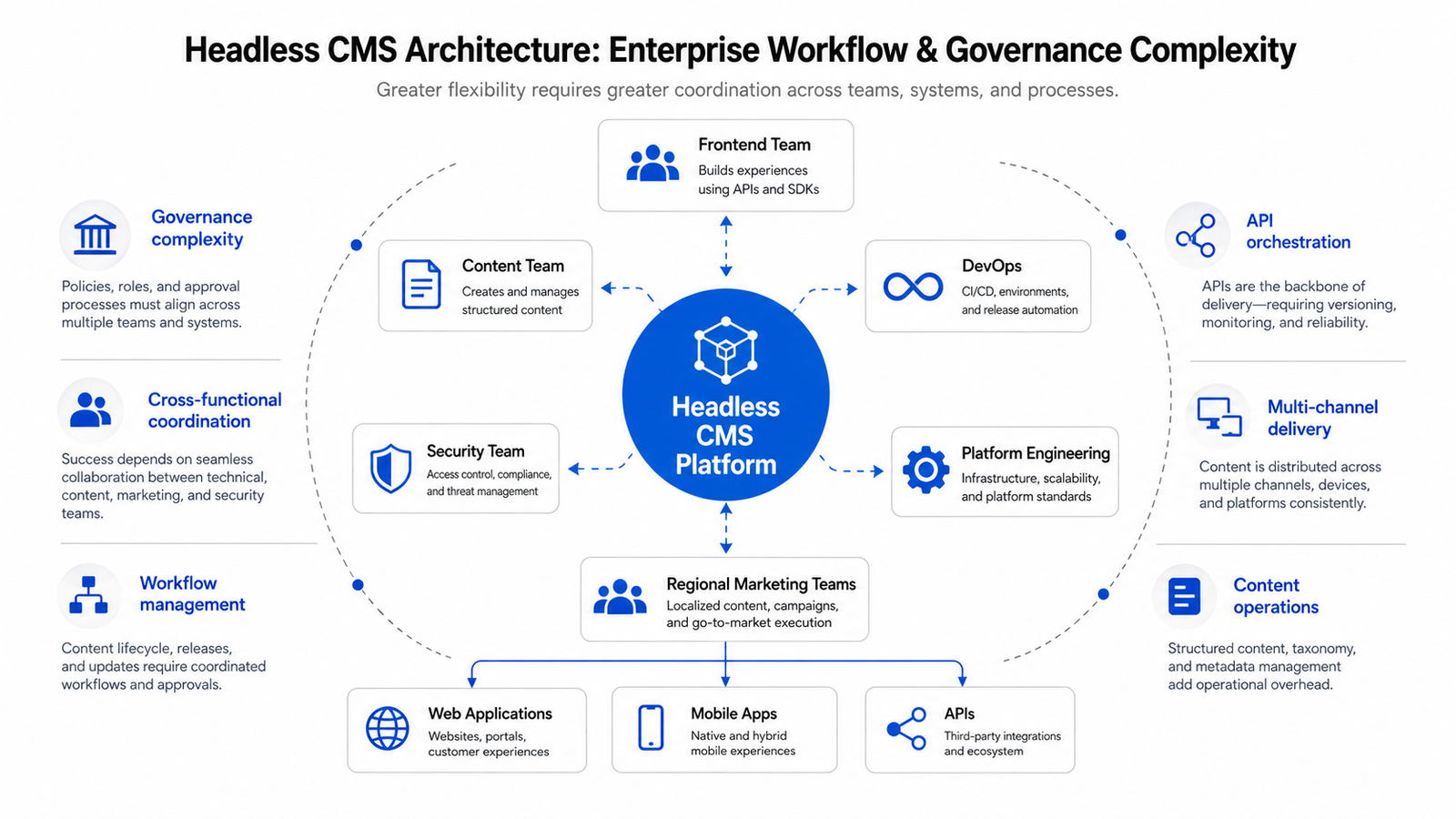
Governance Complexity Increases
Traditional CMS environments typically centralize governance inside a single publishing platform.
Headless ecosystems distribute responsibilities across:
- Frontend teams
- Platform engineering
- Content operations
- Regional marketing teams
- Security and compliance teams
- Infrastructure operations
As systems become more composable, organizations often experience governance fragmentation unless workflows are clearly defined early.
Common operational issues include:
- Inconsistent content models across teams
- Role and permission conflicts
- Broken preview environments
- Unclear publishing ownership
- Regional workflow inconsistencies
- API dependency bottlenecks
For global enterprises operating across multiple brands and regions, governance maturity becomes just as important as architectural flexibility.
Total Cost of Ownership Increases
Headless CMS pricing discussions often underestimate the broader operational costs associated with:
- Frontend engineering
- Infrastructure management
- API integrations
- Platform maintenance
- Developer hiring
- Governance management
- Cross-system orchestration
For many organizations, these costs exceed the licensing cost of the CMS platform itself.
Total cost of ownership should be evaluated across a multi-year operational horizon rather than initial implementation budgets alone.
Enterprise teams should evaluate:
- Long-term frontend maintenance requirements
- Cloud hosting and infrastructure costs
- Developer onboarding complexity
- Platform upgrade responsibilities
- Vendor lock-in risk
- Content migration costs
- Ongoing integration maintenance
Organizations sometimes underestimate how quickly frontend ownership and integration complexity compound over time.
Planning a Headless CMS Migration?
When Headless CMS Is a Bad Idea
Headless architecture is not automatically the best option for every organization.
In many situations, traditional CMS platforms produce better operational outcomes.
Small Marketing Websites
If your primary requirement is a conventional marketing website with limited complexity, introducing headless architecture may create unnecessary engineering overhead.
Limited Engineering Resources
Organizations without dedicated frontend engineering teams often underestimate the long-term maintenance burden associated with decoupled architecture.
Low Content Complexity
If content is not being reused across multiple platforms, the structured content advantages of headless architecture become less valuable.
Short-Term Delivery Priorities
Traditional CMS platforms typically allow faster implementation timelines and lower delivery risk.
For organizations prioritizing speed over architectural flexibility, this tradeoff often makes sense.
Low Operational Maturity
Headless CMS environments require stronger governance, DevOps maturity, frontend ownership models, and cross-functional coordination.
Organizations lacking these operational foundations frequently struggle after migration.
Organizational Readiness Checklist
Before selecting a headless CMS platform, leadership teams should evaluate operational readiness carefully.
| Question | Why It Matters |
|---|---|
| Do you publish across multiple digital channels? | Determines omnichannel value |
| Do you have frontend engineering resources? | Headless architecture increases frontend ownership |
| Do you need reusable structured content? | Critical for personalization and AI systems |
| Do you have DevOps maturity? | Required for scalable headless operations |
| Are current CMS limitations slowing innovation? | Validates modernization urgency |
| Do multiple teams require shared content infrastructure? | Supports centralized content operations |
| Is personalization becoming strategically important? | Structured content improves targeting capabilities |
| Can your organization support governance complexity? | Decoupled ecosystems require stronger governance |
If several of these answers are negative, adopting a headless CMS may introduce more complexity than value.
Real-World Implementation Scenarios
Global Ecommerce Enterprise
A multinational ecommerce organization operating across multiple regions, mobile applications, localized storefronts, and customer portals is usually a strong candidate for headless architecture.
Structured content reuse, omnichannel distribution, personalization capabilities, and composable integrations provide measurable operational advantages at scale.
However, these organizations also require mature governance frameworks, platform engineering investment, and centralized content modeling standards.
Mid-Market B2B Company
A regional B2B organization operating a primary corporate website with moderate publishing requirements often gains limited practical value from fully decoupled architecture.
In these environments, traditional CMS platforms frequently deliver:
- Faster implementation
- Lower maintenance overhead
- Simpler editorial workflows
- Reduced infrastructure complexity
Adopting headless architecture too early can increase operational cost without creating proportional business value.
SaaS Product Ecosystem
SaaS companies managing documentation systems, customer portals, onboarding experiences, and product interfaces often benefit from API-first content infrastructure. Many organizations building scalable SaaS development solutions adopt headless CMS architecture to support multi-platform content delivery and frontend flexibility.
Headless CMS platforms can support centralized content operations across multiple applications while enabling frontend flexibility for product teams.
However, success depends heavily on content governance and strong content modeling discipline.
CMS Architecture by Business Type
| Business Type | Recommended Approach |
|---|---|
| Small business marketing website | Traditional CMS |
| Startup MVP platform | Traditional CMS initially |
| Enterprise ecommerce ecosystem | Headless CMS |
| SaaS platform with multiple interfaces | Headless CMS |
| Media publishing organization | Hybrid evaluation required |
| Global multi-brand enterprise | Headless CMS |
| Regional B2B corporate website | Traditional CMS |
| Omnichannel retail platform | Headless CMS |
Hybrid CMS Architecture: The Middle Ground Many Enterprises Choose
The market conversation often presents CMS architecture as a binary choice between traditional and headless systems.
In practice, many enterprises adopt hybrid approaches.
Hybrid CMS strategies allow organizations to retain some traditional CMS capabilities while selectively introducing decoupled architecture where it creates business value.
This approach is particularly useful for organizations that:
- Need gradual modernization
- Operate legacy systems
- Cannot support full replatforming risk
- Require operational continuity
- Need phased frontend modernization
Common hybrid approaches include:
- Using a traditional CMS with API extensions
- Decoupling only customer-facing applications
- Retaining legacy publishing workflows temporarily
- Introducing structured content models incrementally
For many enterprises, hybrid architecture provides a more realistic modernization path than immediate full headless transformation.
SEO Considerations: Traditional CMS vs Headless CMS
One of the most common misconceptions is that headless CMS platforms automatically improve SEO.
They do not.
SEO performance depends primarily on implementation quality, frontend architecture decisions, rendering strategy, and technical execution.
Where Traditional CMS Performs Well
Traditional CMS platforms simplify:
- Metadata management
- XML sitemap generation
- Canonical configuration
- Plugin-based SEO workflows
- Editorial SEO management
This lowers operational complexity for marketing teams.
Where Headless CMS Can Improve SEO
Headless architecture can improve:
- Performance optimization
- Core Web Vitals
- Frontend rendering efficiency
- Content delivery speed
- Structured content distribution
However, these improvements require strong frontend implementation discipline.
Poorly implemented headless environments can easily create:
- Rendering issues
- Metadata inconsistencies
- Crawlability problems
- Indexing failures
- Broken preview workflows
SEO responsibility shifts significantly toward engineering teams in headless environments.
AI and the Future of CMS Architecture
AI-driven digital experiences are changing how enterprises evaluate content infrastructure. Many organizations investing in structured content ecosystems are also exploring Generative AI development services to support personalization, automation, and intelligent content delivery.
Traditional CMS platforms were designed primarily for webpage publishing. Headless CMS platforms are better aligned with structured content systems that AI applications increasingly depend on.
Why Structured Content Matters
AI systems require machine-readable, reusable, modular content structures.
Structured content supports:
- AI-powered personalization
- Dynamic content assembly
- Content automation workflows
- Semantic search experiences
- Cross-channel content orchestration
- Agent-ready digital systems
This is one reason enterprise organizations increasingly invest in API-first CMS architecture.
Structured Content Requires Operational Discipline
Many organizations underestimate the governance and modeling discipline required to make structured content successful.
Effective structured content systems require:
- Consistent taxonomy frameworks
- Clear content ownership
- Governance standards
- Reusable content models
- Editorial alignment across teams
- Cross-channel publishing standards
Without operational discipline, structured content systems often become fragmented and difficult to scale.
Composable Architecture and AI Readiness
Composable architecture allows organizations to integrate AI services, recommendation systems, personalization engines, and analytics platforms more flexibly.
Many enterprise organizations are also adopting micro-frontend architecture patterns to support independently deployable digital experiences across large-scale platforms.
However, AI-readiness is not achieved simply by adopting headless technology. It also requires:
- Strong content modeling
- Governance maturity
- Structured taxonomy systems
- Cross-functional operational alignment
The organizations likely to benefit most from AI-enabled content ecosystems are those investing in content operations maturity alongside architectural modernization.
Migration Strategy and Operational Complexity
Many organizations underestimate the complexity involved in migrating from traditional CMS platforms to headless architecture. Large-scale CMS modernization initiatives are increasingly treated as broader digital transformation programs rather than standalone platform migrations.
Large-scale CMS modernization projects affect far more than content storage.
Migration Challenges Often Include
- Content model redesign
- Frontend rebuilds
- API integration layers
- SEO preservation planning
- Workflow redesign
- Editorial retraining
- Infrastructure modernization
- Governance restructuring
Phased Migration Is Usually Safer
For enterprise organizations, gradual modernization strategies often reduce risk more effectively than full platform replacement.
Common phased approaches include:
- Frontend-first modernization
- Hybrid CMS adoption
- API layer introduction
- Selective content decoupling
- Regional rollout strategies
Organizations that attempt complete architectural transformation too quickly often encounter operational instability.
Planning a CMS Modernization Strategy?
Governance Should Be Planned Early
Headless architecture increases coordination requirements across:
- Engineering
- Marketing
- Content operations
- Platform teams
- Security
- Infrastructure teams
Without governance clarity, distributed content ecosystems become difficult to manage at scale.
Enterprises should define governance frameworks before migration begins, not after implementation complexity starts accumulating.
Traditional CMS vs Headless CMS: Which Option Should You Choose?
When evaluating Traditional CMS vs Headless CMS, organizations should prioritize operational fit over architectural trends. The best CMS architecture depends on your organization’s operational maturity and digital delivery requirements.
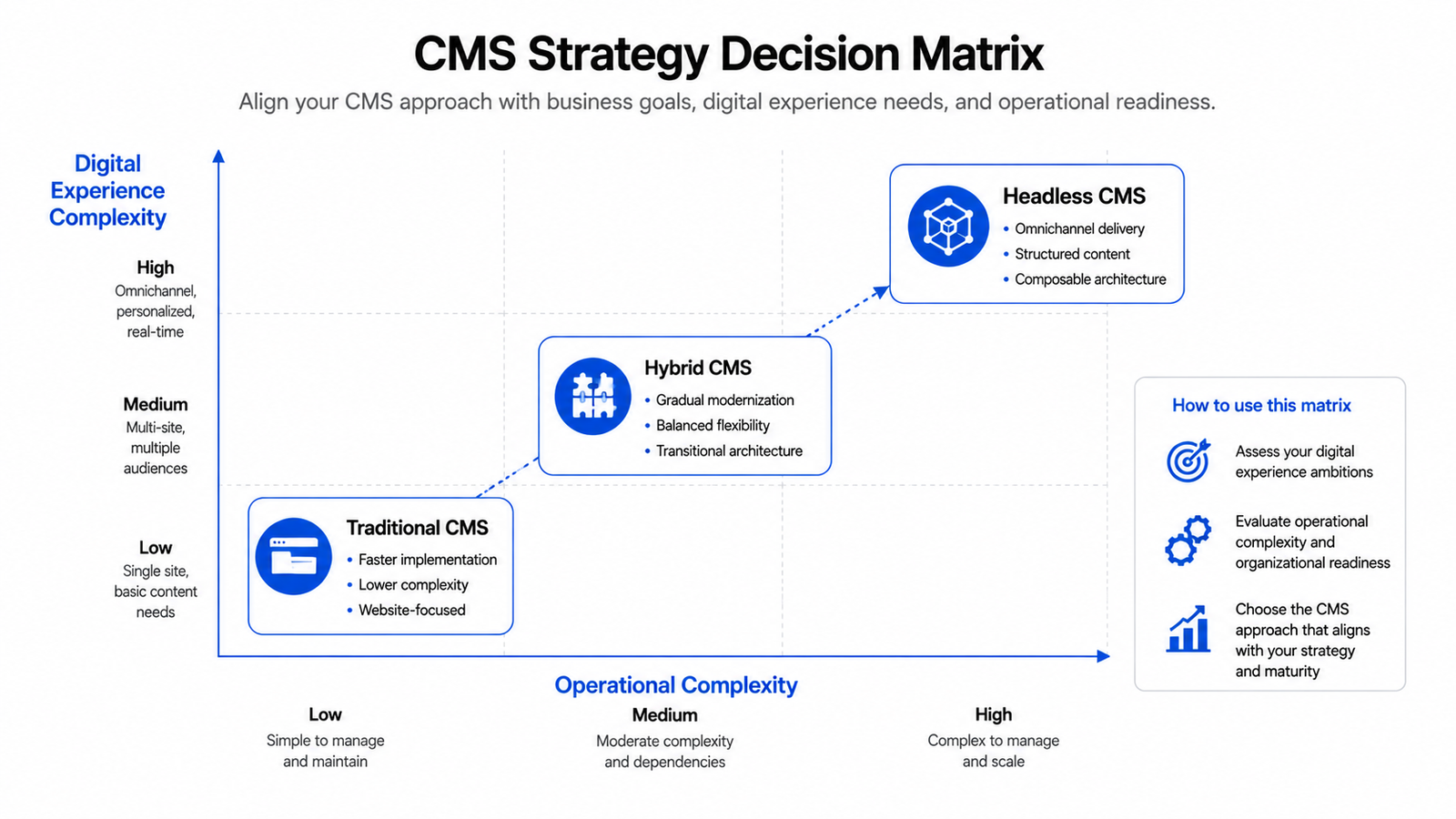
Choose a Traditional CMS If:
- Your primary focus is website publishing
- You need faster deployment timelines
- Your engineering resources are limited
- Your content complexity is relatively low
- You prioritize operational simplicity
- Your editorial teams require visual publishing workflows
Choose a Headless CMS If:
- You manage omnichannel digital experiences
- You require structured reusable content
- You have mature frontend engineering capabilities
- You are building composable digital architecture
- You require scalable API-driven content delivery
- You expect AI-powered personalization requirements to grow
Consider a Hybrid Approach If:
- You are modernizing gradually
- You have mixed business requirements
- You need selective decoupling
- You want to reduce migration risk
- You require operational continuity during transformation
Final Verdict
The Traditional CMS vs Headless CMS decision should not be driven by industry hype or vendor marketing.
Headless CMS platforms can deliver significant advantages for organizations operating complex digital ecosystems with strong engineering maturity, scalable governance models, and structured content requirements.
At the same time, traditional CMS platforms remain highly effective for companies prioritizing operational simplicity, rapid delivery, lower maintenance overhead, and centralized publishing workflows.
For many enterprises, hybrid architecture may ultimately provide the most practical modernization path by balancing flexibility with operational stability.
The most successful enterprise technology decisions are rarely about choosing the most modern architecture. They are about selecting systems that align with organizational capabilities, governance maturity, scalability requirements, and long-term operational strategy.
Before investing in CMS modernization, leadership teams should evaluate not only technical flexibility, but also implementation readiness, workflow impact, governance complexity, operational ownership, and total cost of ownership.
In 2026, the organizations gaining the most value from content infrastructure are not necessarily the ones adopting the newest platforms. They are the ones making architecture decisions that match their operational reality.
Choosing the Right CMS Architecture?
From CMS migration planning to headless architecture evaluation, we help enterprises choose scalable content systems aligned with long-term operational goals.

FAQs
Is headless CMS better than a traditional CMS?
Not always. Headless CMS platforms offer greater flexibility, structured content management, and omnichannel delivery capabilities. However, traditional CMS platforms are often better for organizations prioritizing faster implementation, lower operational complexity, and simpler editorial workflows.
When should a company use a headless CMS?
Headless CMS architecture is typically a strong fit for enterprises managing multiple digital channels, structured content systems, personalization initiatives, or composable digital ecosystems. Organizations also need sufficient frontend engineering and governance maturity to manage the additional complexity effectively.
What are the biggest disadvantages of a headless CMS?
The biggest challenges usually involve operational complexity, frontend ownership, DevOps requirements, governance coordination, and increased implementation cost. Many organizations underestimate the long-term maintenance responsibilities introduced by decoupled architecture.
Does a headless CMS improve SEO?
A headless CMS does not automatically improve SEO. SEO performance depends on frontend implementation quality, rendering strategy, metadata management, and technical optimization. Poorly implemented headless environments can create SEO issues just as easily as traditional platforms.
What is the difference between headless CMS and hybrid CMS?
A headless CMS fully separates content management from frontend presentation layers. A hybrid CMS combines traditional CMS capabilities with API-driven content delivery, allowing organizations to modernize gradually while retaining some built-in publishing functionality.
Is migrating to a headless CMS worth the cost?
It depends on organizational goals and operational maturity. For enterprises managing complex digital ecosystems, the long-term flexibility and scalability benefits can justify the investment. For smaller organizations with limited complexity, traditional CMS platforms may provide better operational efficiency and lower total cost of ownership.