



The eCommerce market is becoming more competitive, customer expectations are rising, and technology adoption is accelerating across industries. Businesses investing in the right eCommerce features 2026 strategies need more than an attractive storefront. They need a high-performing digital commerce ecosystem built around speed, personalization, operational efficiency, and security.
The most successful online brands are investing in smarter customer experiences, AI-powered automation, flexible commerce architecture, and data-driven decision-making. These investments are no longer optional. They are now part of the core eCommerce features 2026 businesses must implement to stay competitive.
This eCommerce development guide explores the most important online store features companies should prioritize in 2026. Whether you are launching a new platform, modernizing an existing store, or planning enterprise-scale digital transformation, these eCommerce must-haves will help you align your technology strategy with business growth.
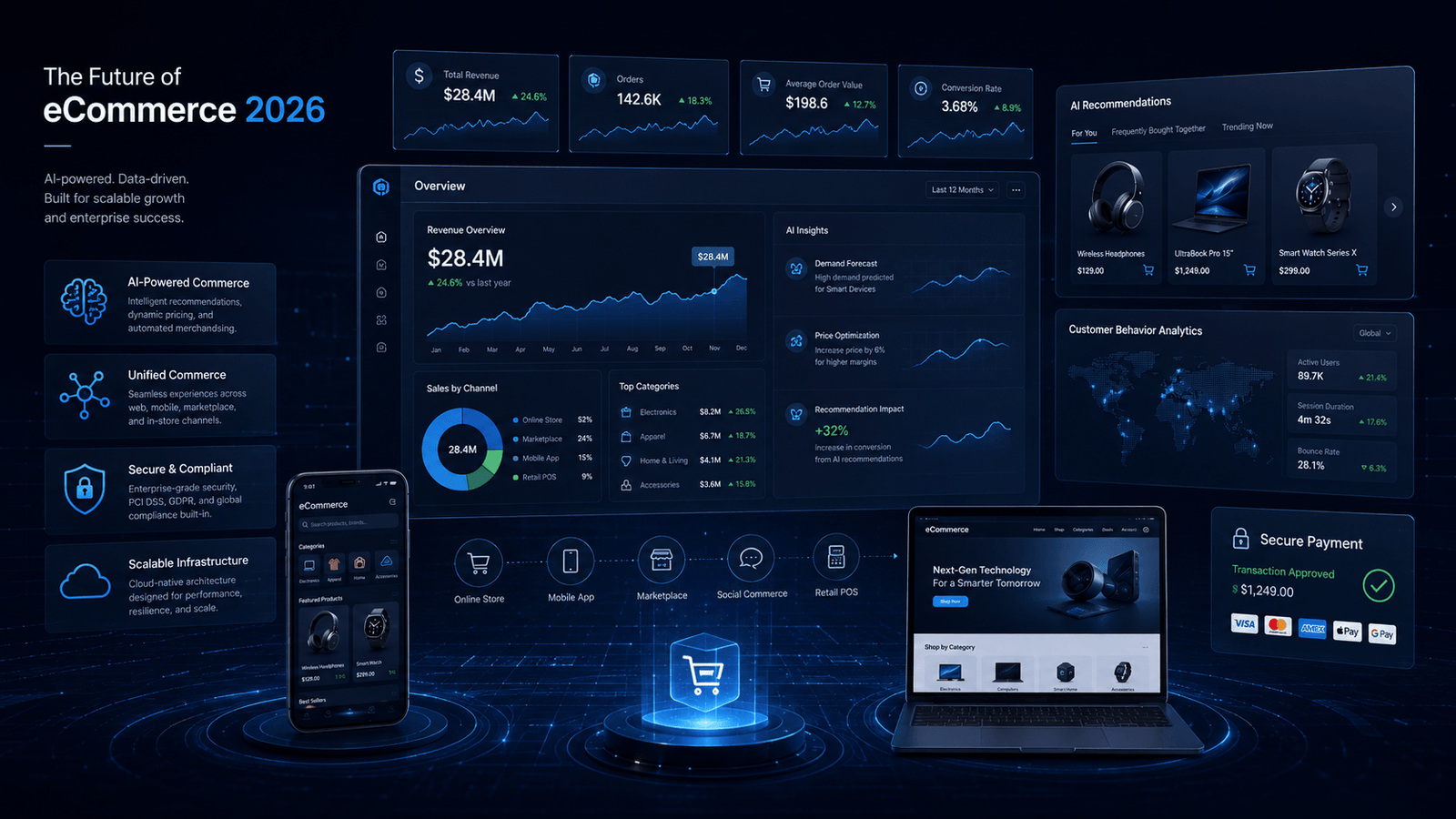
AI-Powered Personalization Will Define Customer Experience
Modern buyers expect online experiences tailored to their preferences, browsing behavior, and purchase history. Generic shopping journeys are no longer effective for growing conversion rates or improving customer retention.
AI-powered personalization has become one of the most important eCommerce features 2026 businesses should adopt. Many organizations are investing in AI development services to build intelligent commerce experiences. Intelligent recommendation engines can now analyze customer data in real time to deliver:
- Personalized product recommendations
- Dynamic homepage experiences
- Smart search results
- Targeted promotions
- Context-aware upselling opportunities
For B2B eCommerce platforms, personalization can also include account-specific pricing, procurement workflows, and industry-focused product catalogs.
Businesses implementing AI-driven personalization are seeing measurable improvements in:
- Average order value
- Customer lifetime value
- Cart completion rates
- Customer engagement
- Repeat purchases
Personalization should extend across the full customer journey, including email marketing, customer support, and post-purchase communication.
Headless Commerce Architecture Is Becoming Standard
Traditional monolithic eCommerce systems often struggle to support rapid innovation and omnichannel experiences. In 2026, businesses are increasingly investing in headless commerce development to improve flexibility and scalability.
Headless architecture separates the frontend presentation layer from backend commerce functionality. This allows businesses to deliver seamless experiences across:
- Websites
- Mobile applications
- Marketplaces
- Social commerce platforms
- IoT devices
- In-store digital systems
One of the major benefits of headless commerce is faster development cycles. Teams can launch frontend improvements without disrupting backend systems.
From an operational perspective, headless platforms also support:
- API-first integrations
- Faster content delivery
- Improved scalability
- Better performance optimization
- Flexible third-party integrations
As digital commerce ecosystems become more complex, headless commerce will remain one of the core eCommerce must-haves for enterprise growth.
Advanced Search and Product Discovery Features for Modern Online Stores
Customers expect fast and accurate product discovery experiences. If users cannot quickly find products, they leave the platform.
Search optimization is one of the most overlooked online store features, yet it directly impacts conversions and customer satisfaction.
Modern eCommerce search systems should include:
- AI-powered predictive search
- Natural language processing
- Visual search functionality
- Voice search compatibility
- Intelligent filtering and sorting
- Synonym recognition
- Misspelling correction
For large catalogs, advanced product discovery capabilities become even more important. B2B companies, distributors, and wholesalers particularly benefit from intelligent filtering systems that simplify large-scale purchasing.
Advanced search capabilities are becoming one of the most important eCommerce features 2026 businesses should prioritize to improve conversions and customer experience.
Mobile-First Online Store Features Are Non-Negotiable
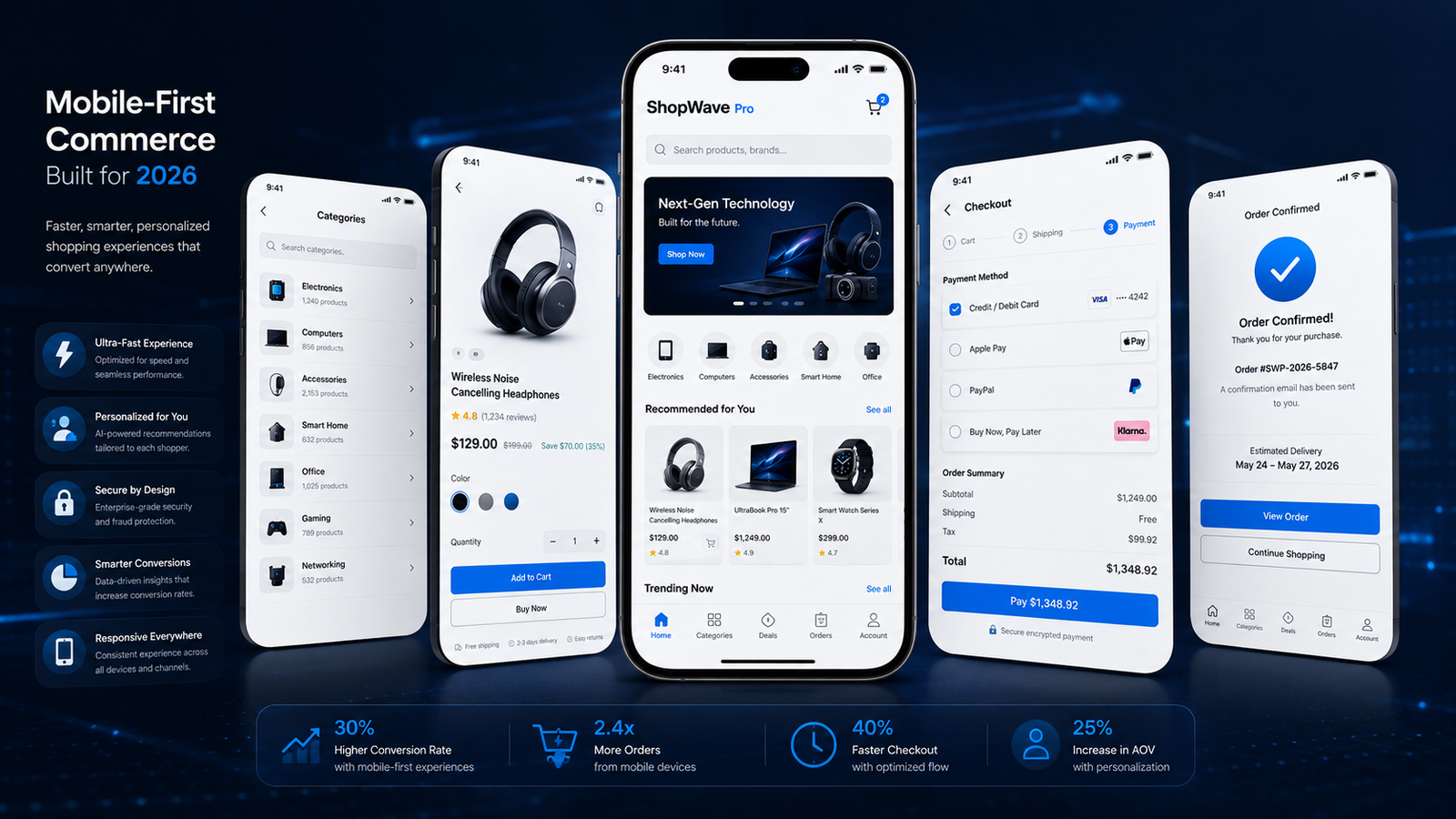
Mobile commerce continues to dominate online shopping behavior across both B2C and B2B industries. Businesses investing in mobile app development are improving customer engagement and conversion rates. Companies that still treat mobile optimization as secondary are losing customers and revenue opportunities.
In 2026, mobile-first design goes beyond responsive layouts. It requires a complete focus on usability, speed, and seamless interaction.
Key mobile optimization features include:
- Fast-loading mobile pages
- One-click checkout
- Mobile wallets and digital payments
- App-like browsing experiences
- Touch-friendly navigation
- Progressive web applications
- Optimized mobile search
Performance is especially important. Slow-loading pages significantly increase bounce rates and reduce conversions.
Businesses should continuously monitor Core Web Vitals, optimize media assets, and reduce unnecessary frontend complexity to improve mobile experiences.
Composable Commerce and eCommerce Must-Haves for Scalable Growth
Composable commerce is gaining momentum as organizations seek more flexible digital commerce infrastructures. Instead of relying on a single platform vendor, businesses can assemble specialized services based on their operational needs.
This modular approach allows companies to integrate best-in-class solutions for modern eCommerce development services, including:
- Payments
- Inventory management
- Customer relationship management
- Search functionality
- Analytics
- Marketing automation
- Shipping and logistics
Businesses evaluating eCommerce features 2026 priorities are increasingly adopting composable architectures to improve scalability and integration flexibility.
For enterprise organizations with complex operational requirements, composable systems are becoming critical eCommerce features 2026 strategies.
AI Chatbots and Conversational Commerce
Customer support expectations are changing rapidly. Buyers now expect immediate assistance throughout the purchasing process.
AI-powered chatbots and conversational commerce tools help businesses provide real-time support while reducing operational overhead. Many businesses are investing in AI chatbot development services to improve customer engagement and automate support operations.
Modern conversational commerce systems can assist customers with:
- Product recommendations
- Order tracking
- Technical support
- Product comparisons
- Returns and refunds
- Personalized shopping assistance
Unlike earlier chatbot systems, AI-powered solutions in 2026 can understand context, analyze intent, and deliver more natural interactions.
Businesses should ensure chatbot experiences integrate smoothly with live support teams for complex customer scenarios.
Secure and Flexible Payment Infrastructure
Payment flexibility directly impacts conversion rates. Customers abandon purchases when payment options are limited or checkout experiences feel insecure.
Modern payment infrastructure should support:
- Multiple payment gateways
- Digital wallets
- Buy now, pay later services
- Subscription billing
- Multi-currency transactions
- Localized payment methods
- Fraud prevention systems
Security remains a top priority for both consumers and enterprise buyers. Businesses must invest in:
- PCI DSS compliance
- Data encryption
- Multi-factor authentication
- AI-based fraud detection
- Secure tokenization
Trust is one of the most valuable assets in digital commerce. Security failures can significantly damage customer confidence and brand reputation.
Integrated Inventory and Supply Chain Visibility
Inventory accuracy and supply chain transparency are now essential operational requirements. Customers expect accurate stock information, real-time shipping updates, and reliable delivery timelines.
One of the critical eCommerce must-haves for 2026 is real-time inventory synchronization across all sales channels.
Businesses should implement systems that support:
- Centralized inventory management
- Warehouse synchronization
- Automated stock updates
- Predictive inventory forecasting
- Supplier integration
- Order routing optimization
AI and analytics can also help businesses forecast demand patterns more accurately, reducing stockouts and overstocking issues.
For B2B operations, supply chain integration becomes even more important because procurement workflows often involve large transaction volumes and recurring orders.
Data Analytics and Business Intelligence
Data-driven decision-making is now central to eCommerce success. Businesses need visibility into customer behavior, operational performance, and revenue trends.
Advanced analytics platforms help organizations measure:
- Customer acquisition costs
- Conversion funnel performance
- Product performance
- Customer retention metrics
- Marketing ROI
- Operational efficiency
Modern eCommerce analytics should combine data from multiple systems, including:
- CRM platforms
- Marketing tools
- ERP systems
- Customer support channels
- Inventory management platforms
Businesses leveraging AI-driven analytics can identify patterns faster and make more accurate strategic decisions.
Omnichannel Commerce Integration
Customers interact with brands across multiple channels before making purchasing decisions. Businesses need consistent experiences across every touchpoint.
Omnichannel commerce remains one of the most important online store features for 2026.
Successful omnichannel strategies integrate:
- Web stores
- Mobile apps
- Social commerce platforms
- Marketplaces
- Physical retail systems
- Customer support channels
The goal is to create a unified customer journey where users can move seamlessly between platforms.
Businesses should prioritize centralized customer data management to support consistent personalization and communication across channels.
Subscription and Recurring Revenue Models
Recurring revenue models continue to grow across multiple industries, including retail, SaaS, manufacturing, and B2B distribution. Businesses using platforms like Shopify development and WooCommerce development are increasingly adopting subscription-based commerce models.
Subscription commerce provides predictable revenue streams and strengthens customer retention.
Key subscription features include:
- Flexible billing cycles
- Self-service subscription management
- Automated renewals
- Usage-based pricing
- Customer account management
- Subscription analytics
Businesses implementing subscription models should focus on customer experience and transparency to reduce churn.
Cybersecurity and Compliance Readiness
Cybersecurity threats continue to evolve, making security one of the most critical eCommerce features 2026 businesses cannot ignore.
Regulatory compliance requirements are also expanding globally. Businesses must ensure their platforms comply with applicable privacy and data protection regulations.
Core security priorities include:
- GDPR and privacy compliance
- Regular vulnerability assessments
- Secure API management
- Access control systems
- Continuous security monitoring
- Incident response planning
Security and compliance investments are now core eCommerce features 2026 priorities for businesses managing sensitive customer and transaction data.
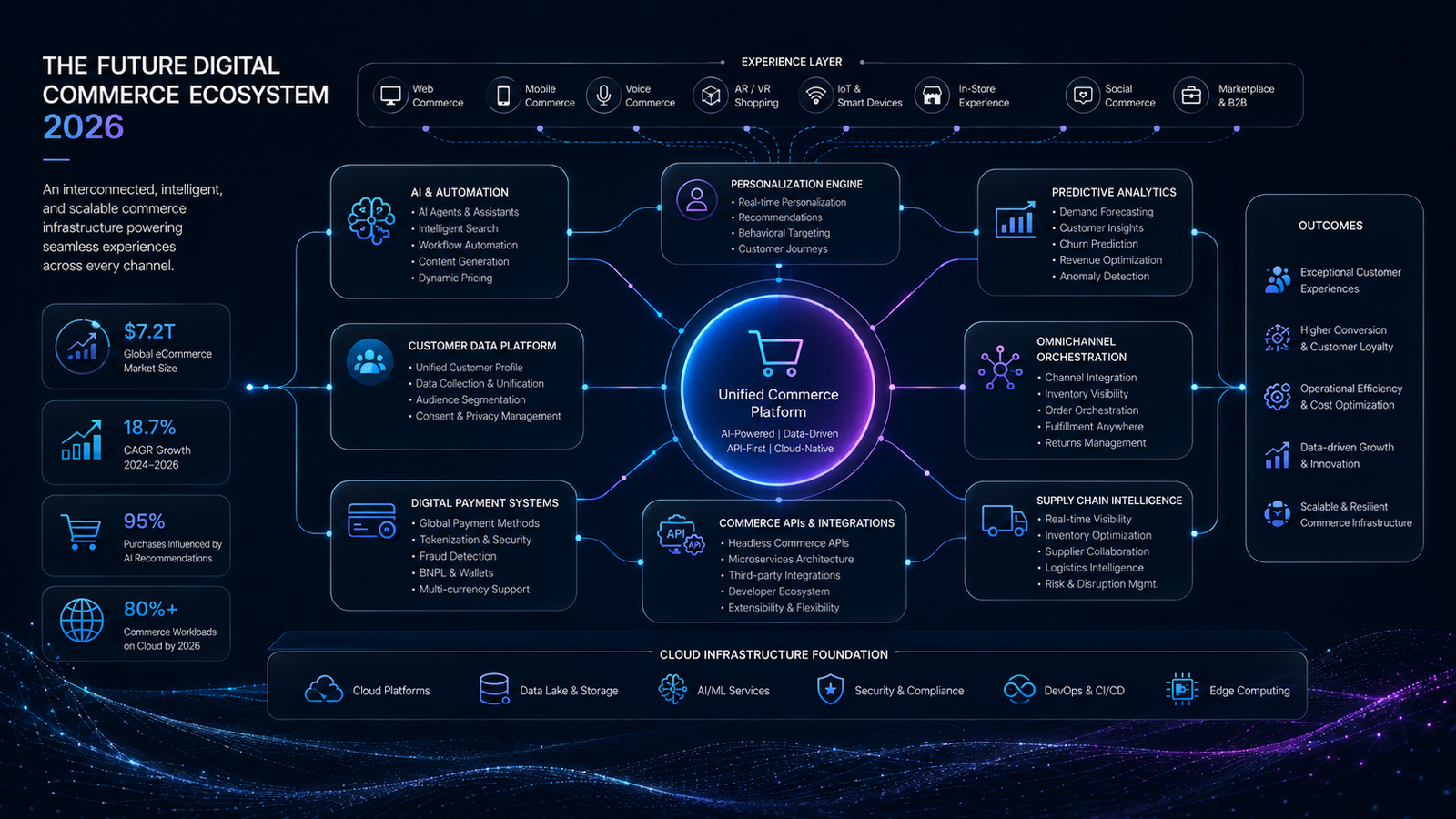
Future Trends Influencing eCommerce Features 2026 Strategies
Several emerging technologies are expected to influence the future of digital commerce over the next few years.
Augmented Reality Shopping
AR experiences are helping customers visualize products before purchase, particularly in furniture, fashion, and industrial equipment sectors.
Voice Commerce
Voice-enabled shopping experiences are becoming more common as smart devices continue to grow in adoption.
Sustainability Tracking
Consumers and enterprise buyers increasingly expect transparency around sustainability practices, sourcing, and environmental impact.
AI-Driven Operations
AI will continue expanding beyond personalization into logistics optimization, pricing automation, and customer service management.
Zero-Party Data Strategies
Businesses are moving toward consent-based customer data collection strategies to improve personalization while respecting privacy regulations.
Key eCommerce Features 2026 Businesses Should Prioritize
Businesses planning digital commerce investments in 2026 should focus on scalable, customer-centric technology ecosystems rather than isolated platform upgrades.
The most important priorities include:
- AI-powered personalization
- Headless and composable commerce
- Mobile-first optimization
- Advanced search functionality
- Integrated analytics
- Secure payment systems
- Omnichannel commerce
- Real-time inventory visibility
Organizations that invest strategically in these eCommerce must-haves will be better positioned to improve customer experience, operational efficiency, and long-term scalability.
FAQs
What are the most important eCommerce features 2026 businesses should prioritize?
The most important eCommerce features 2026 businesses should prioritize include AI personalization, mobile-first design, headless commerce, advanced search functionality, omnichannel integration, secure payment systems, and real-time inventory management.
Why is headless commerce becoming popular?
Headless commerce provides greater flexibility, faster frontend development, improved scalability, and better omnichannel support compared to traditional monolithic platforms.
How does AI improve online store performance?
AI helps improve personalization, automate customer support, optimize search functionality, detect fraud, forecast inventory demand, and enhance operational efficiency.
What security features should eCommerce platforms have in 2026?
Modern platforms should support encryption, PCI compliance, fraud detection, multi-factor authentication, secure API management, and continuous security monitoring.
Why is mobile optimization critical for eCommerce?
Most online shopping activity now happens on mobile devices. Businesses need fast-loading, mobile-friendly experiences to improve conversions and customer satisfaction.
Conclusion
The digital commerce landscape is evolving rapidly, and businesses must adapt to remain competitive. The most effective eCommerce features 2026 strategies focus on customer experience, operational agility, scalability, and security.
Businesses investing in the right eCommerce features 2026 strategies will be better positioned to improve customer experience, operational agility, and long-term revenue growth.
For organizations planning digital transformation initiatives, adopting the right eCommerce features 2026 strategies is no longer simply a technology upgrade. It is a strategic business decision that directly impacts revenue growth, customer loyalty, and long-term competitiveness.