


How to Build an MVP in 2026: A Step-by-Step Guide fo...
Building a successful product no longer requires months of developm...
 Deepak Saini
June 30, 2026
Deepak Saini
June 30, 2026
Building a successful product no longer requires months of development or a massive upfront investment. In 2026, startups have access to powerful development frameworks, AI-assisted tools, and cloud technologies that make it easier than ever to build an MVP. The real challenge isn’t building faster—it’s building the right product.
A Minimum Viable Product (MVP) allows startups to validate ideas, gather real user feedback, and reduce business risk before investing in full-scale development. Instead of launching with dozens of features, successful startups focus on solving one core problem exceptionally well, then improve their product based on real market insights.
This step-by-step guide explains how to build an MVP in 2026, from validating your idea and prioritizing features to estimating development costs, defining timelines, avoiding common mistakes, and preparing for a successful launch. Whether you’re building a SaaS platform, marketplace, mobile app, or custom web application, you’ll learn how to create an MVP that supports long-term business growth.
In 2026, building software is faster than ever. AI-assisted development, low-code platforms, cloud infrastructure, and modern development frameworks have significantly reduced the time required to build an MVP. However, faster development doesn’t guarantee a successful product.
Today, an MVP is more than a simplified version of your final product. It’s a strategic approach to validating a business idea with minimal investment while gathering real feedback from early users. Rather than building every feature at once, startups focus on solving one meaningful problem, measuring user behavior, and improving the product based on real-world insights.
The goal isn’t simply to build an MVP quickly—it’s to build the right MVP. Successful founders validate assumptions before scaling development, reducing business risk and ensuring future investments are guided by customer feedback instead of guesswork.
Founder Tip
The fastest way to fail is building features customers never asked for. Validate the problem first, then build only what’s needed to test your idea.
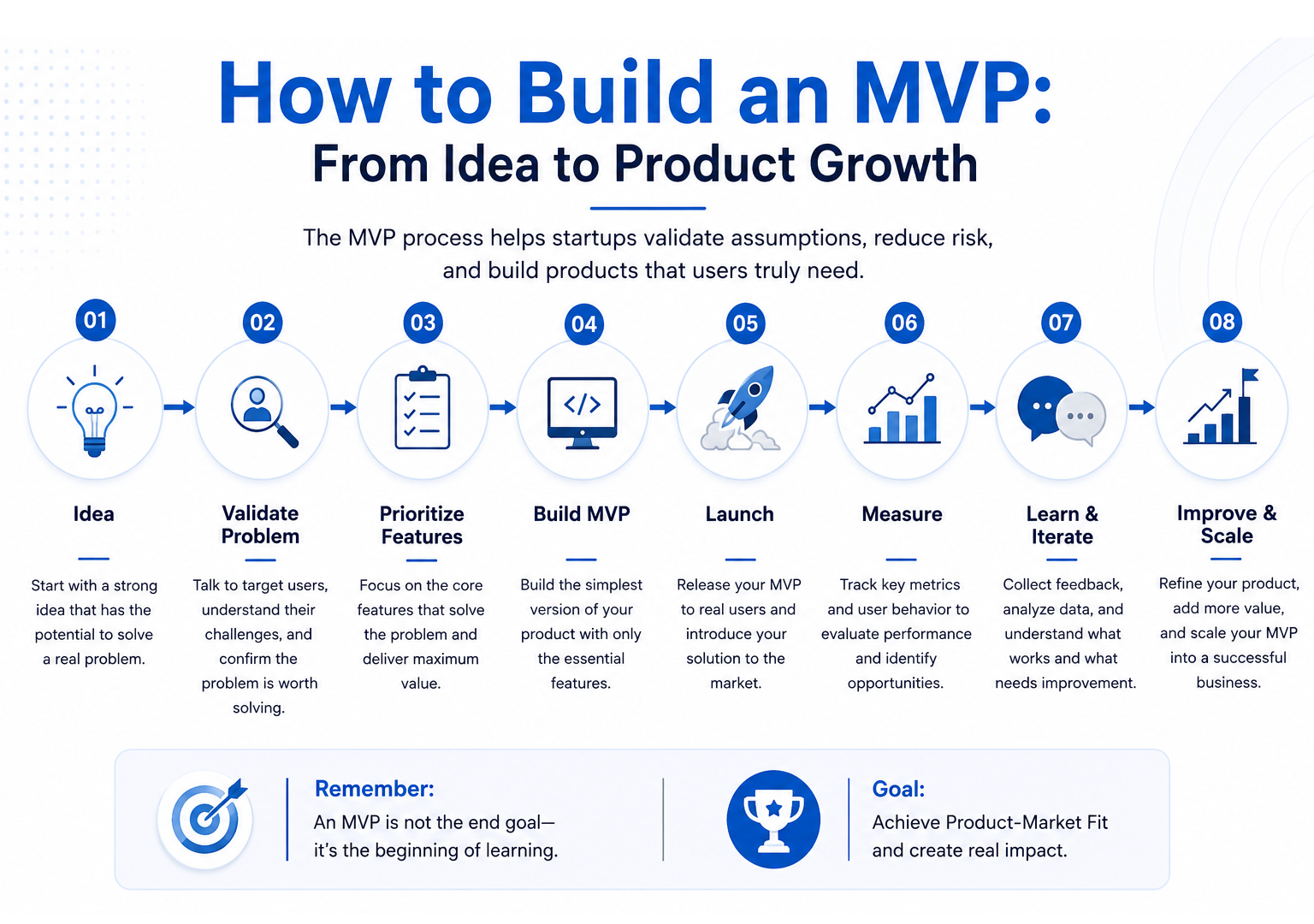
Launching a full-featured product without validating market demand is one of the biggest risks a startup can take. Building an MVP helps founders test their ideas with real users before committing significant time, budget, and development resources to a complete product.
Instead of trying to build every planned feature, an MVP focuses on delivering the smallest version of your product that solves a specific problem. This allows startups to collect meaningful feedback, measure user behavior, and make informed decisions based on real data rather than assumptions.
Beyond reducing development costs, an MVP helps startups identify product-market fit, attract early adopters, demonstrate value to investors, and establish a clear roadmap for future development. The insights gained during the MVP stage often shape the long-term success of the product.
Founder Tip
Investors rarely invest in ideas alone. A validated MVP with real user feedback demonstrates demand, reduces uncertainty, and significantly strengthens your credibility during fundraising.
Building an MVP isn’t simply about launching quickly—it’s about learning quickly. The sooner you validate your assumptions, the sooner you can refine your product, prioritize the right features, and invest confidently in future development.
Before you build an MVP, validate that you’re solving a real problem for a real audience. Many startups fail not because of poor technology, but because they invest months building products that customers never needed in the first place.
Validation doesn’t require a large budget or months of research. It involves understanding your target users, confirming the problem is worth solving, and gathering enough evidence to justify moving into development. The stronger your validation, the lower your business risk.
Expert Insight
The biggest mistake founders make is validating their solution instead of validating the problem. If customers don’t experience the problem strongly enough, even the best-built product will struggle to gain traction.
Validation isn’t a delay to development—it’s one of the smartest investments you can make before you build an MVP. A few days spent testing assumptions can save months of unnecessary development and significantly improve your chances of launching a product that resonates with the market.
Once you’ve validated your idea, it’s time to turn it into a product that users can interact with. Building an MVP is a structured process that balances speed, cost, and functionality while keeping the focus on solving one core problem. Following a clear development roadmap helps startups reduce uncertainty and launch with confidence.
Every successful MVP begins with a clearly defined problem. Rather than trying to solve multiple challenges at once, identify the single most important problem your product will address. A focused value proposition makes development simpler and helps users immediately understand the benefit of your solution.
List every feature you envision, then identify the few that are absolutely necessary for users to achieve the primary goal. Everything else can be scheduled for future releases after gathering user feedback.
Map out how users will navigate your application before development begins. Wireframes help visualize the user experience, identify usability issues early, and reduce costly design changes later in the project.
Select technologies that support your current requirements while allowing your product to scale as your business grows. Your technology stack should align with your budget, timeline, long-term goals, and expected user growth.
Develop the essential features, perform thorough testing, and resolve usability issues before launch. Functional testing, performance testing, and user acceptance testing help ensure a stable experience for early adopters.
Release your MVP to a targeted audience, monitor user behavior, collect feedback, and measure predefined success metrics. The insights gathered after launch should guide future development, helping you prioritize improvements that deliver the greatest business value.
Founder Tip
Launch your MVP when it reliably solves one important problem—not when every planned feature is complete. Early feedback is far more valuable than delayed perfection.
Following a structured MVP development process helps startups move from idea to launch with greater confidence. Once your MVP is live, continuous feedback and iterative improvements become the foundation for building a product that truly meets market needs.
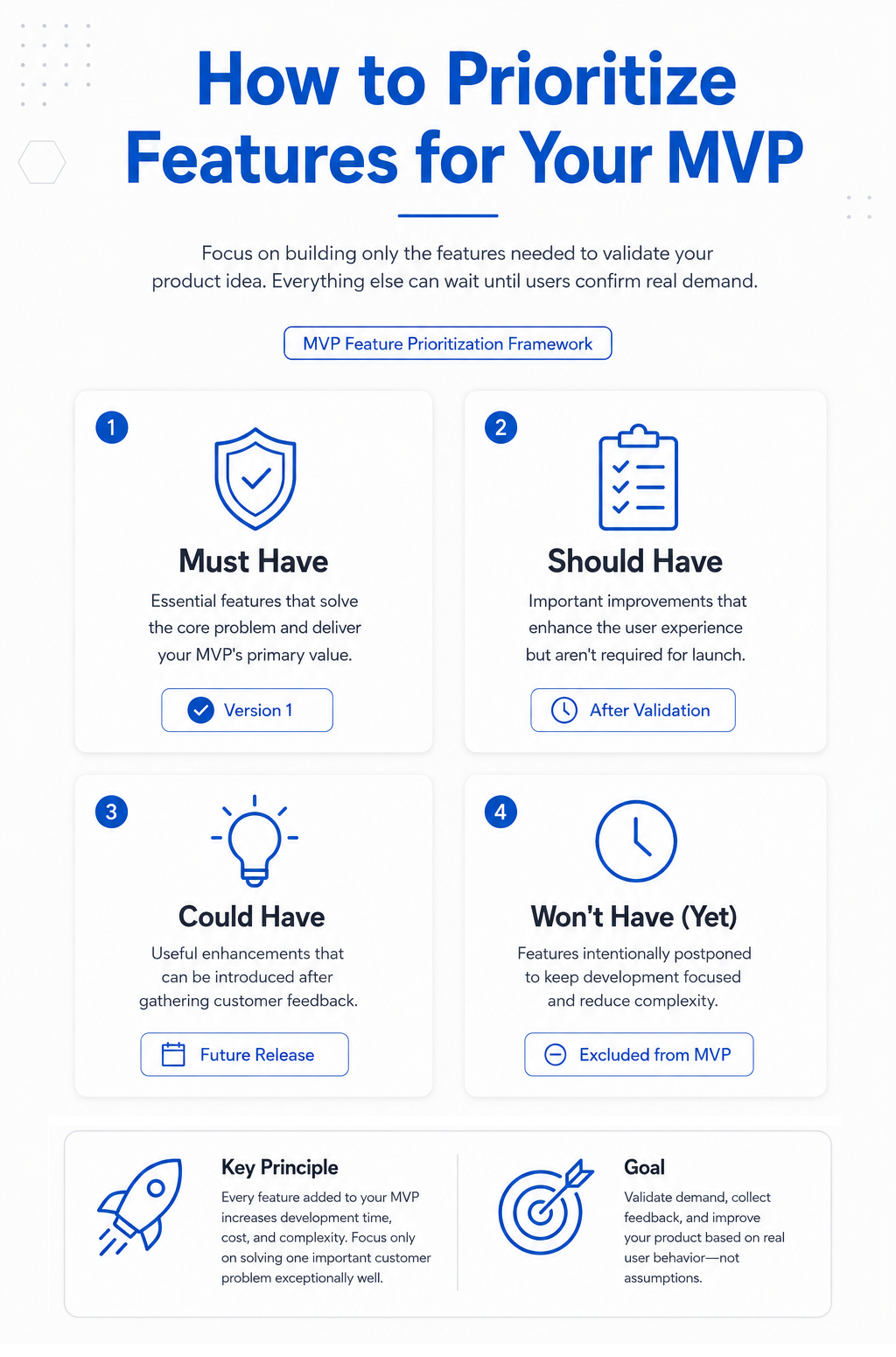
One of the biggest challenges when you build an MVP is deciding what to include in the first release. Founders often have dozens of feature ideas, but trying to build everything at once increases development costs, delays launch, and makes it harder to validate the core concept.
A successful MVP focuses on delivering just enough functionality to solve one important problem. Every feature should contribute directly to that objective. If a feature doesn’t help users achieve the MVP’s primary goal, it’s usually better suited for a future release.
| Priority | Description | Action |
|---|---|---|
| Must Have | Essential features required for the MVP to function and deliver its core value. | Build for Version 1. |
| Should Have | Important features that improve the user experience but aren’t critical for launch. | Add after user validation. |
| Could Have | Nice-to-have enhancements that can wait until later development phases. | Consider for future releases. |
| Won’t Have (Yet) | Features intentionally excluded from the MVP to maintain focus and control scope. | Review after achieving product-market fit. |
Founder Tip
Every feature you remove from your first release saves development time, reduces costs, and gives you faster access to real customer feedback. Simplicity is one of the biggest strengths of a successful MVP.
Feature prioritization isn’t about limiting your vision—it’s about validating it. Once users confirm that your core solution delivers value, you’ll have real data to guide future enhancements instead of relying on assumptions.
The cost to build an MVP in 2026 depends on several factors, including the complexity of your product, the number of features, the technology stack, design requirements, third-party integrations, and the experience of your development team. While every project is unique, understanding the major cost drivers helps startups plan realistic budgets and avoid unexpected expenses.
Rather than focusing on the lowest possible price, founders should evaluate the overall value of their investment. A well-planned MVP that validates a business idea can save significant time and money by reducing rework, preventing unnecessary feature development, and identifying product-market fit earlier.
| MVP Complexity | Estimated Cost (USD) | Typical Examples |
|---|---|---|
| Simple MVP | $10,000–$25,000 | Landing platforms, internal tools, simple marketplaces |
| Medium Complexity MVP | $25,000–$60,000 | SaaS products, customer portals, booking platforms |
| Complex MVP | $60,000–$120,000+ | Healthcare platforms, fintech products, AI-powered applications |
Key Takeaway
The scope of your MVP has a greater impact on cost than the technology itself. Focusing on essential features is one of the most effective ways to control your budget without compromising your product’s core value.
Instead of asking how little an MVP can cost, ask how much validation you need before investing in full-scale development. A focused MVP is designed to reduce uncertainty, not maximize features, making it one of the smartest investments an early-stage startup can make.
Just like development costs, the time required to build an MVP depends on your product’s complexity, feature set, design requirements, and development approach. A well-defined scope allows startups to launch sooner, gather user feedback earlier, and begin improving their product based on real-world usage.
While every project follows its own timeline, most MVPs can be designed, developed, tested, and launched within a few weeks to a few months. The key is maintaining a focused scope and avoiding unnecessary features during the initial release.
| Project Phase | Estimated Duration | Key Activities |
|---|---|---|
| Discovery & Validation | 1–2 Weeks | Research, user interviews, competitor analysis, and defining project goals. |
| Planning & UI/UX Design | 1–2 Weeks | Wireframes, user flows, feature prioritization, and UI/UX design. |
| Development | 3–8 Weeks | Building core features, integrations, and application functionality. |
| Testing & Quality Assurance | 1–2 Weeks | Bug fixes, usability testing, performance optimization, and launch preparation. |
| Launch & Feedback | Ongoing | Release the MVP, monitor user behavior, collect feedback, and plan future iterations. |
Expert Insight
The fastest MVP isn’t always the most successful. Spending an extra week validating requirements or refining the user experience can prevent months of rework after launch.
Many startups underestimate the time required for planning, testing, and user feedback. While development is often the most visible phase, the success of an MVP depends on every stage of the process—from validation and design to post-launch improvements.
Even the best product ideas can struggle if the MVP is built without a clear strategy. While technical challenges are common, the biggest reasons MVPs fail are usually business decisions rather than software development itself. Recognizing these mistakes early can save significant time, budget, and effort.
Many founders believe adding more functionality will make their product more appealing. In reality, an overloaded MVP delays launch, increases development costs, and makes it harder to identify which features truly matter to users.
Founder Tip
If removing a feature doesn’t prevent users from experiencing your product’s core value, it probably doesn’t belong in your first release.
One of the costliest mistakes startups make is investing in development before confirming that customers actually need the solution. Speaking with potential users, researching competitors, and validating demand often reveal valuable insights that influence the final product.
Launching an MVP isn’t the finish line—it’s the beginning of the learning process. The success of an MVP should be measured through customer feedback, engagement, retention, and product usage rather than the number of completed features.
The technology decisions you make today can affect maintenance, scalability, hiring, and future development costs. Selecting a technology stack that supports long-term business goals helps reduce technical debt as your product evolves.
Many startups release an MVP but fail to monitor how users interact with it. Analytics, heatmaps, user sessions, and customer feedback provide valuable data that helps identify usability issues and prioritize future improvements.
Perfection is one of the biggest obstacles to startup success. Delaying launch to add more features often postpones valuable customer feedback and increases the risk of building functionality that users may never need.
Expert Insight
Successful startups don’t launch perfect products—they launch focused products, learn from real users, and improve continuously. The speed of learning often becomes a greater competitive advantage than the speed of development.
Building an MVP is ultimately about reducing uncertainty. By avoiding these common mistakes, startups can launch with greater confidence, validate ideas more effectively, and make better decisions as their product evolves.
Artificial intelligence has transformed how startups build an MVP. Tasks that once required weeks of manual effort—such as generating code, creating wireframes, writing documentation, and testing software—can now be completed much faster using AI-assisted development tools. As a result, startups can reduce development time and accelerate product launches.
However, while AI has made software development more efficient, it hasn’t changed the fundamentals of building a successful product. Customer validation, market research, feature prioritization, and product strategy still require human judgment. AI can help build software faster, but it can’t determine whether people genuinely need what you’re building.
| Development Stage | How AI Helps |
|---|---|
| Product Discovery | Summarizes research, organizes ideas, and assists with competitor analysis. |
| UI/UX Design | Supports wireframing, interface concepts, and design iterations. |
| Development | Generates code suggestions, automates repetitive tasks, and speeds up implementation. |
| Testing | Helps identify bugs, generate test cases, and improve code quality. |
| Documentation | Assists with technical documentation, API references, and project documentation. |
Expert Insight
AI can dramatically reduce development effort, but it can’t replace customer conversations, market validation, or strategic product decisions. The most successful startups combine AI-powered development with continuous user feedback and experienced product thinking.
In 2026, building software is no longer the biggest challenge for startups. Building the right software remains the real competitive advantage. AI should be viewed as a productivity tool that accelerates execution—not as a substitute for product strategy or customer validation.
Before you launch your MVP, take time to review the essentials. A successful launch isn’t measured by the number of features you’ve built—it’s measured by how effectively you collect feedback, validate assumptions, and prepare for future improvements.
| Checklist | Status |
|---|---|
| Clearly define the core problem your MVP solves. | |
| Prioritize only the essential features for Version 1. | |
| Validate your idea with potential customers. | |
| Complete functional, usability, and performance testing. | |
| Set up analytics to measure user behavior and engagement. | |
| Define success metrics before launch. | |
| Establish a process for collecting customer feedback. | |
| Prepare a roadmap for post-launch improvements. |
Key Takeaway
Launching your MVP isn’t the finish line—it’s the beginning of your product’s learning journey. The most valuable insights come from real users after launch, not assumptions made before development.
If you’ve completed the checklist above, you’re in a strong position to launch your MVP with confidence. Continue monitoring user feedback, measuring performance, and refining your product based on real-world insights. Consistent iteration is what transforms an MVP into a successful, scalable product.
Launching your MVP is an important milestone, but it’s not the ultimate measure of success. A successful MVP isn’t defined by how many features it includes or how quickly it was developed. Instead, its purpose is to validate assumptions, gather actionable feedback, and determine whether your product solves a meaningful problem for its target audience.
Rather than focusing on vanity metrics such as downloads or website visits, startups should monitor indicators that reflect genuine user engagement and business potential. These insights help determine whether to iterate, pivot, or confidently invest in the next phase of product development.
| Metric | Why It Matters |
|---|---|
| User Sign-ups | Measures initial market interest and validates demand for your product. |
| Active Users | Shows whether users continue engaging with your MVP after signing up. |
| Retention Rate | Indicates whether your product provides ongoing value instead of one-time curiosity. |
| Customer Feedback | Reveals usability issues, feature requests, and opportunities for improvement. |
| Conversion Rate | Measures how effectively users complete your desired actions, such as registrations, subscriptions, or purchases. |
| Feature Usage | Identifies which features customers actually use, helping prioritize future development. |
No single metric determines whether an MVP has succeeded. Instead, founders should evaluate multiple indicators together to understand user behavior, validate product-market fit, and identify the next set of improvements.
Expert Insight
Don’t celebrate downloads alone. Celebrate returning users, meaningful engagement, and customer feedback. These are the signals that indicate your MVP is solving a real problem and moving closer to product-market fit.
The first version of your product should answer one critical question: Are we building something people genuinely want? If the answer is yes, you have the confidence to expand your product strategically. If not, the insights you’ve gathered allow you to refine your direction before investing in large-scale development.
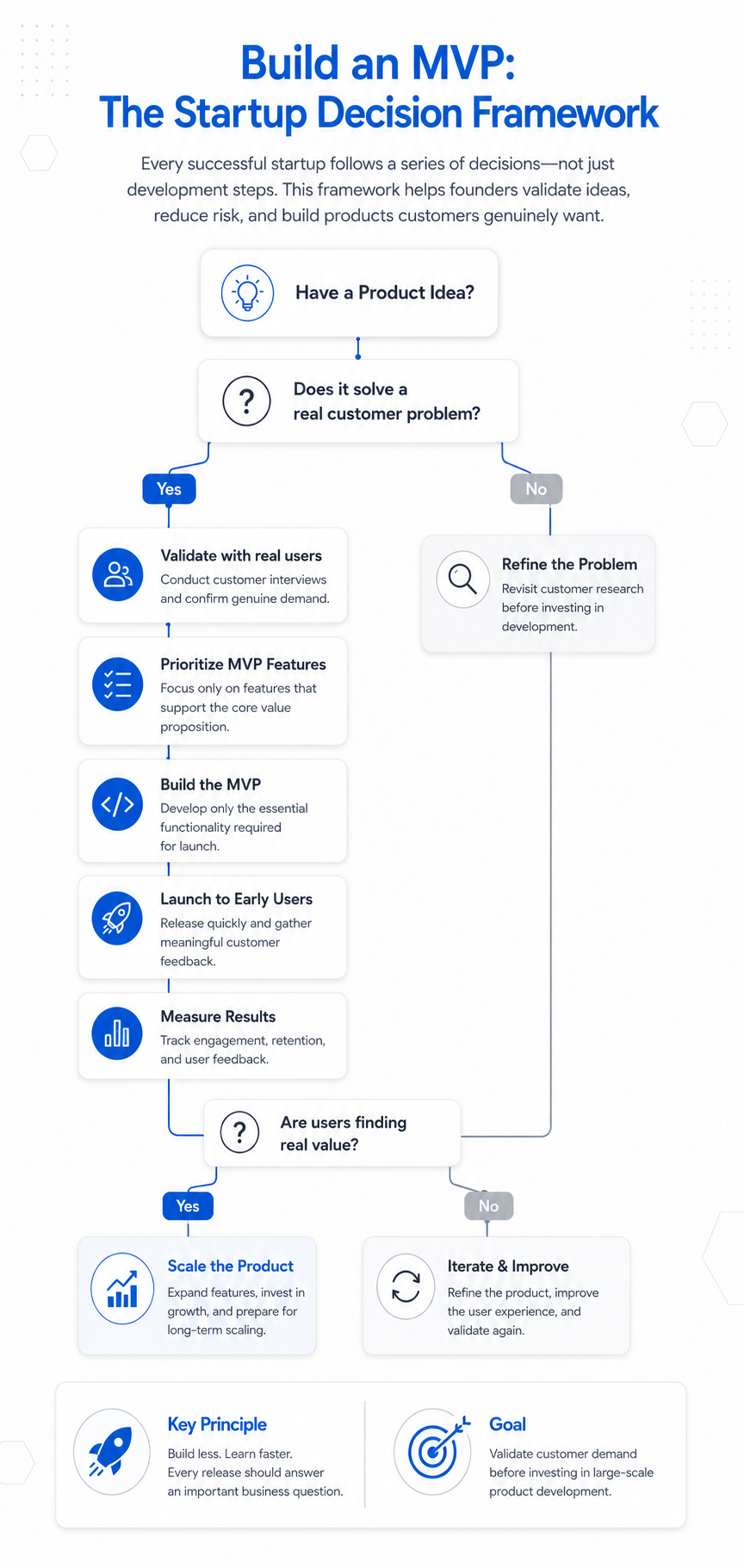
Building a successful startup isn’t about launching with the most features—it’s about solving the right problem for the right audience. A well-planned MVP gives you the opportunity to validate your idea, reduce development risk, gather meaningful user feedback, and make smarter product decisions before investing in full-scale development.
While modern technologies and AI-assisted development have made it faster than ever to build an MVP, speed alone doesn’t guarantee success. The startups that succeed are those that validate early, learn continuously, and improve their products based on real customer insights rather than assumptions.
Whether you’re building a SaaS platform, marketplace, mobile application, or custom web solution, your MVP should be viewed as the beginning of your product journey—not the finished product. Every iteration brings you closer to product-market fit and long-term business growth.
Turn your idea into a market-ready product with expert MVP development guidance.

Most MVPs can be planned, designed, developed, and launched within 6 to 12 weeks, depending on the product’s complexity, feature set, design requirements, and development resources. Projects with a well-defined scope generally reach the market faster than those with evolving requirements.
MVP development costs vary based on the project’s scope, technology stack, integrations, and overall complexity. While simple MVPs typically require a smaller investment, more advanced SaaS platforms, healthcare solutions, or AI-powered applications require larger development budgets. Prioritizing essential features is one of the most effective ways to control costs.
An MVP should include only the features required to solve one primary problem for your target users. Every feature should support the core value proposition, while additional functionality can be introduced after gathering user feedback and validating market demand.
Yes. AI-assisted development can accelerate tasks such as coding, wireframing, testing, documentation, and prototyping. However, AI cannot replace customer validation, product strategy, or market research. Successful MVPs still depend on understanding real user needs and making informed business decisions.
In most cases, yes. Building an MVP allows startups to validate ideas, reduce development risk, collect user feedback, and identify product-market fit before investing in a complete product. This approach helps businesses make better decisions while minimizing unnecessary development costs.
Look for a development partner with experience building startup products, validating ideas, prioritizing features, and scaling applications beyond the MVP stage. A strong partner should focus on your business goals as much as your technical requirements, helping you build a product that supports long-term growth.

Deepak Saini
Deepak Saini is the CEO of Nascenture, a technology company focused on building scalable digital solutions. With a strong interest in AI, blockchain, and emerging technologies, he helps businesses leverage innovation to drive growth, efficiency, and competitive advantage. He regularly shares insights on software development, automation, and future-ready tech strategies.
How to Build an MVP in 2026: A Step-by-Step Guide fo...
Building a successful product no longer requires months of developm...
React vs. Angular vs. Vue: Which Frontend Framework ...
Choosing between React vs Angular vs Vue isn't jus...

Software Solutions for Logistics Companies: Logistic...
Logistics software development is becom...