


How to Build an MVP in 2026: A Step-by-Step Guide fo...
Building a successful product no longer requires months of developm...
 Deepak Saini
June 30, 2026
Deepak Saini
June 30, 2026
Choosing between React vs Angular vs Vue isn’t just a technical decision—it can influence your project’s development speed, long-term costs, scalability, and future growth. Whether you’re building a SaaS platform, enterprise application, customer portal, or eCommerce website, selecting the right frontend framework from the beginning can save significant time, money, and development effort.
Each framework offers distinct strengths, but the right choice depends on your business goals, budget, project complexity, and long-term vision—rather than popularity alone.
In this guide, we’ll compare React vs Angular vs Vue from a business perspective, helping you understand where each framework excels and which one best supports your business goals.
Choosing a frontend framework directly affects your project’s success. The right choice can accelerate development, simplify future enhancements, reduce maintenance costs, and make it easier to scale your application as your business grows.
Before making a decision, consider these key business factors:
With these factors in mind, let’s compare React vs Angular vs Vue side by side.
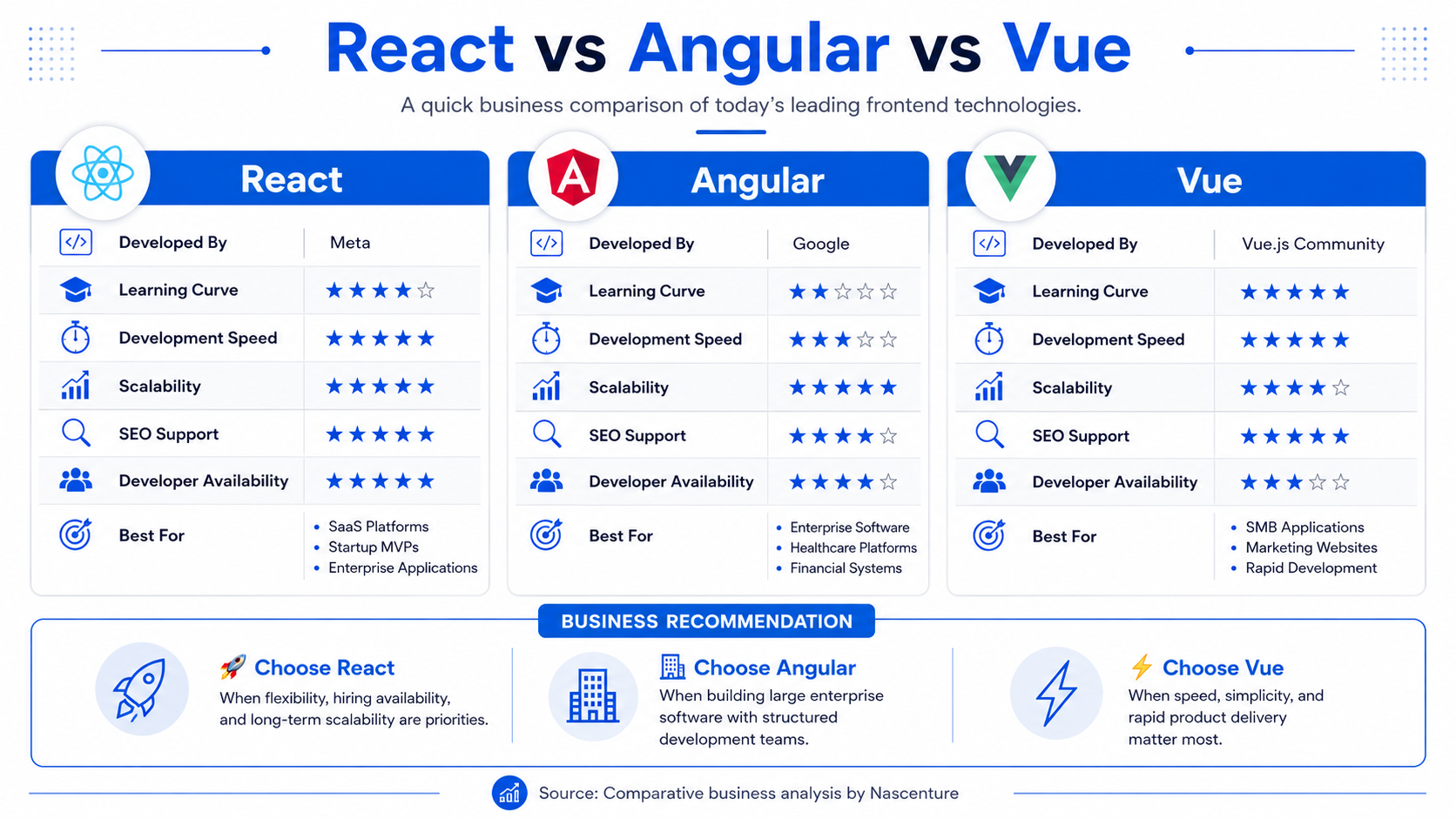
If you’re looking for a quick overview before exploring each framework in detail, the table below highlights their key differences.
| Criteria | React | Angular | Vue |
|---|---|---|---|
| Developed By | Meta (Facebook) | Vue.js Community | |
| Type | Frontend Library | Frontend Framework | Progressive Frontend Framework |
| Learning Curve | Moderate | Steep | Beginner-Friendly |
| Development Speed | Fast | Moderate | Fast |
| Scalability | Excellent | Excellent | Very Good |
| Best Suited For | SaaS, Startups, Enterprise Applications | Large Enterprise Platforms & Complex Applications | SMBs, Startup Products & Business Applications |
Each framework has unique strengths. In the following sections, we’ll examine React, Angular, and Vue individually before comparing them across performance, scalability, development costs, hiring, SEO, maintenance, and real-world business scenarios.
React is an open-source JavaScript library developed by Meta (formerly Facebook) for building interactive user interfaces. Its component-based architecture enables developers to create reusable interface elements, making applications easier to maintain, expand, and update as business requirements evolve.
For businesses, React offers an excellent balance of flexibility, scalability, and developer availability. Its extensive ecosystem and global community make it a popular choice for everything from startup MVPs to large enterprise applications supported by professional React JS development.
React provides significant flexibility, but it often relies on additional libraries for routing, state management, and other advanced functionality. While this gives development teams greater freedom, it also requires thoughtful architectural planning for larger projects.
Angular is a comprehensive frontend framework developed and maintained by Google. It includes many built-in capabilities required for large-scale application development, such as routing, dependency injection, testing utilities, and state management support.
Its structured architecture encourages consistency across large development teams, making Angular a preferred choice for enterprise software, financial platforms, healthcare systems, and other complex business applications.
Angular’s comprehensive feature set comes with a steeper learning curve than React and Vue. However, for organizations building complex applications that require long-term maintainability, its structured approach often becomes a significant advantage.
Vue is an open-source progressive JavaScript framework designed to simplify frontend development while delivering excellent performance and flexibility. Its approachable learning curve makes it easy for development teams to build modern web applications quickly.
Vue offers an effective balance of simplicity, flexibility, and performance, making it an attractive option for businesses seeking rapid development without unnecessary complexity.
Although Vue has a strong and growing community, its enterprise adoption and developer ecosystem remain smaller than React and Angular. Businesses seeking rapid application delivery can benefit from experienced Vue JS development.
Now that we’ve introduced each framework, let’s compare React vs Angular vs Vue across the factors that matter most to businesses, including performance, scalability, development speed, hiring, SEO, maintenance, and long-term costs.
When comparing React vs Angular vs Vue, the real difference isn’t whether they can build modern web applications—they all can. The difference lies in how they impact development speed, scalability, hiring, maintenance, and long-term business success.
Faster development means quicker product launches, shorter feedback cycles, and lower initial development costs.
| Framework | Development Speed | Business Impact |
|---|---|---|
| React | ★★★★★ | Fast development supported by a mature ecosystem and reusable components. |
| Angular | ★★★☆☆ | Longer setup but highly efficient for large, structured applications. |
| Vue | ★★★★★ | Quick to learn and ideal for rapid application development. |
Business Takeaway
If launching quickly is your priority, React and Vue generally provide faster development cycles. Angular requires more upfront planning but often delivers greater consistency for large enterprise projects with long-term roadmaps.
Your frontend framework should support growing users, expanding feature sets, and larger development teams without requiring major redevelopment.
| Framework | Scalability | Business Impact |
|---|---|---|
| React | ★★★★★ | Excellent for startups expecting rapid growth as well as enterprise-scale applications. |
| Angular | ★★★★★ | Designed to manage complex applications developed by multiple teams. |
| Vue | ★★★★☆ | Scales well for most business applications but is less common in very large enterprise environments. |
Business Takeaway
React and Angular are strong choices for organizations planning long-term growth or complex digital products. Vue offers excellent scalability for most startups and small to medium-sized businesses while keeping development straightforward.
Development speed and scalability are only part of the picture. Next, we’ll compare React vs Angular vs Vue across performance, learning curve, hiring availability, SEO, security, and long-term maintenance to help you make a confident business decision.
Choosing the right frontend framework isn’t just about technology—it’s also about the people who will build, maintain, and expand your application. Factors such as the learning curve, developer availability, and community support can significantly influence development timelines, hiring costs, and long-term project success.
A framework that’s easier to learn can reduce onboarding time, accelerate development, and help new team members become productive more quickly.
| Framework | Learning Curve | Business Impact |
|---|---|---|
| React | ★★★★☆ | Moderate learning curve with extensive learning resources and community support. |
| Angular | ★★☆☆☆ | Steeper learning curve due to its comprehensive architecture and TypeScript-first approach. |
| Vue | ★★★★★ | Easy to learn, making it ideal for smaller teams and rapid onboarding. |
Business Takeaway
Vue is generally the easiest framework for new developers to learn, while React strikes a strong balance between flexibility and ease of adoption. Angular requires more training initially but rewards larger teams with greater consistency over time.
Hiring experienced developers is often overlooked during technology selection. Choosing a framework with a larger talent pool can simplify recruitment, reduce hiring costs, and support future team expansion.
| Framework | Developer Availability | Business Impact |
|---|---|---|
| React | ★★★★★ | Largest global developer community with excellent hiring availability. |
| Angular | ★★★★☆ | Strong enterprise talent pool, particularly for large-scale business applications. |
| Vue | ★★★☆☆ | Growing community but a comparatively smaller hiring pool in many regions. |
Business Takeaway
React offers the broadest hiring market, making it easier to scale development teams over time. Angular also has strong enterprise adoption, while Vue’s developer community continues to grow but remains comparatively smaller.
A mature ecosystem gives development teams access to reliable tools, documentation, integrations, and ongoing community support, helping reduce development effort and accelerate feature delivery.
| Framework | Community & Ecosystem | Business Impact |
|---|---|---|
| React | ★★★★★ | Extensive ecosystem with broad third-party support and frequent innovation. |
| Angular | ★★★★★ | Comprehensive official tooling backed by Google and a mature enterprise ecosystem. |
| Vue | ★★★★☆ | Active community with a growing ecosystem suitable for most business applications. |
Business Takeaway
All three frameworks have healthy communities. React stands out for its vast ecosystem, Angular excels with its structured enterprise tooling, and Vue offers an increasingly mature ecosystem that supports rapid application development.
Technology selection doesn’t end with your development team. Next, we’ll compare React vs Angular vs Vue across SEO, security, and long-term maintenance to understand how each framework supports your business well beyond the initial launch.
Launching your application is only the beginning. Over the years, your frontend framework will influence search visibility, software maintenance, security updates, and your ability to introduce new features efficiently. Choosing the right technology today can reduce long-term costs while supporting sustainable business growth.
If your business relies on organic traffic, choosing a frontend framework that supports search engine optimization (SEO) is essential. Modern rendering techniques allow React, Angular, and Vue applications to achieve excellent SEO performance when implemented correctly.
| Framework | SEO Support | Business Impact |
|---|---|---|
| React | ★★★★★ | Excellent SEO capabilities when paired with modern frameworks such as Next.js. |
| Angular | ★★★★☆ | Strong SEO support through server-side rendering, though implementation can be more involved. |
| Vue | ★★★★★ | Excellent SEO performance using modern frameworks such as Nuxt. |
Business Takeaway
All three frameworks can achieve excellent SEO results when implemented correctly. The framework itself is rarely the deciding factor—your development approach, rendering strategy, site performance, and content quality have a much greater impact on long-term search visibility.
Security depends not only on the framework but also on development practices, regular updates, secure coding standards, and ongoing maintenance. Choosing a mature framework with active community support helps organizations respond more effectively to emerging security challenges.
| Framework | Security | Business Impact |
|---|---|---|
| React | ★★★★★ | Strong security when following recommended development practices. |
| Angular | ★★★★★ | Includes several built-in security features suitable for enterprise applications. |
| Vue | ★★★★☆ | Secure framework with active community maintenance and regular updates. |
Business Takeaway
No framework can guarantee security on its own. A secure application depends on experienced developers, secure coding practices, timely updates, and regular security testing throughout the software lifecycle.
Business applications continue evolving long after launch. New features, integrations, compliance requirements, and user expectations all require ongoing updates. A framework that supports maintainability can significantly reduce technical debt and future development costs.
| Framework | Long-Term Maintenance | Business Impact |
|---|---|---|
| React | ★★★★★ | Highly maintainable with proper architecture and modular development practices. |
| Angular | ★★★★★ | Excellent maintainability for large enterprise projects due to its structured architecture. |
| Vue | ★★★★☆ | Easy to maintain for small and medium-sized applications with straightforward code organization. |
Business Takeaway
React and Angular are excellent long-term investments for organizations planning continuous product evolution. Vue also offers strong maintainability, particularly for startups and growing businesses that value simplicity and rapid development.
At this point, it’s clear that each framework has strengths in different areas. The next step is understanding which one best aligns with your business model, industry, and long-term objectives.
If you’re looking for a quick summary, the scorecard below compares React, Angular, and Vue across the factors that matter most when selecting a frontend framework for your business.
| Evaluation Criteria | React | Angular | Vue |
|---|---|---|---|
| Development Speed | 9.5/10 | 7.5/10 | 9/10 |
| Scalability | 9.5/10 | 10/10 | 8.5/10 |
| Developer Availability | 10/10 | 8.5/10 | 7.5/10 |
| Learning Curve | 8.5/10 | 7/10 | 10/10 |
| SEO Support | 9.5/10 | 9/10 | 9.5/10 |
| Long-Term Maintenance | 9/10 | 9.5/10 | 8.5/10 |
| Enterprise Readiness | 9/10 | 10/10 | 8/10 |
| Overall Business Flexibility | 9.5/10 | 9/10 | 8.8/10 |
Business Takeaway
React provides the strongest balance of flexibility, scalability, developer availability, and ecosystem support, making it an excellent choice for many modern business applications. Angular excels in large enterprise environments, while Vue remains a compelling option for startups and small to medium-sized businesses seeking rapid development.
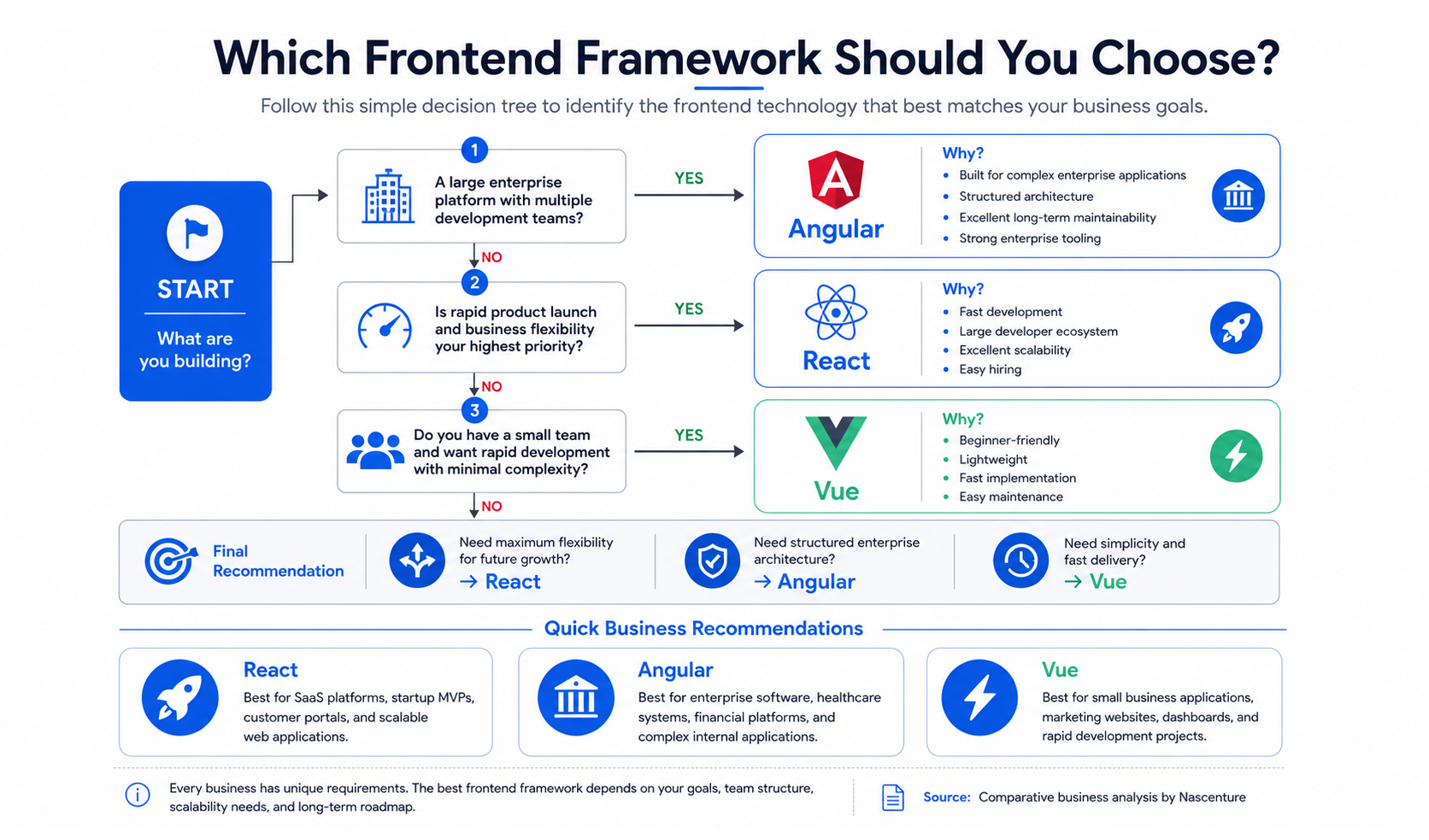
When comparing React vs Angular vs Vue, development cost is one of the biggest considerations for businesses investing in custom software development. However, the initial development budget tells only part of the story. Businesses should also consider developer availability, implementation complexity, ongoing maintenance, future enhancements, and the total cost of ownership over the application’s lifecycle.
Although React, Angular, and Vue can all be used to build high-quality web applications, the overall investment varies depending on the project’s complexity, team size, and long-term business objectives.
| Cost Factor | React | Angular | Vue |
|---|---|---|---|
| Initial Development | ★★★★☆ | ★★★☆☆ | ★★★★★ |
| Development Speed | ★★★★★ | ★★★☆☆ | ★★★★★ |
| Developer Availability | ★★★★★ | ★★★★☆ | ★★★☆☆ |
| Long-Term Maintenance | ★★★★☆ | ★★★★★ | ★★★★☆ |
| Total Cost of Ownership | ★★★★★ | ★★★★☆ | ★★★★☆ |
Business Takeaway
React often provides the strongest balance between development speed, hiring availability, and long-term scalability, making it a cost-effective choice for many businesses. Angular may involve a higher upfront investment because of its learning curve and structured architecture, but it can reduce maintenance costs for large enterprise applications. Vue typically enables rapid development for smaller projects, although hiring experienced Vue developers may be more challenging in some markets.
One of the most common mistakes businesses make is selecting a framework based solely on the lowest initial development cost. In reality, long-term maintenance, developer availability, scalability, and future feature requirements usually have a much greater impact on the total return on investment. A slightly higher upfront investment can often save significant time and money over the lifetime of your application.
Rather than focusing only on the initial development budget, evaluate the total cost of ownership over the next three to five years. Maintenance, feature enhancements, developer recruitment, infrastructure, and future scalability often have a greater financial impact than the initial development phase.
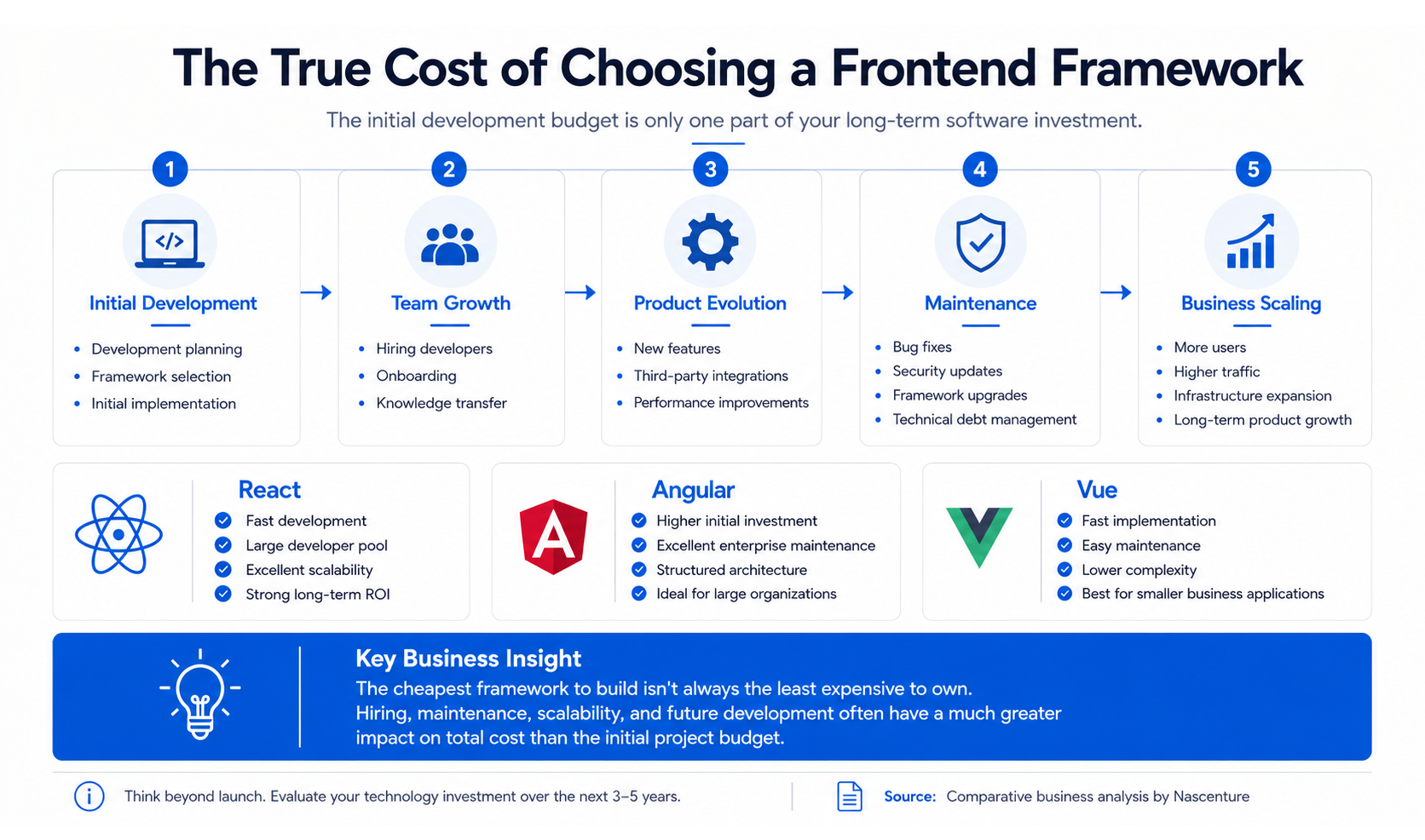
After comparing React vs Angular vs Vue across performance, scalability, hiring, maintenance, and cost, one thing becomes clear—there is no universal winner. The best choice depends on your business goals, project complexity, team structure, and long-term growth plans.
| If You’re Building… | Recommended Framework | Why |
|---|---|---|
| Startup MVP | React | Fast development, excellent hiring availability, and a large ecosystem for future growth. |
| SaaS Platform | React | Balances scalability, flexibility, and long-term maintainability. |
| Enterprise Business Software | Angular | Structured architecture supports large teams and complex applications. |
| Healthcare Platform | Angular | Well suited for complex workflows, compliance-focused development, and long-term maintenance. |
| Financial Services Application | Angular | Strong architecture and built-in capabilities support enterprise-grade systems. |
| eCommerce Platform | React | Excellent user experience, performance, and ecosystem support. |
| Internal Business Dashboard | React or Angular | React suits flexible dashboards with frequent UI updates, while Angular is ideal for complex dashboards used across large teams. |
| Marketing Website | Vue | Fast to develop, lightweight, and well suited for content-driven websites. |
| Small Business Web Application | Vue | Provides rapid development with lower implementation complexity. |
Business Takeaway
Choose React if you want maximum flexibility and future scalability. Choose Angular if you’re building a complex enterprise platform with a large development team. Choose Vue if your priority is rapid development for a small to medium-sized application with straightforward requirements.
Even with the right framework, poor planning can lead to unnecessary costs, delayed launches, and long-term technical challenges. Before making a final decision, it’s worth understanding the common mistakes businesses make during framework selection.
Choosing between React, Angular, and Vue isn’t about selecting the most popular framework—it’s about choosing the technology that best supports your business goals. Every project has different priorities, and the right decision should balance technical requirements with long-term business value.
Before recommending a frontend framework, experienced development teams evaluate several factors that influence the success of the project—not just the first release, but the application’s entire lifecycle.
| Evaluation Factor | Why It Matters |
|---|---|
| Business Goals | Ensures the chosen framework supports your long-term product vision and growth strategy. |
| Project Complexity | Simple applications and enterprise platforms require different architectural approaches. |
| Development Timeline | Projects with aggressive launch schedules may benefit from faster development cycles. |
| Budget | The best decision balances upfront investment with long-term return on investment. |
| Team Size | Larger development teams often benefit from more structured development frameworks. |
| Future Scalability | Your framework should support new features, additional users, and evolving business requirements. |
| Hiring Strategy | Access to experienced developers affects future maintenance and business growth. |
One of the biggest misconceptions is that every business should use the same frontend framework. In practice, the right choice depends on your objectives, technical requirements, available resources, and long-term roadmap. A framework that works perfectly for a startup MVP may not be the right fit for a large enterprise platform—and vice versa.
At Nascenture, technology recommendations are driven by business outcomes rather than personal preferences or industry trends. We evaluate your goals, scalability requirements, timeline, budget, and future growth plans to recommend a frontend framework that supports both your immediate objectives and long-term success.
Business Takeaway
Choose a frontend framework based on where your business is heading—not just where it is today. A well-informed technology decision reduces future redevelopment, simplifies maintenance, and creates a stronger foundation for long-term growth.
Once you’ve selected the right framework, avoiding common implementation mistakes becomes equally important. Let’s look at the most common pitfalls businesses encounter during the framework selection process.
Selecting a frontend framework is a long-term business decision, not just a technical one. While React, Angular, and Vue are all capable technologies, choosing the wrong framework for your specific goals can lead to increased costs, slower development, and unnecessary technical challenges.
Many businesses assume the most popular framework is automatically the best choice. In reality, the right framework depends on your project’s complexity, business goals, budget, and long-term plans—not industry popularity.
Choose the framework that aligns with your business objectives rather than simply following market trends.
Building an application is only the beginning. Future updates, feature enhancements, integrations, and security improvements should all influence your technology decision.
Consider the total cost of ownership over the next three to five years, not just the initial development cost.
As your application evolves, you’ll likely need additional developers. Choosing a framework with a healthy talent pool can simplify recruitment and reduce hiring costs over time.
Think beyond your first development team. Choose a technology that supports future business growth.
A framework that works well for a simple application today may become limiting as your business expands. Consider expected user growth, additional features, integrations, and future scalability from the beginning.
Select a framework that can support both your current needs and your long-term product roadmap.
Business leaders shouldn’t have to choose a frontend framework based solely on online comparisons. An experienced development partner can evaluate your goals, technical requirements, budget, and timeline before recommending the most suitable technology.
The best framework isn’t the one with the most features—it’s the one that delivers the best outcome for your business.
Before finalizing your technology stack, ask your development team these important questions:
Business Takeaway
A good development partner doesn’t recommend the same technology for every project. They recommend the framework that best aligns with your business objectives, technical requirements, and long-term growth strategy.
Choosing between React vs Angular vs Vue isn’t about finding a universal winner. Each framework excels in different business scenarios, and the right choice depends on your project’s goals, team structure, scalability requirements, and long-term vision.
For many businesses, React offers the best balance of flexibility, scalability, developer availability, and ecosystem support for modern web development projects. Angular remains a strong choice for large enterprise applications that require structure and long-term maintainability, while Vue excels in projects that prioritize simplicity, rapid development, and ease of adoption.
The best frontend framework isn’t the one with the most features—it’s the one that helps your business launch faster, scale confidently, and continue delivering value as your needs evolve. By aligning your technology choice with your long-term business strategy, you’ll create a stronger foundation for sustainable growth.
Get expert guidance to choose the best technology for your business goals.

React is often the preferred choice for startups because of its flexibility, large developer community, and extensive ecosystem. It allows businesses to launch quickly, scale efficiently, and hire experienced developers more easily as their products grow. Vue is also a strong option for startups seeking rapid development with a simpler learning curve.
Yes. Angular remains one of the leading frontend frameworks for enterprise applications. Its structured architecture, built-in development tools, and long-term maintainability make it well suited for large-scale business software, government platforms, healthcare systems, and financial applications.
Vue can support enterprise applications, but it is more commonly chosen for small to medium-sized projects and startups. For highly complex enterprise environments with large development teams, organizations often prefer React or Angular because of their broader enterprise adoption and larger talent pools.
React generally has the largest global developer community, making it easier to recruit experienced developers and scale teams. Angular also has strong enterprise adoption, while Vue’s talent pool continues to grow but is comparatively smaller in many regions.
Yes, but not as much as many businesses assume. React, Angular, and Vue can all support excellent SEO when implemented using modern rendering techniques and performance best practices. Factors such as page speed, content quality, site architecture, and technical SEO typically have a greater influence on search visibility.
Start by evaluating your business goals, project complexity, expected growth, budget, and development timeline. React is often the best all-round choice for flexibility and scalability, Angular is ideal for complex enterprise systems, and Vue is well suited for smaller projects that prioritize simplicity and rapid development. If you’re unsure, consult an experienced development partner who can recommend the most suitable technology based on your specific requirements.

Deepak Saini
Deepak Saini is the CEO of Nascenture, a technology company focused on building scalable digital solutions. With a strong interest in AI, blockchain, and emerging technologies, he helps businesses leverage innovation to drive growth, efficiency, and competitive advantage. He regularly shares insights on software development, automation, and future-ready tech strategies.
How to Build an MVP in 2026: A Step-by-Step Guide fo...
Building a successful product no longer requires months of developm...
React vs. Angular vs. Vue: Which Frontend Framework ...
Choosing between React vs Angular vs Vue isn't jus...

Software Solutions for Logistics Companies: Logistic...
Logistics software development is becom...