


How to Choose a Web Development Company in Houston &...
Choosing the wrong web development company in Houston can cost your...
 Deepak Saini
March 23, 2026
Deepak Saini
March 23, 2026

Choosing the wrong web development company in Houston can cost your business more than just money. It can slow down growth, reduce conversions, and leave you with a website that fails to perform when it matters most.
Understanding how to choose a web development company in Houston starts with one mindset shift: treat your website as a business asset, not just a digital brochure. A high-performing website should generate leads, build trust, and support your long-term growth.
Yet many Houston businesses make the same costly mistake of choosing a web development partner based on price alone. The result is usually a site that looks acceptable but fails to perform where it matters, leading to missed opportunities and a costly rebuild within months.
Working with the right web development partner ensures your site is fast, scalable, and built around your actual business goals. This includes optimizing for search engine visibility, user experience, and long-term performance.
This guide will help you evaluate web development companies in Houston, understand realistic costs, and choose a partner that delivers measurable business results.
A website is not just a deliverable. It is a business asset. The right strategy, clean development, and ongoing optimization determine how well it performs.
The company you choose directly affects how your site ranks on Google based on Google’s ranking factors, how it converts visitors into leads, and how well it scales as your business grows.
Houston is a highly competitive, industry-driven market. A local web development company understands this better than a generic vendor. They know the competitive landscape across industries like oil and gas, commercial real estate, healthcare, and legal services.
This insight shapes your website strategy, your content, and your local SEO structure. Without Houston market experience, a vendor may deliver a functional site, but it will likely struggle to attract and convert local customers.
The financial stakes are real. Choosing the wrong partner does not just affect your initial budget. It leads to months of underperformance, rebuilding costs, and lost business to competitors with stronger digital presence.
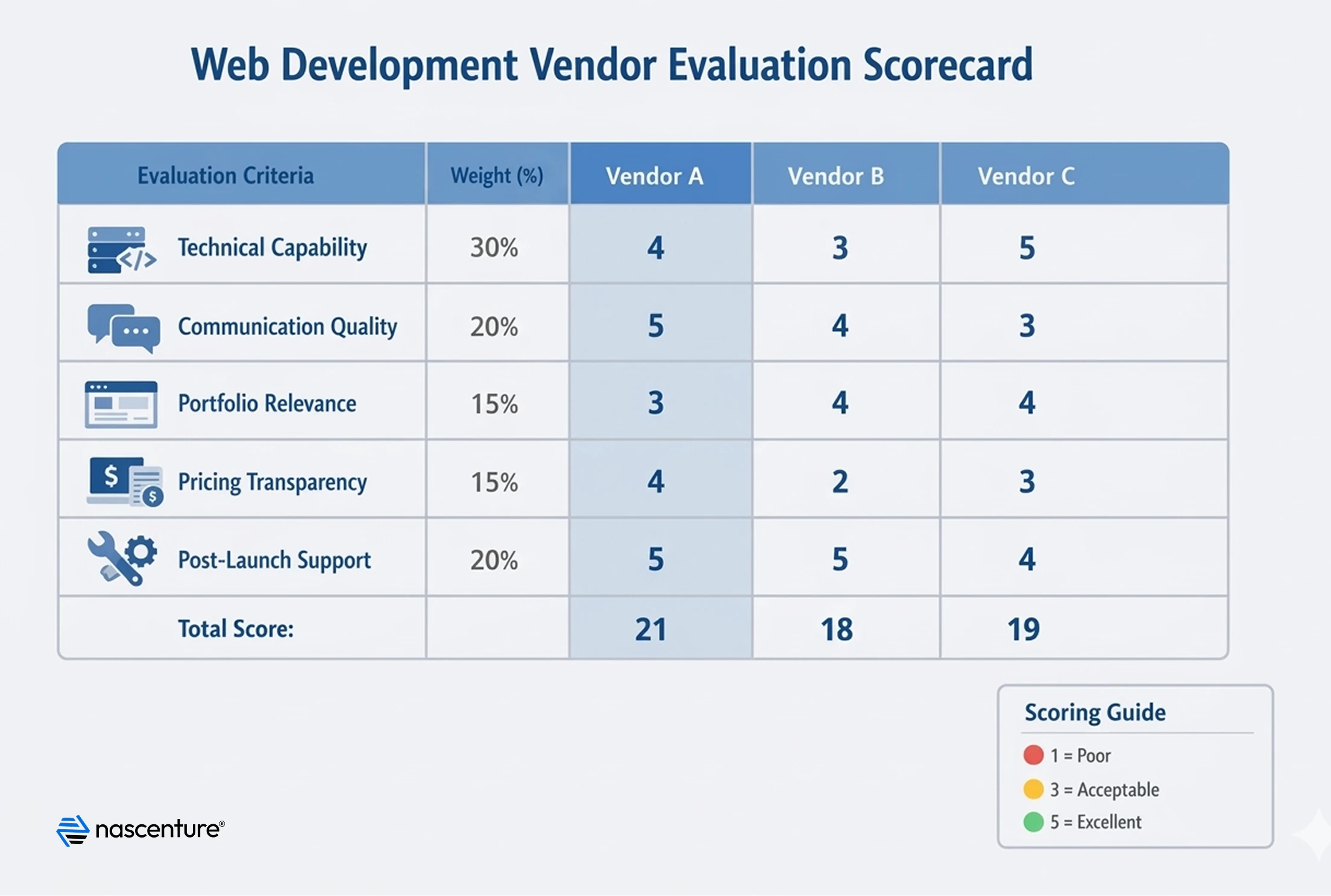
Understanding how to choose a web development company in Houston requires a structured approach. The right decision depends on technical expertise, communication quality, and alignment with your long-term business goals.
A proper vendor evaluation for Houston website development follows a defined process. Skipping steps is where most businesses introduce risks that later become expensive.
The quality of vendor proposals you receive depends on how clearly you define your requirements. Before contacting any web development company in Houston, document the following in detail.
Vendors who receive a clear and detailed brief provide accurate and comparable proposals. When requirements are vague, estimates often look attractive at first but increase significantly as the project progresses.
This step is critical when learning how to choose a web development company in Houston that can deliver both design quality and technical performance.
A strong portfolio matters, but it should not be your only criteria when evaluating Houston web design agencies. Visual design alone does not tell you whether the code is fast, easy to maintain, or capable of ranking in search engines.
For a more reliable technical assessment, request the following from any shortlisted web development services Houston vendor.
A vendor who cannot answer these questions with clarity is often stronger in visual design and weaker in technical depth. That gap can directly impact your website’s long-term performance and growth.
Communication failures cause more web project overruns than technical issues. The discipline a vendor shows during the sales process is often a direct indicator of how they will manage your project.
Evaluate their process carefully. Look at how quickly they respond to your inquiry, whether their proposal addresses your requirements or feels generic, and whether they ask meaningful questions before providing a quote.
You should also confirm who will actually work on your project. A reliable web development company in Houston should clearly identify the project manager, developers, and key points of contact.
For Houston businesses working with local vendors, request an in-person meeting or a structured video call with the project lead and at least one developer. The quality of this interaction often reflects their actual project management approach and communication standards.
Client references are usually a vendor’s strongest relationships. They are still valuable, because the right questions can reveal insights that portfolio reviews cannot.
Focus on specific scenarios instead of general feedback. Ask how the vendor handled scope changes during the project, how smooth the go-live process was, and whether the website achieved its intended business goals.
You should also ask whether the client would choose the same vendor again for a larger or more complex project. This is one of the most reliable indicators of long-term satisfaction.
These responses provide deeper insight than surface-level ratings or testimonials and help you evaluate whether the vendor can deliver consistent website performance and conversion outcomes aligned with your business goals.
One of the most common points of confusion for Houston businesses evaluating web development options is the wide variation in pricing. Understanding what drives these differences is essential for interpreting proposals accurately.
Houston web design cost depends on project type, vendor expertise, scope complexity, and the level of strategy and custom development involved. The ranges below reflect the 2026 Houston market for professional, business-grade websites, not template-based DIY solutions or offshore-only production.
| Project Type | Estimated Cost Range | Typical Timeline | Key Scope Drivers |
|---|---|---|---|
| Brochure Website (5 to 10 pages) | $3,500 to $10,000 | 4 to 8 weeks |
|
| Business Website with Lead Generation (10 to 30 pages) | $8,000 to $30,000 | 6 to 14 weeks |
|
| E-Commerce Website | $15,000 to $80,000+ | 8 to 20 weeks |
|
| Custom Web Application or Portal | $40,000 to $200,000+ | 3 to 9 months |
|
| Enterprise Website Redesign | $25,000 to $120,000 | 3 to 6 months |
|
These ranges assume you are working with a professional Houston-based or Houston-experienced vendor that follows a defined process and focuses on performance and scalability. Proposals that fall significantly below these ranges should be evaluated carefully to understand what is excluded from the scope.
Statistic
Industry data shows that the average website conversion rate is around 2% to 3%, while optimized websites with strong user experience and performance can achieve significantly higher results, often improving conversions by multiple factors.
Understanding the Houston web development process helps you evaluate vendor proposals more effectively and set realistic expectations for timelines, costs, and internal involvement.
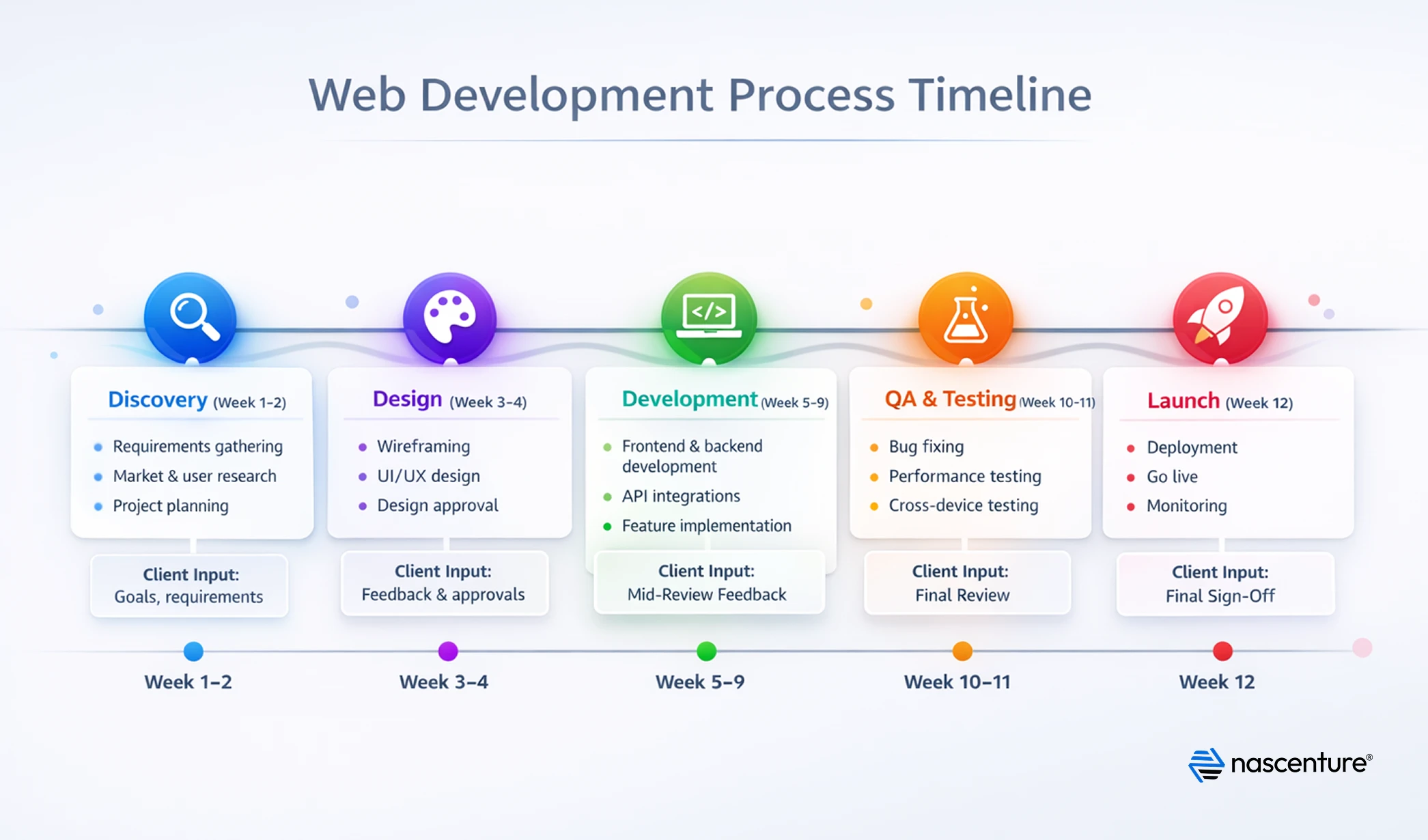
A professionally managed web development project follows a defined sequence of phases. Each phase has clear deliverables, requires input from your team, and directly impacts the next stage. Vendors who skip or compress phases typically reduce cost at the expense of quality and increase project risk.
The discovery phase defines business objectives, target audience, and technical requirements. For most business websites, this phase takes one to two weeks and results in a project brief, sitemap, content inventory, and technical specification.
Discovery is not optional. It forms the foundation for accurate timelines, realistic budgets, and aligned expectations. Projects that skip this phase often face scope issues and cost overruns during development.
Professional web design begins with wireframes and user flow planning before any visual design work. This ensures stakeholders agree on structure and usability before focusing on aesthetics.
The design phase produces desktop and mobile mockups for key pages. These are reviewed and approved before development starts. Skipping this step often leads to revision cycles later in the project.
The web development phase converts approved designs into functional pages, integrates the CMS, and connects third-party systems.
This is usually the longest phase and is highly sensitive to scope changes. Content integration, including text, images, and media, is often underestimated. Delays in content delivery from your team can directly impact project timelines.
A professional QA phase includes functional testing across browsers and devices, performance validation against Core Web Vitals, SEO technical checks, form testing, and accessibility review.
Reducing QA to speed up launch often leads to issues that are more expensive to fix after the site goes live.
A structured launch includes DNS configuration, SSL setup, redirect mapping, and analytics tracking. It should also include a defined post-launch support period, where the vendor monitors performance and resolves issues during the first few weeks.
Before signing any contract, clarify support terms. The difference between warranty fixes and billable changes should be clearly defined.
If you are evaluating vendors for a web development project in Houston and want to benchmark a proposal against a structured delivery process, our team provides independent project scoping reviews before any budget is committed to web development services.
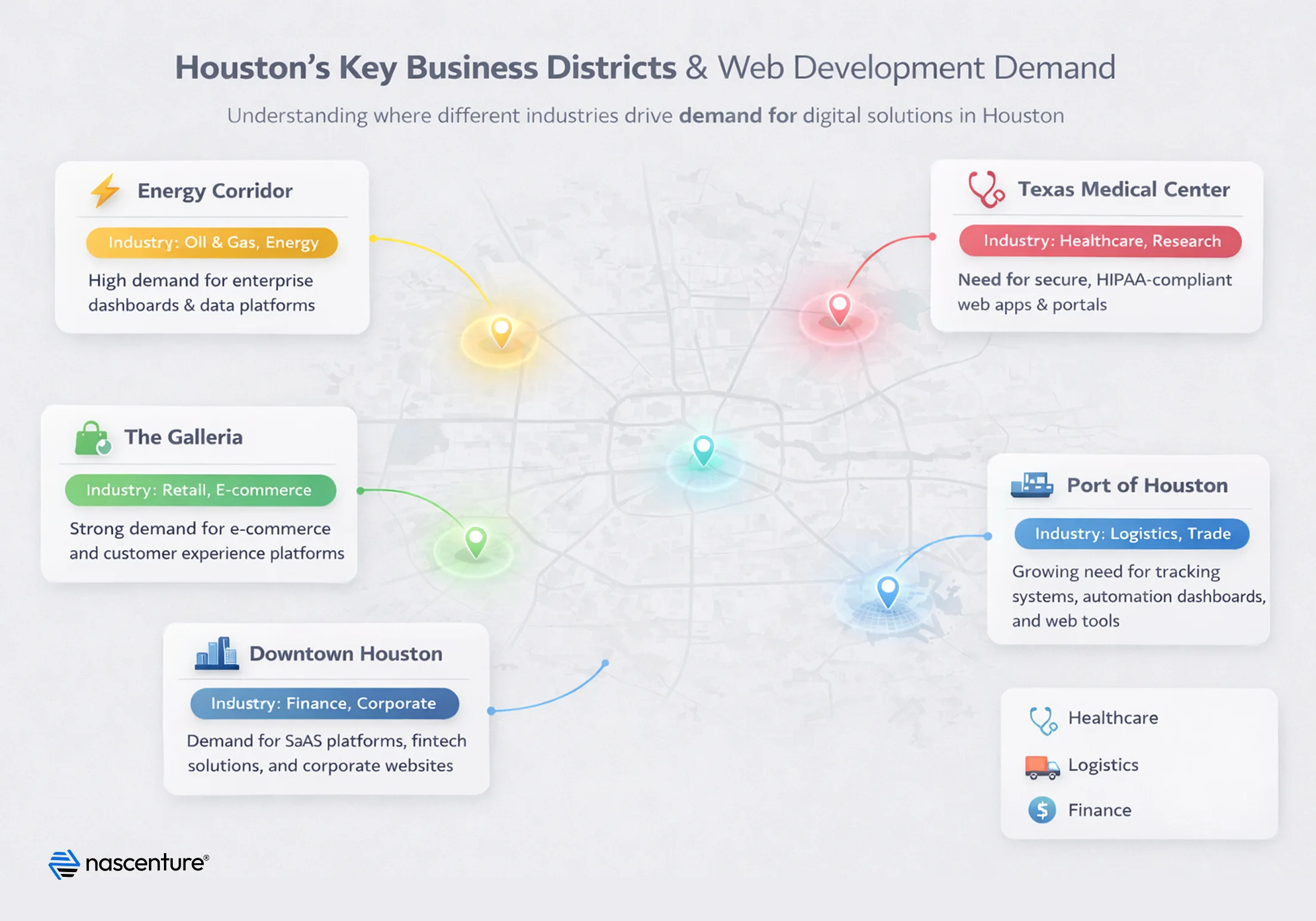
Houston’s economy is concentrated in a small number of high-value industries where web development requirements include specific technical and regulatory considerations. A web development company with relevant industry experience can deliver significantly better outcomes than a generalist vendor.
Energy sector companies in Houston, including oilfield services, engineering consultancies, and midstream operators, require websites that communicate technical credibility to procurement teams and project managers. The buyer journey is long, research-driven, and relationship-focused.
Websites in this sector need structured service architecture, detailed case studies, and project portfolios that demonstrate domain expertise rather than generic claims. Compliance elements such as HSE certifications, industry memberships, and regulatory credentials must also be clearly presented.
A vendor without energy sector experience will often underestimate the level of content depth and technical detail required.
Houston’s healthcare ecosystem, anchored by the Texas Medical Center, has strict and non-negotiable web development requirements. HIPAA compliance directly impacts how forms, booking systems, and patient portals are designed, while ADA accessibility is both a legal and user experience requirement.
Healthcare websites also depend heavily on local SEO targeting, as patients typically search within specific neighborhoods or zip codes. Vendors without healthcare experience risk creating compliance issues and limiting patient acquisition.
Houston law firms operate in one of the most competitive local search markets. Websites must be structured around search intent, geographic targeting, and regulatory guidelines.
Practice area pages, attorney profiles, case results, and review integrations all require careful planning. For law firms, even one converted client can justify the full website investment, while a poorly performing site results in lost opportunities.
Commercial real estate websites in Houston often require advanced functionality such as property search, MLS or listing integrations, document management systems, and agent profile directories.
These are technically demanding features. Vendors without relevant experience are likely to mis-scope the project, leading to delays, cost overruns, or limited functionality.
When deciding how to choose a web development company in Houston, identifying red flags early can save significant time, cost, and risk.
Certain vendor behaviors during the evaluation process are strong indicators of delivery issues. Recognizing them before signing a contract is far less expensive than dealing with problems during the project.
The Real Predictor of a Successful Project
Process documentation quality is a more reliable indicator than portfolio or price. A vendor who can clearly describe each phase, their requirements from you, and how scope changes are handled has the discipline that prevents costly project failures.
Houston businesses evaluating web development options typically encounter three types of providers. Each comes with a distinct risk and value profile, depending on project complexity and business goals.
| Provider Type | Best Suited For | Key Advantages | Key Risks |
|---|---|---|---|
| Local Houston Agency | Mid-to-large business websites, industry-specific projects, ongoing partnerships |
|
|
| National Agency with Houston Experience | Enterprise websites, multi-location businesses, complex integrations |
|
|
| Freelancer or Small Studio | Small business websites, budget-constrained projects, simple redesigns |
|
|
For Houston businesses with a budget above $15,000 and clear performance expectations, working with a local agency that has experience in software development in Houston generally delivers stronger long-term results than a freelancer model at a similar investment level.
Businesses that require more than a standard website, such as CRM integrations, workflow automation, or custom functionality, should evaluate vendors with custom software development capabilities to avoid platform limitations as the business scales.
Understanding web development timelines in Houston is a key part of choosing the right vendor. Unrealistic timelines often lead to delays, rushed work, and poor outcomes.
Timeline misalignment is one of the most common issues between Houston businesses and web development teams. Compressing timelines without reducing scope does not speed up delivery. It pushes unfinished work into post-launch fixes, which are more costly and disruptive.
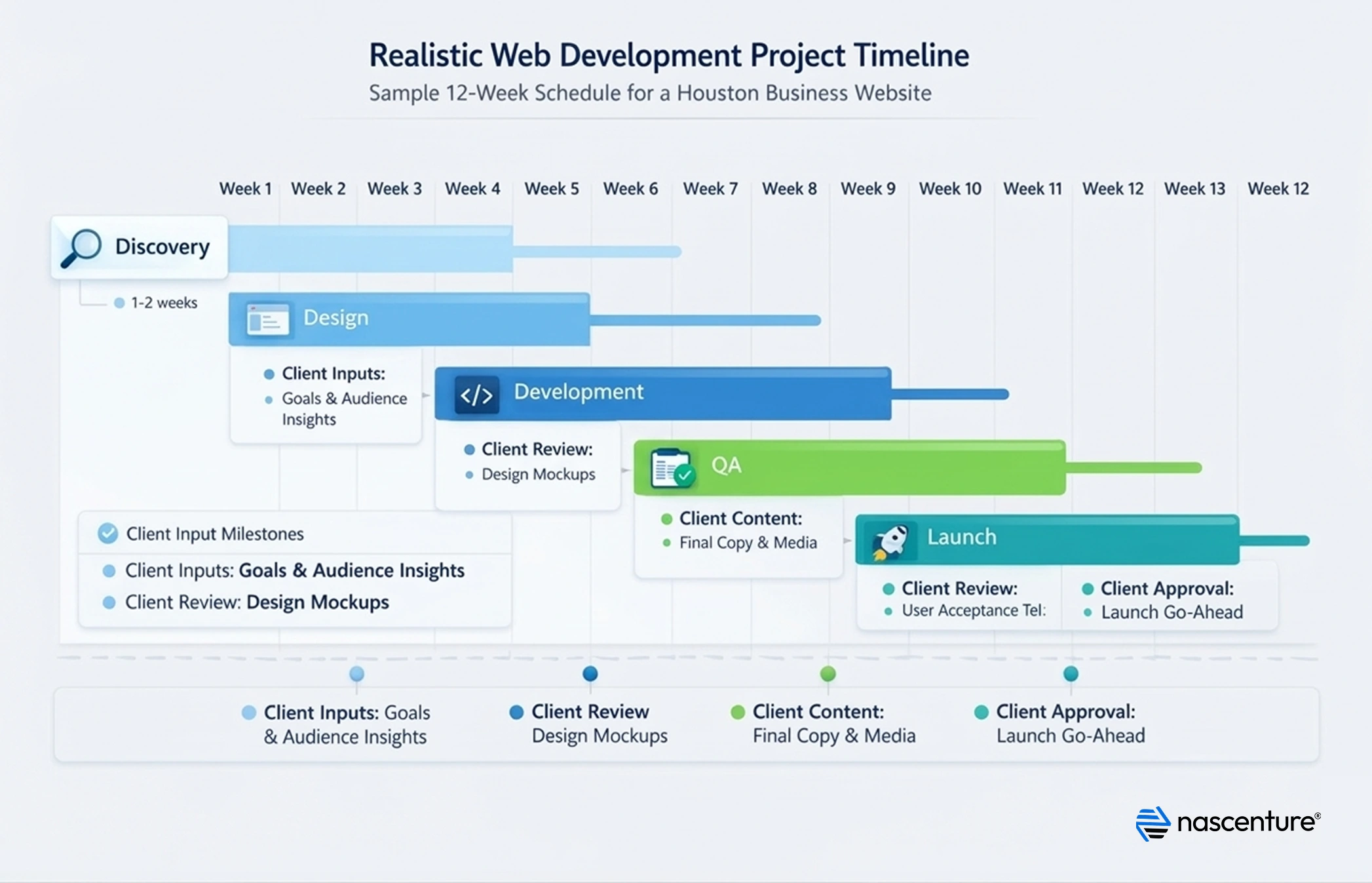
Realistic timelines depend on project complexity, content readiness, and the number of revision cycles. The estimates below reflect professionally managed projects with active client involvement.
The most common cause of delays is late content delivery from the client side. If your team is responsible for copy, images, or brand assets, treat these as critical project milestones.
Every week of delay in content delivery typically results in a direct extension of the overall project timeline.
The following recommendations apply to any Houston business starting a web development project, regardless of size, industry, or budget.
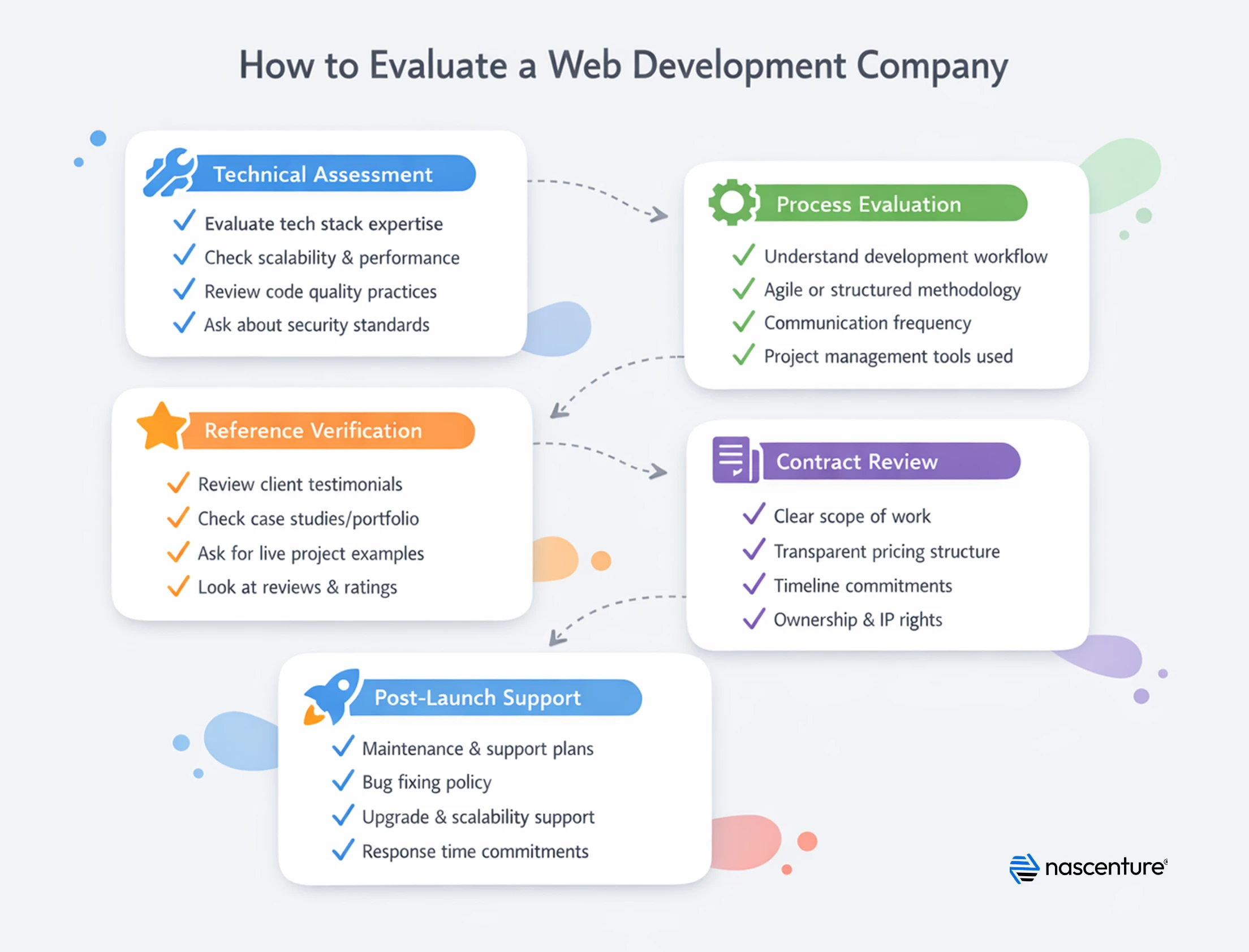
If you are still evaluating how to choose a web development company in Houston, focus on the factors that directly impact long-term performance, not just initial cost or visual design.
The best web development companies combine technical expertise, structured processes, and a clear understanding of business objectives. They do not just build websites. They deliver platforms designed to generate leads, support growth, and scale with your business.
Look for a partner who can demonstrate proven results, communicate clearly throughout the project, and explain how their approach improves search visibility, user experience, and conversion performance. These are the factors that separate high-performing vendors from average service providers.
Choosing a web development company in Houston is not just about comparing price or visual design. It requires a structured evaluation process, clear success criteria, and a partner who can support your business long-term.
Houston’s competitive market makes this decision critical. The difference between the right and wrong partner is reflected in real outcomes: leads generated or lost, rankings gained or missed, and the cost of rebuilding a platform that was not built correctly the first time.
Businesses that make strong web development decisions follow a consistent approach. They apply the same level of rigor to vendor selection as they would to any major business investment. The result is a website that becomes a long-term growth asset, not an ongoing operational issue.
If you are ready to start a web development project in Houston, our Houston web development services follow the structured framework outlined in this guide, with a focus on performance, scalability, and measurable results.
For a small business in Houston, a professionally built brochure website with 5 to 10 pages, custom design, basic SEO setup, and a contact form typically costs between $3,500 and $10,000. Websites with more pages, CRM integration, or custom functionality fall into higher ranges.
Be cautious of quotes significantly below $3,000. These often rely on templates with limited customization, which can impact both performance and scalability.
Timelines depend on scope and how quickly your team can provide content and approvals. Typical ranges include:
The most common cause of delays is late content delivery. Preparing copy, images, and brand assets in advance helps keep the project on schedule.
For most businesses, a local Houston agency or a national firm with proven Houston experience delivers better results than a fully remote vendor with no local context. Local teams understand the competitive landscape and can collaborate more effectively during key project phases.
For enterprise-scale or highly technical projects, a national agency may be a better fit, provided they can demonstrate relevant industry experience.
A well-structured contract should include:
Look beyond design. Evaluate technical capability by:
The most common mistake is selecting a vendor before defining clear success criteria. Without defined goals, decisions are often based on price or design, which are poor indicators of long-term performance.
Another frequent issue is not requesting a detailed scope document before signing. Every deliverable, integration, and phase should be documented to avoid disputes during development.

Deepak Saini
Deepak Saini is the CEO of Nascenture, a technology company focused on building scalable digital solutions. With a strong interest in AI, blockchain, and emerging technologies, he helps businesses leverage innovation to drive growth, efficiency, and competitive advantage. He regularly shares insights on software development, automation, and future-ready tech strategies.
How to Choose a Web Development Company in Houston &...
Choosing the wrong web development company in Houston can cost your...

Agentive AI: The Ultimate Guide to Human-Centered Ar...
Artificial Intelligence has changed the way we interact with technolog...

A Beginner’s Guide to AI in Real Estate
The real estate world is undergoing rapid change, and AI in real estat...