


Software Solutions for Logistics Companies: Logistic...
Logistics software development is becoming a strategic priority for...
 Deepak Saini
April 28, 2026
Deepak Saini
April 28, 2026
You built your website. You launched it. You waited for leads to come in.
But nothing happened. No calls. No enquiries. No new customers.
If your website is not generating leads, you are not alone. Many businesses invest time and money into a website that looks good but fails to turn visitors into enquiries.
Here is the truth: getting visitors is only half the job. What actually drives results is how effectively your website converts those visitors into leads.
A website that is not generating leads is not just underperforming. It is costing you real business opportunities. Instead of working as a 24/7 sales tool, it becomes a static online brochure.
The good news is that most of the reasons why a website is not converting are fixable. Issues like unclear messaging, weak calls to action, slow loading speed, and poor SEO can quietly stop users from taking action.
This guide breaks down the real reasons your website is not generating leads and what you can do to fix them so your website starts bringing in consistent enquiries and customers.
If someone lands on your website and does not immediately know what to do next, they usually do nothing.
Most business websites either hide the next step, overwhelm users with too many options, or use vague buttons like “Learn More” that do not guide the user anywhere.
Every page should have one clear primary action. It could be “Book a Free Consultation,” “Get a Free Quote,” or “Download Your Free Guide,” but it must be obvious and easy to act on. This is a core principle in UI/UX design, where the goal is to guide visitors toward a clear next step.
Your call to action should be visible without scrolling, placed in the right spots, and clearly communicate the value they will get.
The Fix: Review each page from a visitor’s perspective. Tools that analyze layout, usability, and design structure can help identify issues you might otherwise miss. If the headline and main button do not clearly show what to do next, the page is not doing its job. Replace vague CTAs with clear, benefit-driven actions and place them where users naturally decide, such as above the fold, after key sections, and at the end of the page.
A quick review can reveal where your website may be missing opportunities to convert visitors into leads.

Website speed plays a critical role in conversions. Studies show that even a one-second delay in page load time can reduce conversions by up to 7%.
If your site takes more than three seconds to load on mobile, a large percentage of visitors will leave before they even see your content.
Common causes include unoptimized images, heavy page builders, too many plugins, slow hosting, and no caching setup. These technical issues are often resolved during a website redesign or through modern custom web development practices. Google also considers page speed in its search rankings through Core Web Vitals, so a slow website can hurt both your traffic and conversions.
The Fix: Test your website using Google PageSpeed Insights or GTmetrix. Compress images using tools like Squoosh or ShortPixel. Remove unnecessary plugins, enable caching, and use a reliable hosting provider. Aim for a load time under 2.5 seconds on mobile devices.

Your website will not generate leads if the people visiting it are not potential customers.
Many websites rank for broad or informational keywords that attract users who are not ready to take action. These visitors may browse your site, but they are unlikely to contact you or become customers.
For example, if a local service business ranks for general queries like “how plumbing works,” those visitors are looking for information, not services. They were never likely to convert.
High-converting websites focus on keywords with clear commercial intent. A focused SEO strategy helps ensure your website attracts visitors who are actively looking for your services. These include searches where users are actively looking to hire or buy, such as location-based or service-specific queries.
The Fix: Use Google Search Console to identify which search queries are bringing traffic to your site. Adjust your SEO strategy to focus on transactional and local intent keywords. Create dedicated service pages for each offering and optimize them for location-based searches, which helps your business appear when people search for services in a specific city.
When someone lands on your website, they make a decision within seconds.
They are trying to answer three simple questions: What do you do? Is this for me? Why should I choose you?
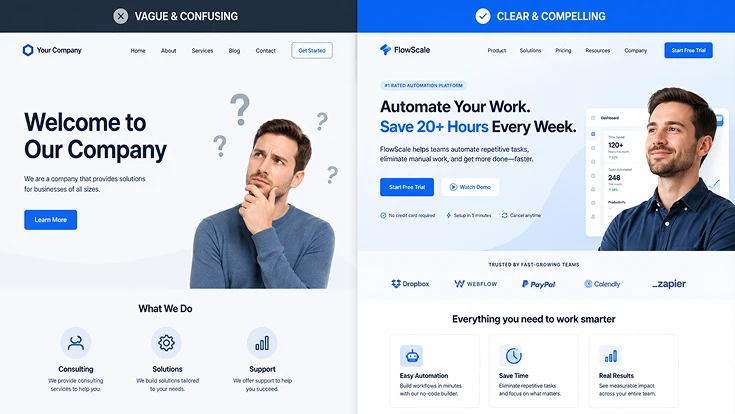
If your homepage headline says something generic like “Welcome to ABC Company” or “Your Trusted Partner in Excellence,” it does not answer any of these questions.
A strong value proposition is clear, specific, and focused on the customer. Many successful businesses apply proven strategies to make their websites stand out and communicate value immediately. It explains who you help, what problem you solve, and why you are the right choice without using vague or generic language.
The Fix: Rewrite your hero headline using this formula: [What you do] + [Who you do it for] + [The result they get]. For example: “We help Toronto restaurants fill more tables with targeted local marketing.” Then test your headline by showing it to someone unfamiliar with your business for five seconds. Ask them to explain what you do. If they cannot answer clearly, your message needs improvement.
Quick Test: Hide your logo and show your homepage to a few people who do not know your business. Ask them to describe what you do in one sentence. If they cannot, your value proposition is not clear enough.
This is a common but critical issue. Many websites lose leads because their contact forms are hard to find, too complicated, or not working properly.
Some forms are buried deep within the site. Others ask for too much information, which creates friction and discourages users from completing them. In some cases, submissions are not delivered at all.
Your contact form is the final step between a visitor and a lead. If it fails, you lose potential customers.
The Fix: Test your form regularly to make sure every submission reaches you. Keep it simple by asking only for essential details such as name, email, and a short message. Place your form where users can easily find it, especially on the homepage and service pages. Also display your phone number and email clearly so visitors have multiple ways to contact you.
People do not buy from websites. They buy from businesses they trust.
Today, anyone can create a professional-looking website. Because of that, visitors look for proof that your business is real, reliable, and capable. If they do not find that proof, they leave and choose a competitor who provides it.
Trust signals include customer reviews, ratings, case studies, before and after results, client logos, certifications, years in business, team photos, and a physical address.
These are not optional elements. They are essential for building credibility and increasing conversions.
The Fix: Add at least five genuine testimonials that include names, photos, and specific results. Display your review ratings clearly. Show client logos if available. Include a short about section with a real team photo, as people trust faces more than text.
Most website traffic now comes from mobile devices. If your site does not provide a smooth experience on a phone, you are losing a large portion of potential leads.
A mobile-friendly website is not just one that loads on a small screen. It must be easy to use, which is why modern websites rely on responsive design to ensure the layout adapts smoothly across devices. Small buttons, hard to read text, horizontal scrolling, and intrusive popups make it difficult for users to take action.
Search engines also prioritize mobile performance. A poor mobile experience affects both your rankings and your ability to convert visitors into leads.
The Fix: Test your website on a real mobile device. Tap through every page, click every button, and complete your forms. Then ask someone else to do the same without guidance. Identify any friction and remove it to create a smooth and simple user experience.
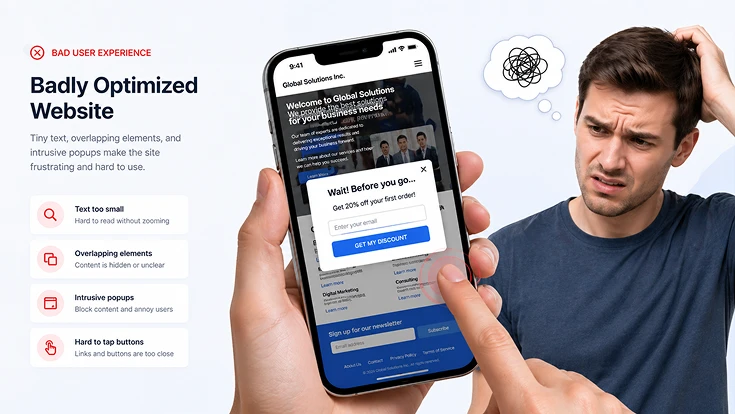
Friction is anything that slows down or discourages a visitor from taking action.
It can be a form that requires too many steps, a phone number that is not clickable, a page where the call to action is hard to find, or a process that feels unnecessarily complicated.
Every extra step between interest and action reduces your chances of getting a lead. The goal of your website should be to make the path to conversion as simple and direct as possible.
The Fix: Review the full journey from landing on your website to submitting a form and remove any unnecessary steps that create friction. Make phone numbers clickable, keep forms simple, and ensure users can take action easily. You can also add a direct scheduling option using tools like Calendly so visitors can book instantly without back-and-forth communication.
“Your website does not need to impress everyone. It needs to convert the right people, and that starts by removing every barrier between interest and action.”
Not every visitor is ready to hire you immediately. Many are still researching, comparing options, or early in the decision-making process.
If the only action on your website is “Contact Us,” you lose those visitors who are not ready to commit yet, which is often the majority.
To capture these users, you need to offer something valuable in return for their contact details. Many businesses implement this through digital marketing strategies combined with dedicated landing pages. This is known as a lead magnet. It could be a checklist, a short guide, a free consultation, a quote tool, or an email course.
The Fix: Create one lead magnet based on your audience’s biggest question or pain point. For example, a web design agency could offer “The 10-Point Website Audit Checklist,” while a financial planner could offer “2025 Retirement Planning Guide for Couples.” Feature it clearly on your homepage and across key pages so visitors have an easy way to engage, even if they are not ready to contact you yet.
Download the exact checklist used to find conversion issues.

Many websites try to explain all their services on a single page. This makes it harder for visitors to find what they are looking for and reduces your chances of converting them into leads.
Each service solves a different problem and often targets a different type of customer. When everything is combined into one page, your message becomes unclear and less relevant.
It also affects your SEO. Search engines prefer focused pages that clearly match specific search queries.
The Fix: Create a dedicated landing page for each core service you offer. Clearly explain the service, who it is for, and the results you deliver. Optimize each page around a specific keyword and include a strong call to action so visitors can easily take the next step.

Before you start fixing everything, you need to understand where the real problem is.
Most websites do not fail because of one issue. They fail due to a combination of smaller problems such as weak messaging, poor design, slow speed, or an unclear user journey.
The fastest way to identify the issue is to look at your data and user behavior instead of relying on assumptions.
Ask yourself:
Once you identify the weakest point in your website journey, you can focus your efforts where they will have the biggest impact.
You do not need to fix everything at once. Focus on the changes that will have the biggest and fastest impact on your leads.
This approach helps you fix the most important issues first, so you can start seeing results without overhauling your entire website.
Traffic without leads is not a luck problem. It is a strategy problem.
The good news is that every issue on this list can be fixed. Most improvements do not require a complete redesign. In many cases, a clearer headline, a faster website, or a stronger call to action can significantly improve your results.
Start by reviewing your website honestly. Identify the two or three issues that are most likely affecting your conversions and fix those first. Measure the results, then continue improving step by step.
If you apply these changes and still do not see results, the problem may be deeper. It could involve your website structure, SEO strategy, or overall positioning. In that case, a detailed audit can help you identify what is holding your website back.
Your website can become a consistent source of leads with the right strategy, structure, and optimization.
If your website is getting traffic but not generating leads, the problem is usually not one single issue. It is a combination of gaps in your messaging, design, and overall strategy.
We help businesses turn underperforming websites into lead generation systems that bring consistent enquiries, calls, and customers.
From improving your website structure and speed to refining your messaging and user experience, we focus on the changes that have the biggest impact on conversions.
Get in touch to discuss your website and identify what is stopping it from converting visitors into leads.

Deepak Saini
Deepak Saini is the CEO of Nascenture, a technology company focused on building scalable digital solutions. With a strong interest in AI, blockchain, and emerging technologies, he helps businesses leverage innovation to drive growth, efficiency, and competitive advantage. He regularly shares insights on software development, automation, and future-ready tech strategies.
Software Solutions for Logistics Companies: Logistic...
Logistics software development is becoming a strategic priority for...

Top Software Development Trends in the UK for 2026
Software development trends UK businesses are prioritizing in 2026 ...
How to Choose the Best SEO Company in Mississauga in...
Finding the right SEO company in Mississauga is not as simple as picki...